
The ‘back door’ migrant route into Britain: Immigration crackdown as people smuggling gangs exploit soft border between UK and Ireland
The ‘back door’ migrant route into Britain: Immigration crackdown as people smuggling gangs exploit soft border between UK and Ireland
While the spotlight on illegal immigration often centers around small boat crossings from France, a new method has emerged as a focal point for authorities. Criminal networks are now exploiting the Common Travel Area (CTA) between the UK and Ireland as a covert pathway for migrants, bypassing traditional border checks.
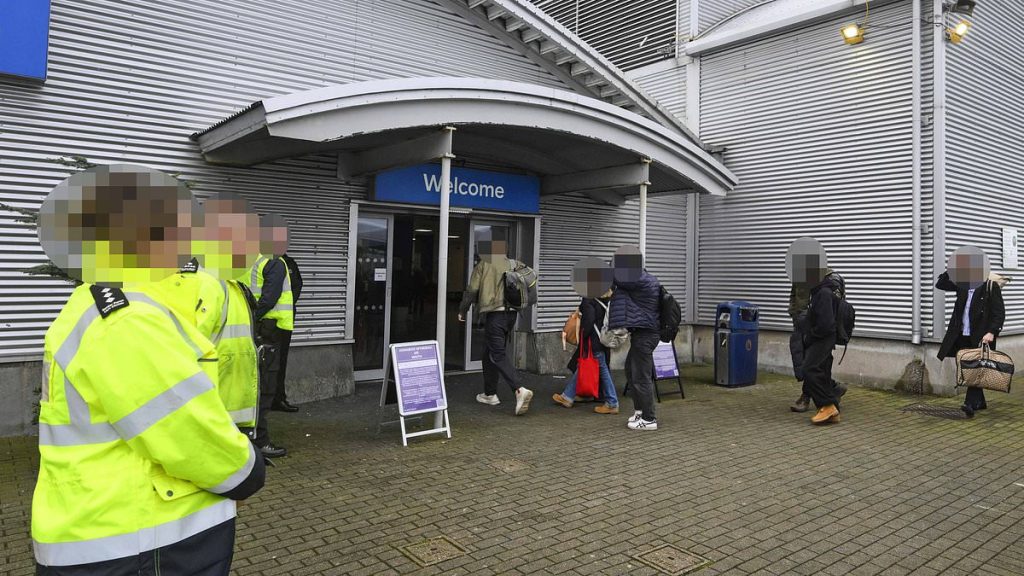
To target this method, authorities launched a coordinated operation, resulting in the detention of 32 immigration offenders across UK-Ireland seaports and airports. The Daily Mail observed the operation in action at Holyhead, where ferry passengers underwent real-time facial recognition checks as they navigated the terminal.
Lorries were inspected for hidden migrants and illicit cargo as they entered the port, with additional checks conducted adjacent to a motorway outside the town. DCC Wendy Gunney heads the Domestic Organised Immigration Crime taskforce, which collaborated with Immigration Enforcement, Border Force, the National Police Chiefs’ Council (NPCC), and local police during the three-day operation.
UK Border Force personnel monitored arrivals at Holyhead’s passenger terminal earlier this week, using live facial recognition to compare individuals against a database of known immigration offenders. The technology works by capturing images of passers-by with cameras and recording facial metrics, such as eye spacing, which are then cross-referenced with an existing watchlist. An officer reviews the flagged identities to verify any potential matches.
‘The Common Travel Area is exploited by criminal gangs as a back-entry route into the UK, so our operation is about making our borders as robust as they can be,’ she told the Mail.
Alongside smuggling people, these gangs also transport drugs and black market goods, according to DCC Gunney. Though there’s no formal passport control between Britain and Ireland, passengers are required to present photo ID, and officials conduct regular spot checks.
‘The threat from the Common Travel Area is increasing, particularly regarding organised crime,’ said DCC Gunney.
Civil liberties advocates argue that the implementation of live facial recognition signifies a major expansion of the surveillance state. DCC Gunney maintained that the technology is reliable, assuring the public that those not on the watchlist have nothing to worry about.
Beyond Holyhead, officers were deployed at Loch Ryan in Scotland, Heysham in Lancashire, and Birkenhead on Merseyside. Among the 32 detainees was a Lesotho national with an invalid UK entry and a pending domestic violence charge in Ireland. He was promptly repatriated to Ireland.
Four Pakistani men arriving at Birmingham airport from Belfast were discovered to lack valid UK visas and had unresolved asylum applications. Due to breaching reporting conditions by traveling to Northern Ireland, all four had their asylum applications revoked.
Ben Thomas, Regional lead for Immigration Enforcement, noted that the operation delivered ‘swift justice’ to those exploiting the CTA. During a traffic stop on the A55 in North Wales, an Indian man was identified as a visa overstayer with a failed asylum application. He was also suspected of working illegally for a delivery firm.
The Home Office indicated efforts were underway to deport him and potentially fine the company. In 2024, 14 Albanians were discovered concealed within a livestock wagon that had entered the British mainland from Northern Ireland.
