
Kindergarten Exemption Rates Hit Historic High as Federal Push Reshapes Vaccine Policy
Goldlaner.com – The number of American kindergartners entering school without full vaccination coverage reached an all-time peak during the 2025–26 academic year, according to data released Monday by the Centers for Disease Control and Prevention. Roughly 157,000 newly enrolled schoolchildren carried an exemption for at least one state-mandated vaccine — nearly 20,000 more than the previous year. The 4.2% exemption rate marks the highest figure ever recorded and represents a doubling of the share seen just ten years ago.
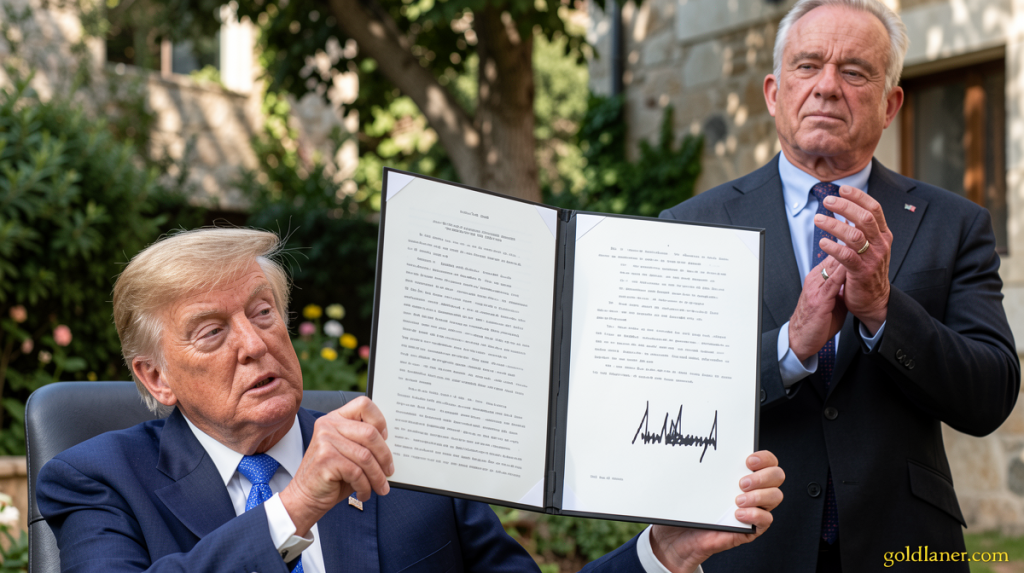
The timing of the CDC release is not coincidental. Last week, President Donald Trump signed an executive order designed to fundamentally alter how the federal government engages with childhood immunization policy. The directive instructs the Department of Justice, the Department of Education, and the Department of Health and Human Services to link compliance with new federal vaccine guidelines to the flow of federal funding to states. While the order frames its purpose as expanding parental autonomy, the practical effect would be to pressure state legislatures and health departments to restructure long-standing immunization mandates.
The Order’s Language and Its Limits
The executive order centers on what it calls the goal to “maximize parental choices over vaccinations for their children.” It specifically directs states to “provide religious and medical exemptions” to school vaccine requirements and urges officials to “give parents more information and options.” Yet the constitutional architecture of American public health law remains intact: every state retains primary authority over its own immunization mandates, and the Supreme Court has broadly upheld that state power in prior challenges.
How the administration intends to enforce its preferences through funding conditions remains unspecified. No regulatory rulemaking or formal guidance has yet been issued to clarify what “compliance” would look like in practice, leaving state health departments to interpret the order on their own terms.
A Patchwork of State Rules, Now Under Pressure
All fifty states require certain vaccines before a child can attend school, and every state permits a medical exemption. The vast majority also recognize non-medical grounds — typically labeled religious or personal-belief exemptions — though utilization of those provisions has climbed steadily. Exemptions rose in every state except nine, and nearly half of all states now report exemption rates above 5%, per the CDC figures.
Only four states — California, Connecticut, Maine, and New York — currently bar non-medical exemptions altogether. New York eliminated its religious-exemption pathway in 2019, a decision made in the wake of measles outbreaks that ranked among the largest the country had experienced in decades. The absence of a religious carve-out in those four states has made them outliers in a national landscape where personal-belief exemptions are increasingly common.
Of the exemptions recorded last year, just 0.2% were grounded in medical reasons — a proportion that has remained essentially flat for years. The overwhelming majority of exemptions therefore reflect religious or philosophical objections rather than clinical contraindications.
Herd Immunity Thresholds and the MMR Gap
The CDC data show that the measles-mumps-rubella vaccination rate among kindergartners slipped marginally, from 92.5% to 92.4%, over the past school year. That figure sits well below the approximately 95% coverage level epidemiologists consider necessary to sustain herd immunity and prevent community outbreaks. Even a small erosion in coverage, sustained over successive cohorts, can leave pockets of susceptible children large enough to fuel transmission chains — a dynamic already visible in several states where localized measles cases have resurfaced.
State Responses: Defiance, Compliance, and Litigation
State health officials have reacted to the executive order with a mix of quiet dismissal and explicit reaffirmation of existing policy. Texas’s health department told CNN in an email:
“Federal recommendations do not change the requirements in Texas.”
Maine’s CDC director, Dr. Puthiery Va, issued a statement emphasizing continuity:
“Vaccines are our most effective defense against vaccine-preventable illnesses. In Maine, vaccines remain available at no cost to eligible children through the Maine CDC’s Immunization Program. Maine’s school and child care immunization requirements remain unchanged by federal actions to date.”
Many other states — including those that historically follow federal immunization guidance and those that have deliberately departed from it — have indicated the order does not compel any immediate legislative or regulatory change at the state level.
Courts as the Next Battleground
Amending state exemption statutes ordinarily requires action by state legislatures, most of which will not reconvene until January. That legislative calendar, however, does not preclude judicial intervention. Mississippi began permitting religious exemptions in 2023 following a federal court order, and a parallel effort to introduce religious exemptions in West Virginia is currently entangled in litigation. Before those judicial interventions, both states had been recognized for exceptionally high childhood vaccination coverage.
The interplay between the new executive order, existing state statutes, and pending court cases sets up a multi-front contest over who ultimately controls the terms of childhood immunization in American schools. For now, the CDC’s numbers tell the clearest story: exemption utilization is at its highest point in recorded history, and the administrative machinery the Trump administration has activated is aimed squarely at widening that trend further.
Related Reading
Frequently Asked Questions
What is Record share of kindergartners missed required?
Record share of kindergartners missed required is the main topic of this guide. The article explains the context, practical details, and next steps readers should understand.
Why does Record share of kindergartners missed required matter?
Record share of kindergartners missed required matters because readers are looking for a useful answer, not just a short summary. Good content should match search intent and help them decide what to do next.