
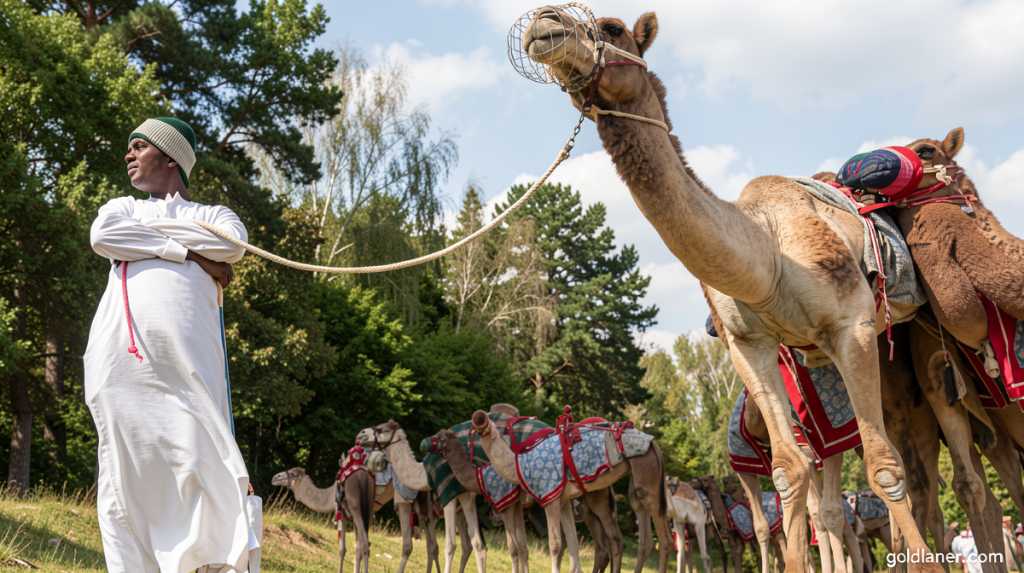
Camel commerce goes digital in the Gulf’s oldest trade
Goldlaner.com – For millennia, the dromedary has been woven into the fabric of daily life across the Arabian Peninsula. These animals carried caravans across dunes, supplied milk and meat to nomadic communities, and provided leather and wool for household use. Today, their role has shifted from utility to spectacle and prestige, yet the economic gravity they exert remains enormous. The emirate of Abu Dhabi alone is home to roughly half a million camels, and the broader Gulf region treats them as living assets whose value can rival luxury automobiles.
It is against this backdrop that a quiet disruption has taken root in Al Ain, a city in the UAE long associated with its bustling open-air camel souq, where traders from across the region have haggled over livestock for generations. In late 2024, a startup called Hign Al Khaleej — a name that translates roughly as “Gulf camels” — opened a digital platform for purchasing, selling, and auctioning camels online. By 2025, the company had attracted more than 15,000 registered users across its mobile application and web interface, according to founder and chief executive Jaber Al Ahbabi.
What the platform actually does
The marketplace currently lists around 3,300 camels spread across five countries: the UAE, Saudi Arabia, Qatar, Oman, and Kuwait. Each listing carries details on the animal’s age, breeding lineage, and veterinary record. Before completing a transaction, users must register a phone number and a government-issued identification number, giving the platform a basic layer of identity verification on both sides of the deal.
Al Ahbabi describes the design philosophy plainly: the goal is to consolidate every tool a camel buyer or seller might require into a single interface, minimizing risk and friction. Beyond livestock transactions, the app also handles the sale of camel feed and pharmaceuticals, and it hosts job postings for roles such as trainers and shepherds.
A market measured in millions
The financial stakes attached to elite camels are difficult to overstate. At a 2025 auction in Abu Dhabi, fifteen animals changed hands for a combined AED 1.77 million (approximately $500,000). One particular camel, after a heated bidding contest, fetched AED 500,000 (roughly $136,000), local media reported. Top-tier specimens have traded for several million dirhams in private deals.
Prize money amplifies the incentive. This year’s Al Dhafra Camel Festival in Abu Dhabi, scheduled to run from late October through mid-January, is offering AED 97 million (about $26.4 million) in beauty-competition winnings. Camel racing, a sport with deep roots across the Gulf, similarly generates substantial purses. These events create a continuous demand cycle: breeders invest in superior genetics, owners train for competition, and winners attract buyers willing to pay premium prices.
Why the old system could not scale
Al Ahbabi grew up in a family that owned and raced camels, giving him an insider’s view of how transactions traditionally unfolded. He describes the legacy process as neither cost-effective nor time-efficient. A seller wishing to offload an animal might load it into a pickup truck and drive considerable distances to meet prospective buyers, with no assurance of a sale. Buyers, meanwhile, could find themselves flying to Saudi Arabia to inspect stock with little advance information, only to discover the animals were being held in remote desert locations far from urban centers.
“It’s a traditional activity deeply rooted in our history and culture, so the system to buy and sell camels is quite old school.”
For many participants, the accumulated expense and logistical complexity of face-to-face trading had become prohibitive. Al Ahbabi, a former government employee who now devotes his full working hours to the startup, saw the inefficiency as an opening.
Organic growth and institutional backing
Despite the deeply traditional character of the industry it serves, Hign Al Khaleej has scaled rapidly. Approximately 3,000 camels have already been transacted through the platform since its launch. That traction caught the attention of regional tech-ecosystem players. In May, the company was named among seventeen Al Ain firms selected by Hub71 and the Khalifa Fund for Enterprise Development to enter a three-month startup development programme. At the programme’s July demo day, the startup placed third, earning AED 40,000 (around $10,000) in in-kind support.
Al Ahbabi initially resisted outside capital, citing his lack of experience in the technology sector and a preference to avoid debt. The pace of organic user growth, however, has shifted his calculus. He now views partnership with investors as a natural next step to accelerate expansion.
The ambition ahead
The founder’s stated objective is to make Hign Al Khaleej the default destination for anyone whose interests intersect with camels — whether they seek to acquire an animal, sell one, purchase feed and medicine, or find employment in the sector.
“I want anyone who has an interest in camels, and for anyone who wants a camel or anything for camels to go straight to Hign Al Khaleej.”
If that vision materialises, the camel souq of Al Ain will not disappear, but its commercial centre of gravity may migrate from the dusty auction yard to a smartphone screen — a transformation that would echo the broader digitisation of Gulf economies while preserving a cultural practice that has endured for centuries.
Related Reading
Frequently Asked Questions
What is Want to buy a camel Now there?
Want to buy a camel Now there is the main topic of this guide. The article explains the context, practical details, and next steps readers should understand.
Why does Want to buy a camel Now there matter?
Want to buy a camel Now there matters because readers are looking for a useful answer, not just a short summary. Good content should match search intent and help them decide what to do next.