
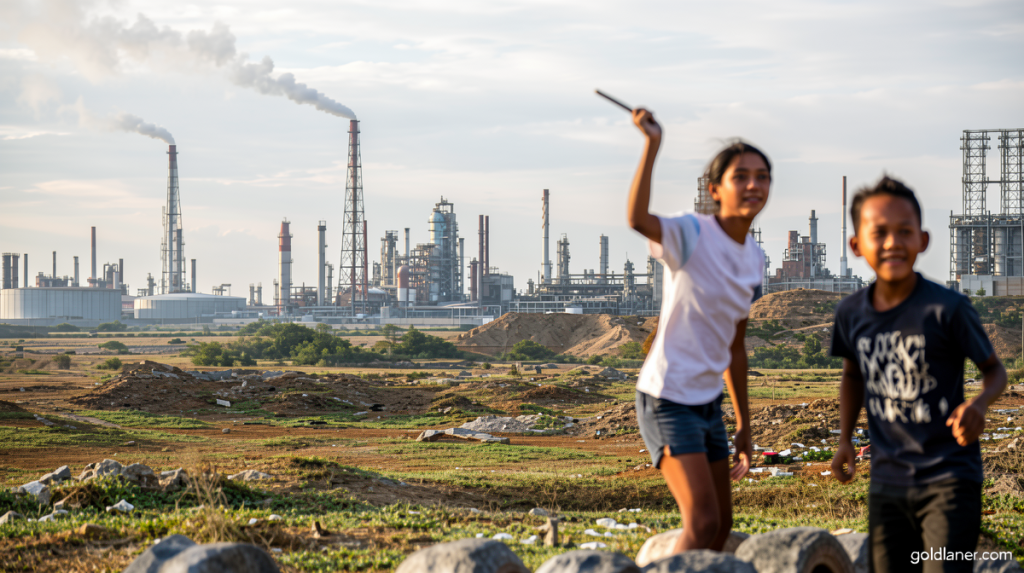
A 100-Year Lease Reshapes the Transatlantic Oil Equation
Goldlaner.com – On Friday, the White House confirmed a sweeping arrangement under which Washington will hold a 55 percent stake in a newly formed joint venture partnered with a private Venezuelan energy operator. The agreement, structured as a century-long oil field lease, would place American capital directly inside the country’s vast hydrocarbon infrastructure — a move that had eluded successive administrations for decades. For a nation whose energy calculus has grown increasingly dependent on Venezuelan crude, the deal represents a structural shift rather than a marginal adjustment.
The announcement lands against a backdrop of extraordinary import growth. American crude purchases from Venezuela have more than quadrupled over the past year, climbing to approximately 600,000 barrels per day — the highest volume drawn from that country since the first Trump administration imposed sanctions in 2019. The Energy Information Administration now ranks Venezuela as the second-largest source of imported oil for the United States, trailing only Canada.
Reserve Arithmetic and Global Standing
The numbers behind the venture are staggering. Venezuela holds 303 billion barrels of proven oil reserves. The newly constituted entity will command 65 billion of those barrels. By comparison, the United States currently controls roughly 46 billion barrels of reserves, per EIA data. In other words, the joint venture would more than double the scale of American-controlled reserves overnight, producing what would rank as the world’s second-largest oil company by total reserves — second only to Saudi Aramco.
That distinction carries weight in a market where reserve size still anchors long-term pricing power, geopolitical leverage, and downstream investment decisions. A century-long lease also signals an intention to operate beyond election cycles, beyond short-term commodity swings, and beyond the political turbulence that has historically deterred Western capital from Caracas.
Why the Barrel Type Matters
United States domestic production skews toward light, sweet crude — ideal for gasoline blending but ill-suited to heavier fuel streams. Venezuelan crude, by contrast, is a heavy, sour material that distills readily into asphalt, industrial lubricants, diesel, and jet fuel. A substantial share of American refinery capacity was purpose-built in the 1970s, when Venezuela ranked among the top suppliers of heavy crude to the Gulf Coast and East Coast. Those facilities operate at peak efficiency when fed Venezuelan barrels.
That compatibility becomes critical in the current environment. The Iran war disrupted roughly one-fifth of global oil supply, and the United States has stepped in as a supplier of last resort for nations unable to secure reliable jet fuel or diesel from the Persian Gulf. Restoring heavier-crude flows from Venezuela would ease pressure on those refineries, reduce dependence on spot-market arbitrage, and improve the overall yield profile of domestic refining.
The Strategic Petroleum Reserve Problem
The deal also intersects with a pressing domestic vulnerability. The Strategic Petroleum Reserve sits at its lowest level since 1982, when the Reagan administration was in the process of filling it. The Trump administration has been drawing down SPR stocks to offset the shortfall in Persian Gulf exports. Should another supply shock materialize, the United States would face a constrained ability to respond. A sustained increase in Venezuelan imports would help replenish strategic buffers and reduce the frequency with which emergency releases become necessary.
Production Recovery: Progress and Limits
Since the US government captured Nicolás Maduro in January and placed him under arrest on conspiracy charges, Venezuela’s output has climbed. The country is now producing approximately 1.2 million barrels per day — roughly 150,000 barrels above the level recorded at the start of the year, according to Luisa Palacios, former chair of Citgo and current managing director of Columbia University’s Center on Global Energy Policy.
Yet that figure remains a fraction of what the infrastructure once delivered. Before the socialist nationalization of the late 1990s under Hugo Chávez, Venezuela was pumping close to 3.5 million barrels per day. Decades of deferred maintenance under the Chávez and Maduro regimes left pipelines, separators, and wellheads in a state of advanced decay. Palacios estimates that restoring former output levels will require billions of dollars in foreign investment spread across at least a decade.
The Investment Climate Question
For years, American energy majors have watched Venezuela from a distance. Chevron stands alone among US supermajors as a company that maintained a continuous operational presence through the sanctions era. Others balked at a combination of factors: institutional corruption, rampant crime, and a political environment whose stability remains uncertain even after Maduro’s removal and the installation of Delcy Rodríguez as his successor.
Public pressure on oil executives did not move the needle. Several earlier negotiations with Rodríguez — who had previously headed the country’s oil ministry — to restructure the sector also stalled. The government’s handling of the recent devastating earthquake, which killed thousands, reinforced perceptions of institutional fragility. In that context, the Friday announcement functions less as a commercial contract and more as a sovereign guarantee: the United States is not merely inviting private capital into Venezuela but co-owning the venture itself, absorbing a majority of the risk.
Strategic Implications
The arrangement, if executed as described, would bind American energy policy to Venezuelan output for a century. It would deepen the interdependence between Gulf Coast refining and Andean production at a moment when Middle East supply volatility has made that interdependence strategically valuable. It would also position the United States to project energy influence in South America through ownership rather than diplomacy alone.
Whether the deal ultimately delivers the promised investment flows, stabilizes Venezuelan output, and replenishes strategic reserves will depend on execution details yet to be fully disclosed. But the direction of travel is unambiguous: Washington has chosen to become a principal operator in Venezuela’s oil sector rather than a distant buyer, and the scale of the commitment — measured in reserves, in lease duration, and in equity share — leaves little room for retreat.
Related Reading
Frequently Asked Questions
What is Trump found an unusual solution to his?
Trump found an unusual solution to his is the main topic of this guide. The article explains the context, practical details, and next steps readers should understand.
Why does Trump found an unusual solution to his matter?
Trump found an unusual solution to his matters because readers are looking for a useful answer, not just a short summary. Good content should match search intent and help them decide what to do next.