
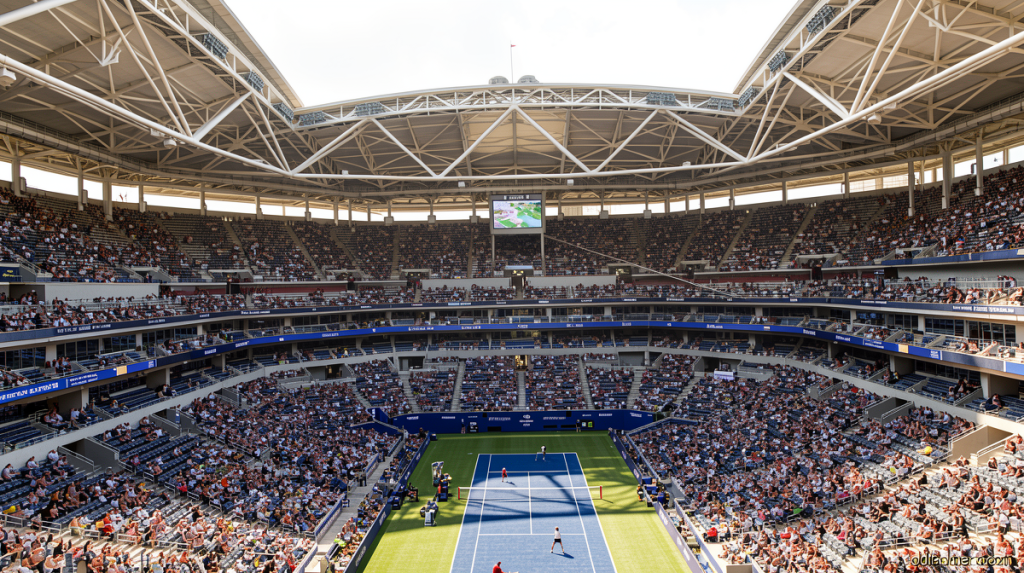
US Open’s $800 Million Makeover Is Redrawing the Line Between Spectator and Sponsor
Goldlaner.com – When the lights come on at Arthur Ashe Stadium for the opening round on August 30, fans will find a noticeably different venue than the one that hosted last year’s tournament. The 29-year-old show court is entering the first phase of an $800 million overhaul, and the changes are aimed squarely at the wallet of the ultra-wealthy attendee. Court-side seating is expanding by roughly 66 percent to approximately 5,000 spots, while the upper-deck sections that once offered budget-friendly views are being dismantled. Nearly 3,000 of those upper-level seats will vanish once the renovation wraps up next year, according to the United States Tennis Association.
The result is a tournament where the cheapest available ticket becomes a scarce commodity at precisely the moment attendance is hitting record highs. For decades, the US Open has carried a reputation as the most accessible of the four Grand Slam events, drawing working-class families and casual sports fans to Flushing Meadows. That accessibility is now under structural threat.
What the Renovation Actually Changes
The expanded court-side zone will accommodate more of the ultra-premium seats that command the highest per-ticket prices in professional tennis. Alongside that growth, the suite level — long occupied by marquee sponsors including Grey Goose vodka, Dobel Tequila, and Emirates airline — is being remodeled and enlarged. Two entirely new tiers of suites are being added at Ashe, with rental starting at $15,000 for a single session.
The sponsor spaces themselves are receiving lavish upgrades. Emirates’ massive suite, positioned above the center of the stadium, is being reconfigured to replicate the curved bar and expansive lounge layout of its double-decker Airbus 380 aircraft. Grey Goose’s revamped area draws its design language from a high-end French hotel. Dobel Tequila’s new suite spans nearly 700 square feet — two-and-a-half times the footprint of its predecessor. Lander Otegui, executive vice president of marketing and innovation at Proximo Spirits, Dobel’s parent company, explained that the additional square footage is intended to attract a larger contingent of A-list celebrities and social-media personalities into the space.
Even the merchandise and hospitality offerings have been repriced upward: tennis-themed Champagne cocktails now run $30, caviar-topped chicken nuggets list at $100, and ball-crew shirts carrying the Ralph Lauren label sell for $150.
Players and Fans Push Back
The pricing trajectory has not gone unnoticed inside the sport. Tommy Paul, a top-ranked American player, reacted with visible disbelief on a recent podcast upon learning that a grounds pass — the credential that allows players, coaches, and media to move freely around the complex — now costs $500. In 2019, the same pass was available for under $100.
“I wish it wasn’t that high,” Paul told USA Today this month, adding that the tournament is becoming “more corporate” and failing to bring in the “true fans.”
Resale-market data corroborates the squeeze. TicketData, a price-tracking platform, found that asking prices for opening-round matches peaked at 60 percent above the prior year’s levels. With record attendance figures and a shrinking supply of mid-tier seats, the arithmetic is straightforward: fewer affordable options meeting surging demand produces a price spike that lands hardest on casual attendees.
The Economics Driving the Luxury Pivot
Victor Matheson, a sports economist at the College of the Holy Cross, frames the US Open’s transformation as the latest chapter in a pattern that has been unfolding since the early 1990s. Newly built or renovated arenas across North America have systematically replaced bleacher rows and general-admission gates with premium seating, private suites, and luxury boxes.
“The average fan has been displaced for 30 years,” Matheson said. “We’ve got more and more people competing for the same number of premium experiences, and those people have more and more money — especially at the upper end — and they’re willing to spend it.”
The USTA’s own financial reports illustrate the shift in revenue composition. While ticket sales and broadcast rights still account for more than half of tournament income, the line item labeled “corporate hospitality and services” has nearly doubled, climbing from $42 million in 2019 to $83 million in 2024. That growth rate outpaces every other revenue stream in the organization’s ledger.
Matheson’s analysis of Boston Celtics ticketing offers a concrete illustration of why venues pursue this strategy: two court-side seats at TD Garden generate as much revenue as an entire upper-deck section. The margin differential, he notes, is difficult for any organizer to ignore.
“There is a huge amount to be made on those super-premium experiences,” he said.
The Experience Economy in Full Swing
The US Open’s premiumization does not exist in a vacuum. The World Economic Forum projects that global sports tourism will balloon from $600 billion in 2023 to $1.7 trillion by 2032, driven by consumers who increasingly value proximity to the event over passive viewing. Companies that package VIP access, hospitality, and travel around marquee competitions are riding that wave.
On Location, which assembles premium packages for events ranging from the FIFA World Cup to the Super Bowl to the US Open, reported $666 million in revenue for the first half of this year — a 60 percent jump over the same period a year earlier. Chief operating officer Ed Horne called it the company’s “biggest year” in nearly three decades of operation.
“People largely don’t just want a ticket anymore but want to get closer than ever,” Horne said. “We are in an ‘experience economy,’ and there is no sense that is slowing down.”
For the casual fan who once filled the upper decks of Ashe with a $25 ticket and a hot dog, the calculus has changed. The stadium is still there, the tennis is still played, but the architecture of access has been quietly re-engineered to serve a narrower, wealthier audience. Whether the sport’s governing bodies will intervene to preserve a meaningful tier of affordable seating remains an open question as the renovation proceeds through next year.
Related Reading
Frequently Asked Questions
What is The US Open is getting more?
The US Open is getting more is the main topic of this guide. The article explains the context, practical details, and next steps readers should understand.
Why does The US Open is getting more matter?
The US Open is getting more matters because readers are looking for a useful answer, not just a short summary. Good content should match search intent and help them decide what to do next.