
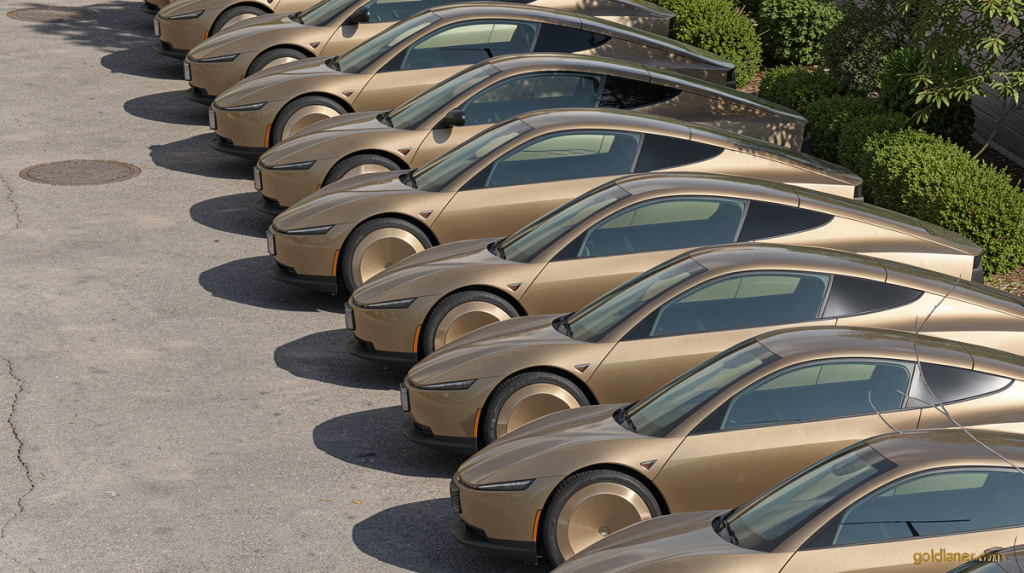
Tesla Keeps Hyping Robotaxis as Its Future
Goldlaner.com – Tesla keeps hyping robotaxis as its core growth narrative, and this Thursday’s Cybercab unveiling is the latest chapter in that story. The automaker released almost no advance material beyond a 51-second clip posted to X, showing the vehicle threading through Austin traffic while passengers summon rides via a smartphone app. No voiceover, no scripted commentary — just the car moving. What the footage confirmed was what industry watchers had already assembled from scattered sightings: the Cybercab, first revealed at a high-profile Hollywood showcase roughly two years ago, has since circulated as prototypes across several American cities.
The spectacle of a new vehicle rolling down a Texas boulevard, however, papers over a question that matters far more to investors and regulators alike. Can any operator convert driverless transportation into a genuinely profitable line of business? At present, no one has answered that question with audited numbers. Neither the automaker nor its closest rival has published standalone financials for its autonomous-ride operations, and the sector as a whole has yet to demonstrate a repeatable revenue model.
A Chasm in Miles Driven
The operational gap between the two leading players is difficult to overstate. Waymo, the Alphabet-backed service running since 2018, announced in March that it had delivered 220 million miles of paid, driverless rides since launch. Tesla, by contrast, disclosed in July that its fleet had logged just 380,000 miles of unsupervised driving — less than 0.2 percent of the rival’s cumulative total.
Waymo’s pace has only quickened. The company reported in March that weekly paid-ride volume had climbed to as many as 500,000, doubling over the prior year, and on Tuesday it extended service to Denver, San Diego, and Tampa, bringing its footprint to 14 cities. The automaker, meanwhile, offers unsupervised rides in six cities, all in Texas and Florida. Its operations began in June 2025 using Model Y SUVs with a company employee seated behind the wheel as a safety monitor; only recently have some vehicles run with no human aboard at all.
Musk’s Timeline Versus Market Reality
CEO Elon Musk has staked significant corporate credibility on the Cybercab’s eventual dominance. Last year he projected the service would reach half the American population by 2025. In January he told investors the company would eventually “make several times more Cybercabs per year than all our other vehicles combined.” Neither forecast has materialized, and the stock has not rewarded the optimism. Tesla shares (TSLA) have gained just 7 percent over the trailing six months and closed Wednesday more than 20 percent below their year-ago level.
“Investing is about betting on the future,” Bryant Walker Smith, an autonomous-vehicle scholar at Stanford Law School’s Center for Internet and Society, observed. “Tesla is very good at selling that future. But at least with respect to automated driving everywhere and all the time, the company has been far less successful at actually delivering it.”
The Unit-Economics Wall
Even if the automaker eventually scales deployment nationwide, profitability is far from assured. Smith argues the binding constraint is less about sensor technology and more about the cost structure of operating a fleet. Every vehicle demands maintenance, cleaning, charging, and eventual replacement — tasks performed by paid workers.
“If you set aside development and hardware costs, you have the ongoing operational costs,” Smith explained. “How do you compete with a Uber driver who might be making under minimum wage to provide and maintain their own car, to clean it and do all the other services that Waymo and Tesla may ultimately have to pay real people real money to do?”
That comparison highlights a structural disadvantage: a human-driven ride-hail platform externalizes vehicle ownership and upkeep onto individual drivers, while an autonomous operator internalizes every cost line item. Closing the gap demands either dramatically lower vehicle prices, dramatically higher ride volumes, or both simultaneously.
Saturated Markets and Reluctant Consumers
Beyond unit economics sits the demand question. Convincing American households to abandon personal car ownership in favor of on-demand rides — whether human-driven or autonomous — remains an open behavioral challenge. And even among consumers already comfortable with ride-hailing, the market is crowded. Anthony Townsend, a senior research associate studying urban mobility, noted that “capturing market share in an already-saturated market for ride-hail” will be an uphill fight for any new entrant, autonomous or not.
FAQ
When does Tesla plan to launch the Cybercab service? The company is scheduled to unveil the service this Thursday, though a full commercial rollout timeline has not been publicly confirmed beyond Musk’s earlier (unmet) projection of reaching half the U.S. population by 2025.
How many cities currently offer unsupervised autonomous rides? Waymo operates in 14 cities as of this week’s expansion to Denver, San Diego, and Tampa. Tesla’s unsupervised service covers six cities, all in Texas and Florida.
Has any robotaxi operator reported a profit? No. Neither Tesla nor Waymo has published standalone financial results for its autonomous-ride operations, and the industry has yet to demonstrate a sustainable revenue model at scale.
What is the main economic obstacle to robotaxi profitability? Analysts point to ongoing operational costs — maintenance, cleaning, charging, and vehicle replacement — that an autonomous operator must internalize, whereas traditional ride-hail platforms shift those costs onto individual drivers.