
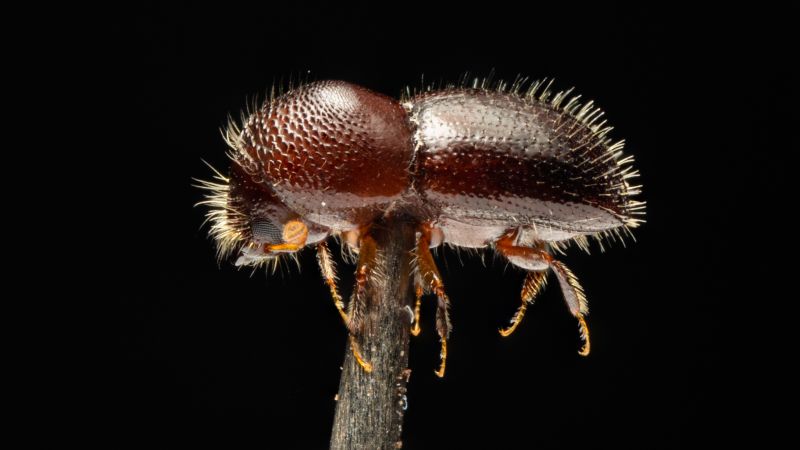
A Tiny Beetle Is Devouring South Africa’s Iconic Trees — and the Billions They’re Worth
Goldlaner.com – Stellenbosch has long been celebrated as a picturesque South African town where vineyards cascade up the dramatic slopes of the Western Cape mountains. For nearly three and a half centuries, residents have proudly called it the City of Oaks. That reputation now hangs by a thread. Countless majestic English oaks and other urban trees that once graced streets and homesteads have vanished. The survivors bear telltale signs of their impending doom — hundreds of microscopic perforations beneath their bark, each no wider than a pen dot. These tiny scars mark the beetle that is systematically dismantling the region’s arboreal heritage.
The polyphagous shot-hole borer represents one of nature’s most successful invaders. Originating in southeast Asia, this minuscule insect has conquered every continent except Antarctica. It arrived in new territories by hitching rides on wood products, live plants, and packaging materials. A comprehensive review published in the Forests journal in July documented attacks on more than 680 tree and woody plant species worldwide. The beetle’s ecological footprint continues expanding, threatening millions of trees and billions of dollars in economic value globally.
The Perfect Invader
South Africa has experienced the beetle’s devastation more acutely than most nations. Initial sightings occurred in the eastern KwaZulu-Natal province in 2012, with the first official documentation arriving five years later. Today, the pest has established itself across eight of the country’s nine provinces. Scientists suspect it has already reached Limpopo as well — it simply has not been confirmed yet.
François Roets, a professor in conservation ecology and entomology at Stellenbosch University, describes the beetle as “the perfect invader.” He recalled teaching undergraduates to design an ideal invasive species based on known characteristics. “This little beetle has all of those things rolled into one,” he explained.
The beetle’s success stems from a sophisticated biological partnership. When the insect bores into trees to create breeding galleries, it carries fungal spores in pouches behind its mandibles. These spores release as the beetle chews through wood, establishing a symbiotic relationship that benefits both organisms at the tree’s expense. The fungus provides food for the beetle and its developing larvae while simultaneously blocking the tree’s vascular tissue. This obstruction prevents the host’s natural defense mechanisms from reaching the invading insect.
The consequences for infected trees prove devastating. The fungal disease, known as fusarium dieback, produces symptoms resembling severe drought. Water and nutrient flow becomes critically restricted, leading to extensive damage and frequently death. Survival timelines vary by species. Oak trees typically perish within four years of infestation, while box elders rarely endure beyond their first twelve months.
Reproduction Without Compromise
One factor accelerating the beetle’s spread deserves special attention. Unlike most insects, the polyphagous shot-hole borer does not require a male partner to reproduce. Virgin females can lay unfertilized eggs that develop into males. These males then mate with their mothers, initiating new colonies through a system called haplodiploidy. This reproductive efficiency, combined with the beetle’s diminutive size and preference for concealing itself within wood, has enabled explosive population growth across South Africa.
By 2022, satellite imagery captured the dramatic transformation of Johannesburg’s suburban landscape. Strips of trees had disappeared from once-green streets, leaving behind bare corridors. The primary response strategy proved straightforward but expensive: remove infected or dead trees before beetles could migrate to healthy hosts. This approach addresses the immediate threat but does not eliminate the underlying problem.
Economic Consequences Mount
The financial burden of this ecological crisis extends far beyond individual tree losses. A 2022 study conducted by economists and ecologists at Stellenbosch and Pretoria universities calculated the potential economic impact on South Africa. Their research estimated losses could reach 275 billion rand — approximately 18.5 billion dollars at contemporary exchange rates — over a ten-year period. This figure represents roughly 0.66 percent of the nation’s entire gross domestic product.
Urban trees provide numerous services that become costly when lost. They reduce air pollution, lower urban temperatures, manage stormwater runoff, and enhance property values. Municipalities must also invest in monitoring programs, treatment protocols, and public education campaigns to slow the beetle’s advance. The economic calculations likely underestimate long-term consequences, as agricultural sectors face additional threats from infestations affecting commercial tree crops.
Scientists continue researching potential biological controls and resistant tree varieties. Meanwhile, communities worldwide watch nervously as this sesame-seed-sized invader demonstrates that even the smallest organisms can reshape ecosystems and economies on a massive scale. The question remains whether humanity can develop solutions fast enough to match the beetle’s relentless expansion.
Related Reading
Frequently Asked Questions
What is This perfect invader is spreading across?
This perfect invader is spreading across is the main topic of this guide. The article explains the context, practical details, and next steps readers should understand.
Why does This perfect invader is spreading across matter?
This perfect invader is spreading across matters because readers are looking for a useful answer, not just a short summary. Good content should match search intent and help them decide what to do next.