
From Rejected at the Border to History-Maker on Europe’s Biggest Stage
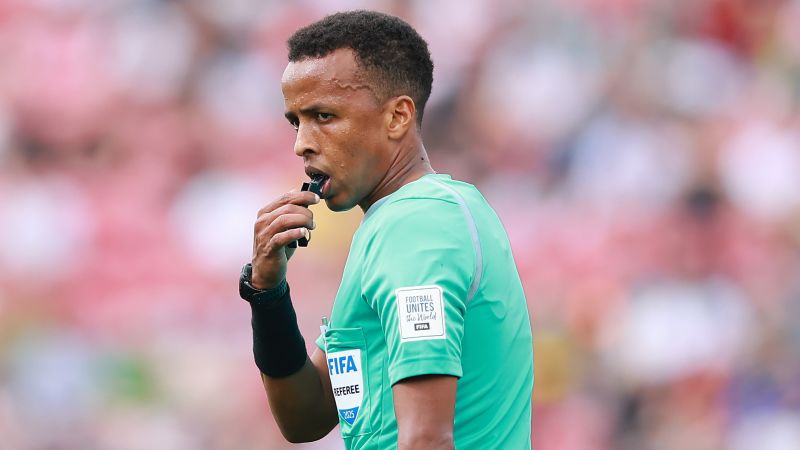
Goldlaner.com – Just days after being turned away from the United States with his World Cup dreams in tatters, Omar Abdulkadir Artan stepped onto the pitch in Salzburg and etched his name into football lore. The 34-year-old Somali official became the first non-European to referee the UEFA Super Cup, guiding Paris Saint-Germain to a 2-1 victory over Aston Villa in Austria. It was a moment that transcended sport, proving that setbacks can become springboards for extraordinary achievement.
Artan’s journey to this pinnacle moment has been anything but straightforward. His path to the world stage nearly ended before it truly began. With FIFA having selected him as one of seven African referees for the summer tournament, the Somali official was poised to become his nation’s first-ever representative at a men’s World Cup. Then, mere days before the opening whistle, everything changed.
A Dream Interrupted at Miami Airport
At Miami International Airport, Artan faced an 11-hour interrogation that would alter his trajectory. US Customs and Border Protection officials detained him, ultimately denying his entry citing “vetting concerns.” While the agency declined to elaborate at the time, a Trump administration source later revealed to CNN that the review uncovered “derogatory information, including association with suspected members of terror organizations.”
“It was a very tough period,” Artan reflected in a conversation with UEFA. “A lot of people have sympathy for me because, when someone has been working a lot of years and is supposed to do something and then can’t do it, it’s very challenging.”
The official did not specify the nature of the alleged terror connections, and that information remains undisclosed to this day. However, the context matters significantly. Somalia continues to be among 39 countries subject to enhanced scrutiny under the Trump Administration’s travel ban policies. Complicating matters further, Artan had reportedly secured a visa prior to his departure, only to be rejected at the border.
FIFA maintained that immigration decisions fall squarely within host nations’ authority. Questions remain unanswered regarding whether Artan received full compensation for his World Cup assignments and whether he will be considered for future international tournaments. For now, the Somali official must wait until at least 2030, when the World Cup returns to Europe across Spain, Portugal, and Morocco.
A Decade of Breaking Barriers
Artan’s credentials speak for themselves. Since joining FIFA’s international referee roster in 2018, he has accumulated a remarkable series of continental firsts. He made history at the 2023 Africa Cup of Nations as the first Somali official to participate in the tournament. Two years later, in 2025, he achieved dual milestones by becoming both the first to officiate a CAF Champions League final and the inaugural recipient of the CAF Men’s Referee of the Year award.
Following his deportation from the United States, Artan returned to Mogadishu to receive a hero’s welcome from his compatriots. Rather than succumbing to disappointment, he used the moment to inspire fellow Somalis, insisting that his ambitions remained undiminished.
“I really appreciate the support I received throughout the world, though. I’m so grateful,” he said.
UEFA’s Timely Intervention
Within days of his return home, UEFA demonstrated remarkable confidence in Artan by appointing him to referee the Super Cup. The prestigious annual contest between the Champions League and Europa League champions represents one of European football’s premier events. Artan’s selection was not merely symbolic; it reflected genuine faith in his abilities.
On Wednesday, he proved that faith well-founded. Officiating in Salzburg, Austria, Artan was supported by two fellow East African officials: Liban Ahmed from Djibouti and Stephen Yiembe from Kenya. Together, the trio managed the high-stakes encounter with composure and precision, earning praise from pundits and former players alike.
Legendary goalkeeper Gianluigi Buffon captured the sentiment perfectly when he wrote: “Tonight, football gave him the stage he deserved.” Analysts highlighted the officiating team’s ability to maintain control without stifling the game’s natural rhythm, making crucial decisions at pivotal moments.
Beyond the Pitch
Artan’s Super Cup appearance carries significance beyond personal triumph. The appointment aligns with a broader cooperation agreement signed earlier this year between UEFA and the Confederation of African Football, designed to facilitate the exchange of expertise across multiple strategic domains. His success demonstrates the tangible benefits of such partnerships.
Looking forward, Artan carries a message that resonates far beyond football’s boundaries. His story offers hope to aspiring officials worldwide who face obstacles that might deter lesser spirits.
“I believe that if I can succeed, anyone can. You can do whatever you want to do. Don’t ever stop dreaming,” he declared.
While the Super Cup provided Artan with a platform to showcase his talents on European soil, his influence extends much further. The Somali official has transformed what could have been a career-ending setback into an opportunity to inspire a generation. His journey from Mogadishu to Salzburg illustrates that determination, when paired with excellence, can overcome even the most formidable barriers.
As Artan prepares for future assignments, whether at the 2030 World Cup or beyond, his legacy is already secure. He has proven that geography and bureaucracy need not define one’s potential. For Somali football and for African officiating as a whole, Omar Abdulkadir Artan represents more than individual success—he embodies the possibility of breaking through every boundary that stands in the way of greatness.
Related Reading
Frequently Asked Questions
What is He was denied entry to the US?
He was denied entry to the US is the main topic of this guide. The article explains the context, practical details, and next steps readers should understand.
Why does He was denied entry to the US matter?
He was denied entry to the US matters because readers are looking for a useful answer, not just a short summary. Good content should match search intent and help them decide what to do next.