
How a royal scandal created one of the world’s greatest sacred masterpieces
A Sacred Masterpiece Born from Royal Turmoil
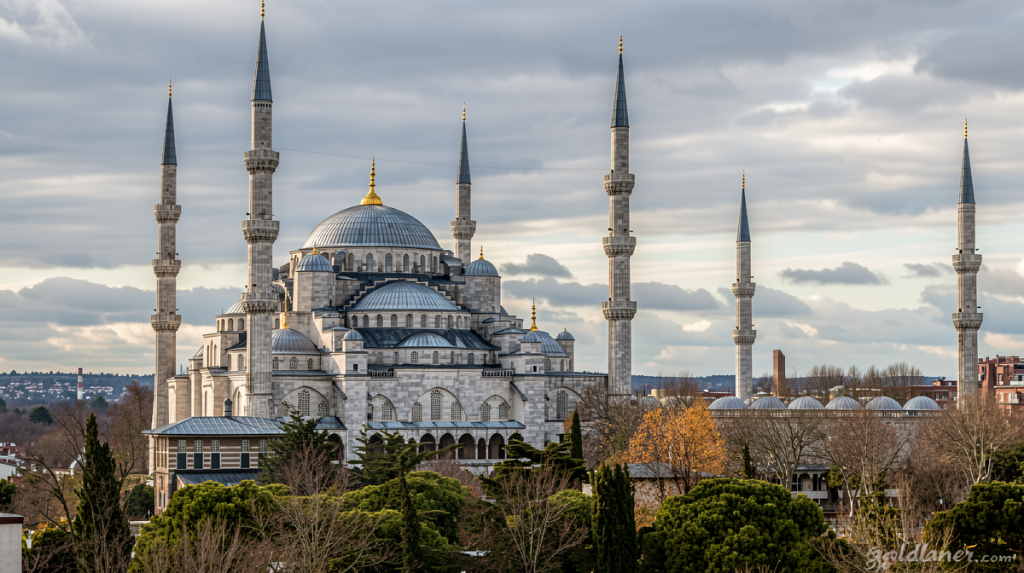
Goldlaner.com – Within the heart of Istanbul, where the seasons paint the sky in ever-changing hues, there exists a sanctuary whose interior remains perpetually bathed in celestial blue. The Sultan Ahmed Mosque, beloved by locals and visitors alike as the Blue Mosque, stands as a testament to both spiritual devotion and political ambition. Its name derives from the sultan who commissioned its creation during the early seventeenth century, a period when the city was still widely recognized by its ancient Byzantine designation of Constantinople.
The Spiritual Significance of Blue
Blue carries profound meaning within Islamic tradition, representing both the boundless heavens and the infinite nature of the cosmos. This color dominates the interior of the mosque, creating an atmosphere that has captivated worshippers and tourists for centuries. The architectural achievement represents more than religious expression; it embodies the cultural aspirations of an empire at its zenith.
“It’s not just a mosque,” explains historian and travel writer Saffet Emre Tonguç. “They wanted to attract the people from Anatolia, and so they created a place which was also economically interesting for people.”
Architectural Grandeur on Seraglio Point
The mosque’s imposing presence on Seraglio Point, the inaugural hill among Istanbul’s seven historic elevations, commands attention from across the city. Its architectural identity is defined by six towering minarets and thirteen domes that contribute to Istanbul’s celebrated silhouette. As a functioning place of worship, the mosque accommodates five daily prayer sessions, each lasting approximately ninety minutes, while simultaneously welcoming visitors who dress respectfully to admire its interior during intervals between prayers.
When construction commenced in 1609 and concluded in 1616, Istanbul remained a relatively modest settlement compared to its modern scale. The Ottoman Empire, originating from northwest Anatolia—the peninsula constituting most of contemporary Turkey—had established Constantinople as its capital following the conquest of 1453, which effectively ended Byzantine rule.
A Teenage Sultan’s Grand Ambition
Sultan Ahmed I’s journey to the throne was marked by extraordinary tragedy. He ascended to power at merely thirteen years of age, following the death of his father, Mehmed III, and within months of witnessing the brutal execution of his elder half-brother Şehzade Mahmud. The tradition of fratricide served as the Ottoman solution to succession disputes, and Mehmed III had previously ordered the strangulation of nineteen brothers within the confines of Topkapi Palace.
By the time Ahmed I was nineteen and initiated construction on his monumental mosque, the Ottoman Empire stretched across three continents, extending from the fortified walls surrounding Vienna to the Mediterranean port of Algiers and the sacred sites of Mecca. The young sultan’s vision was to create something that would eclipse even the legendary Hagia Sophia, establishing his legacy in stone and tile.
A Complex of Faith and Commerce
The mosque represents only one component of an extensive külliye—a comprehensive complex serving religious, charitable, and economic functions. Surviving elements include a madrasa for theology students, a soup kitchen providing sustenance to the impoverished, a hospital and hospice facility, shops within the Arasta Bazaar, and the mausoleum honoring Sultan Ahmed himself, after whom the entire district was named.
The Sultanahmet neighborhood occupies a strategic position at the convergence of the Bosphorus Strait, the Golden Horn, and the Sea of Marmara, marking both the geographical boundary of Europe and the historical center of Istanbul. This area contains numerous UNESCO World Heritage sites, including the imperial Topkapi Palace, the underground Basilica Cistern with its cathedral proportions, and the 2,500-year-old Obelisk of Theodosius situated in Sultanahmet Square, recognized as the oldest monument in this ancient metropolis.
Layers of History Beneath the Blue Canopy
The vast square now filled with chestnut vendors and touring groups once served as the Hippodrome of Constantinople. This ancient arena hosted chariot races, public executions, and witnessed the devastating Nika riots of 532, during which approximately thirty thousand rebels opposing the Byzantine emperor were slaughtered. Long before the Sultan Ahmed Mosque rose from the earth, the fourth-century Palace of Daphne occupied this ground as a significant wing of Constantinople’s Great Palace.
Although the palace structures have vanished, mosaics excavated from beneath the Arasta Bazaar now reside in the Great Palace Mosaics Museum, located within the mosque complex and currently undergoing restoration. The architectural rivalry that Sultan Ahmed I ignited with Islam’s holiest site fundamentally transformed Istanbul’s skyline, creating a legacy that continues to inspire awe among those who walk beneath its blue-domed heavens.
