
Killings of three British politicians in a decade shine light on febrile political mood
Killings of Three British Politicians Reveal Deepening Political Tensions
Killings of three British politicians – The Killings of three British politicians over the past decade have once again brought attention to Parliament, where lawmakers gathered Monday to honor another fallen colleague. This marks the third such memorial in just over ten years. As members rose individually to pay tribute, a clear pattern emerged: mounting concern about rising violence against public servants. Home Secretary Shabana Mahmood spoke to the chamber, noting that while politics remains a noble calling, it must not become dangerous. “We must stay alert and adapt to new threats,” she stated, seeking to reassure MPs worried about their safety.
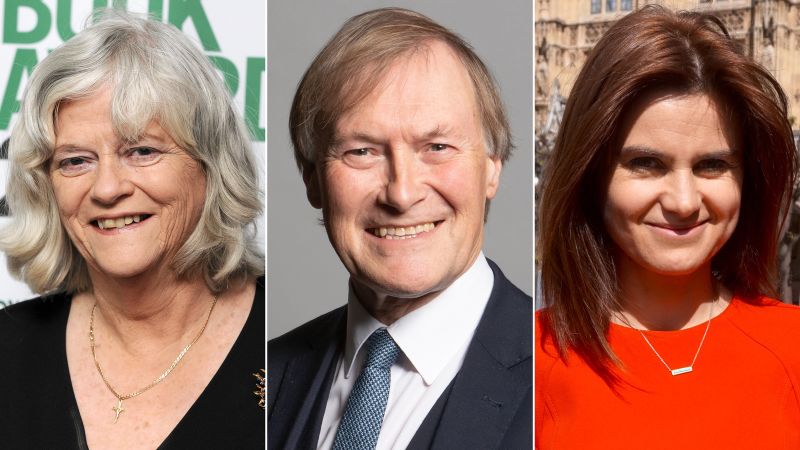
The recent death of former MP Ann Widdecombe joins a growing list of political assassinations. Alongside Jo Cox, who was killed in 2016, and David Amess, murdered in 2021, the Killings of three British politicians highlight a particularly dangerous period in modern British political history. These deaths occurred during peacetime, unlike the era known as “The Troubles”—the Northern Ireland conflict that lasted from the late 1960s until the 1998 Good Friday Agreement. During that earlier period, four MPs were killed by Irish republican militants between 1979 and 1990.
Investigation Into a Targeted Killing
Authorities began their investigation after finding Widdecombe, a former Conservative who became Reform UK’s immigration spokesperson, dead at her home. She had sustained “serious injuries” before dying. While initial reports suggested no political motive, counter-terrorism officers were later assigned to lead the case. Police arrested a 28-year-old White British man, initially charging him with murder and later adding terrorism-related suspicions. By Tuesday, investigators described the incident as a “targeted attack,” though they would not confirm specific motives. One line of inquiry examines whether the suspect focused on people connected to Reform UK.
The reasons behind these Killings of three British politicians varied considerably. Jo Cox, a Labour MP representing the center-left, was killed by someone with extreme right-wing views and a large collection of Nazi-era items. David Amess, a Conservative representing the center-right, was murdered by a “fanatical Islamist” inspired by Islamic State beliefs. Rather than stemming from one shared ideology like the violence of the 1980s, these attacks appear more disconnected from each other.
Concerns About Democratic Stability
Alan Renwick, a politics professor at University College London and head of the university’s Constitution Unit, cautioned against linking extreme acts by a few people to larger social trends. Still, he acknowledged that politicians face greater dangers today, raising questions about democracy’s future. “Clearly, MPs and other public figures now encounter threats almost as a matter of course,” he told CNN. “This represents a shift from earlier times, and it weakens democratic practice.”
Numerical data backs up this view. According to The Times, crimes against MPs reached nearly 1,000 in 2025, almost twice the number from 2022. A parliamentary study showed this equals a ten-fold rise from the 151 offenses logged in 2017. This increase followed Jo Cox’s murder, which happened just days before Britain voted to leave the European Union—a choice made during a bitter campaign that reshaped British politics and began an age of uncertainty that continues today.
On Tuesday, Brendan Cox, Jo’s husband, shared that he feels less hopeful about political conversation than he did right after his wife’s death. “After Jo was killed, there was genuine shock and sadness across all political parties, and the entire nation paused to declare this is not how we should behave,” he told Sky News. “But looking back, I believe we have retreated into our separate camps.” He pointed to the “Wild West culture we experience online” as a major driver of violence, noting it encourages and justifies aggressive conduct. “Until we address that digital space that validates violence as a political tool, we will continue to see troubling outcomes.”
