
Justices Kagan and Barrett demand more Supreme Court security funding in rare appearance before Congress
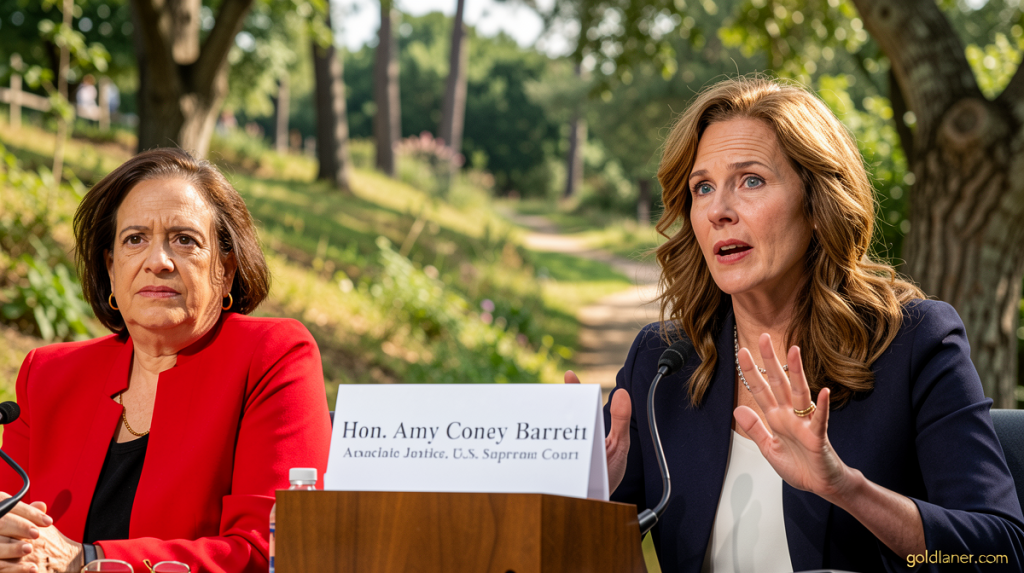
Supreme Court Justices Seek Enhanced Protection Amid Rising Threats
Justices Kagan and Barrett demand more – During a seldom-seen congressional appearance on Tuesday, Justice Amy Coney Barrett issued a heartfelt appeal for greater financial resources dedicated to protecting the nation’s highest court. The hearing provided an opportunity for Barrett to discuss, for the very first time, personal dangers that have been aimed at her and her loved ones. She was accompanied by Justice Elena Kagan, who together sought additional millions for judicial security measures.
Personal Encounters with Danger
Barrett recounted two specific episodes that highlighted the growing risks facing Supreme Court justices. One involved a recent swatting attempt targeting her residence, while another concerned the provision of a bulletproof vest by court security personnel. She noted that when threats against her became “particularly intense,” the protective gear was issued. Speaking to a House appropriations subcommittee, Barrett reflected on the unexpected nature of her role.
“I didn’t expect that performing this service was going to put me in the position of explaining to my children what a bulletproof vest was and why I had to wear one,” Barrett told the committee.
The conservative justice described how one of her teenage sons opened the front door on the evening of the swatting incident to join friends. Instead, he encountered numerous police vehicles that “had responded to a false report of gun shots and raised voices in my home.” Barrett expressed appreciation that the Supreme Court police detail assigned to her property coordinated quickly with local officers, preventing them from “attempt to enter our home.”
Funding Requests and Security Infrastructure
The judiciary has submitted a request for approximately $921 million in overall security funding, representing a $29 million increase over the previous year. This allocation supports frontline security forces stationed at federal courthouses nationwide. Within this total, nearly $15 million is designated to expand Supreme Court Police availability for protecting justices and their families, including at private residences. Additionally, $6 million has been earmarked for constructing a dedicated facility to conduct security screening before visitors access the Supreme Court building.
Law enforcement officials in Washington’s Virginia suburbs reported in May that they had been dispatched to a Supreme Court justice’s home following what they classified as a “fictitious” gunfire report. CNN subsequently verified that Barrett’s residence was the location in question, although neither the justice nor the court had publicly acknowledged the event beforehand.
Ethics Code and Enforcement Challenges
Beyond security matters, the justices addressed questions regarding the court’s ethics code, emergency docket utilization, and judicial diversity. Several lawmakers signaled their willingness to back the requested funding increase, citing a noticeable rise in threats directed at jurists.
Rep. Rosa DeLauro, a Connecticut Democrat, criticized the 2023 ethics code as being “entirely self-policing.” She pointed out that “every other body has that” enforcement mechanism, noting that “It’s just the Supreme Court that doesn’t.” This observation prompted an interesting dialogue between the two justices.
While acknowledging the practical difficulties, Kagan said that she would support a code of ethics for the high court with some type of enforcement mechanism.
Barrett said that she wasn’t as sure. “I’m less certain,” Barrett said, while adding that she was “fully committed to the code.”
Major ethics controversies involving justices have diminished since reports three years ago revealed how certain justices, particularly conservative Justice Clarence Thomas, accepted luxury travel without proper disclosure. However, the Tuesday hearing marked the first occasion Congress could directly question the justices on this matter.
Kagan reiterated her belief that an enforcement mechanism should exist, though she recognized the complexity of policing nine justices who occupy the pinnacle of the federal judiciary. “I will say that’s an extremely difficult question for a pretty obvious reason,” Kagan explained. “I don’t think that you’d want an enforcement system that is controlled by the executive branch or by the legislature.” Some external experts have proposed that the court might utilize retired judges or a judicial panel to evaluate complaints and questionable conduct. Kagan indicated that enforcement would likely need to originate within the judiciary itself, though this approach would generate additional questions regarding implementation and authority.
