
The UAE is putting a homegrown satellite constellation into orbit
UAE Advances Sovereign Space Capabilities with New Satellite Constellation
The UAE is putting a homegrown – The United Arab Emirates continues to demonstrate remarkable progress in space exploration, building upon earlier milestones that included successfully sending an astronaut beyond Earth’s atmosphere and achieving Mars orbit through its Hope Probe mission. As global powers increasingly prioritize independent satellite networks amid growing international tensions, a local enterprise is positioning itself at the forefront of commercial satellite production.
Altair: A New Era of Orbital Observation
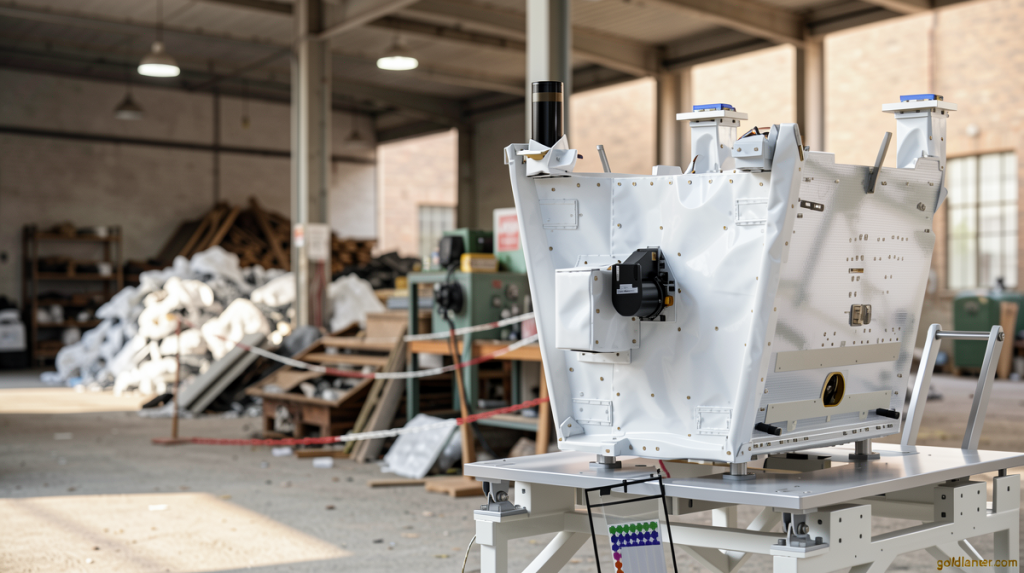
Orbitworks, headquartered in Abu Dhabi, is currently engineering artificial intelligence-powered satellites destined to comprise a ten-unit constellation known as Altair. This network will serve diverse applications ranging from defense intelligence collection to ecological surveillance. The venture represents a collaboration between Marlan Space, an Abu Dhabi entity, and Loft Orbital, which operates from San Francisco. According to company plans, the inaugural satellite will reach orbit this coming October.
Currently, American firm SpaceX dominates the satellite landscape, controlling approximately sixty-nine percent of all operational satellites worldwide, based on data from Orbital Radar. Nevertheless, other nations are actively developing independent capabilities. Canada intends to deploy hundreds of additional satellites to decrease dependence on Washington, while the European Union is constructing a network comprising two hundred ninety satellites of its own.
Democratizing Space Access Through Innovation
Orbitworks positions itself as a catalyst for establishing independent space capabilities within the UAE. Dr. Hamdullah Mohib, who serves as chief executive of both Orbitworks and Marlan Space, explained the shifting global perspective to CNN’s Paula Hancocks: “There has been a lot more focus on nations to have their own assets in space.” However, he acknowledged that financial constraints prevent many countries from pursuing this path independently.
“Not everybody can afford to have their own assets,” Mohib noted, highlighting that Altair will operate under a “constellation-as-a-service” framework. This approach enables corporations, governmental bodies, and academic institutions to rent access to the constellation’s capabilities rather than purchasing entire satellite systems.
Conventional satellites transmit substantial volumes of unprocessed information back to Earth, where analysis may require several hours or even days. Orbitworks’ next-generation satellites employ artificial intelligence to analyze data while still in orbit, delivering actionable insights to end users nearly in real time. Mohib emphasized that incorporating AI functionality has become essential for remaining competitive in the global marketplace.
“Everybody that’s anybody that does satellites is looking to put AI on board,” observed Quentin A. Parker, an emeritus professor specializing in astrophysics and space science at the University of Hong Kong.
Strategic Partnerships and Manufacturing Scale
Mohib expressed confidence that partnering with the American company Loft Orbital would facilitate attracting Western clients. He noted that while Chinese firms offered attractive pricing and intellectual property sharing arrangements, the U.S. partnership provided strategic advantages. The company is currently engaging with potential customers interested in utilizing Orbitworks’ production facilities.
The organization’s manufacturing facility spans fifty thousand square feet and possesses the capacity to produce fifty satellites annually, with each unit weighing as much as five hundred kilograms or one thousand one hundred pounds. This production capability positions Orbitworks to meet growing demand in an expanding market.
UAE’s Ambitious Space Economy Vision
The worldwide space sector generated two hundred twenty-four billion dollars in revenue during 2024, according to a 2025 Boston Consulting Group analysis, with satellite communications and Earth observation representing the largest segments. The Middle East and Africa region accounted for eighteen billion dollars of that total, with the UAE contributing between forty and forty-five percent. The nation has set an objective to double its space economy revenues and secure a position among the world’s ten leading space economies by 2031, supporting broader economic diversification efforts beyond petroleum dependence.
Private enterprises globally have significantly reduced expenses and accelerated technological advancement. SpaceX pioneered reusable rocket technology, dramatically lowering launch expenditures. The UAE has similarly invested heavily in space infrastructure, establishing regulatory frameworks and creating institutions dedicated to space activities.
The three billion UAE dirham ($820 million) National Space Fund was created to facilitate cooperation between international and Emirati organizations in developing domestic expertise.
This financial commitment has nurtured a vibrant private sector, including Orbitworks, which identifies itself as “the Middle East’s first private space infrastructure company.” Looking ahead, the UAE maintains ambitious plans, including a five-billion-kilometer expedition to the asteroid belt situated between Mars and Jupiter, scheduled for deployment in 2028.
Faisal Hamady, a Dubai-based managing director and partner at Boston Consulting Group, told CNN that the UAE has progressively concentrated on developing sovereign space security infrastructure and technologies capable of capturing emerging economic opportunities. “For much of its early history, the UAE bought satellites and expertise abroad, but the national strategy now explicitly aims to build a market-driven ecosystem,” Hamady explained, marking a significant transition from satellite importer to space technology innovator.
