
John Roberts fought for decades to overturn Humphrey’s Executor
John Roberts fought for decades to overturn Humphrey’s Executor
John Roberts fought for decades to overturn – Chief Justice John Roberts has long advocated for a robust presidential authority, emphasizing the need for an executive capable of swiftly removing heads of independent agencies. This vision, which he has championed for over four decades, began taking shape during his early years as a Reagan administration lawyer. His determination to reshape the balance of power culminated in a landmark decision in June 2026, where the Supreme Court overturned the 1935 ruling in Humphrey’s Executor v. United States, a case that had historically limited the president’s ability to dismiss agency leaders. The reversal marked a significant shift in constitutional interpretation, aligning with Roberts’ belief in expanding executive control over regulatory bodies.
Roberts’ Legal Strategy and Constitutional Vision
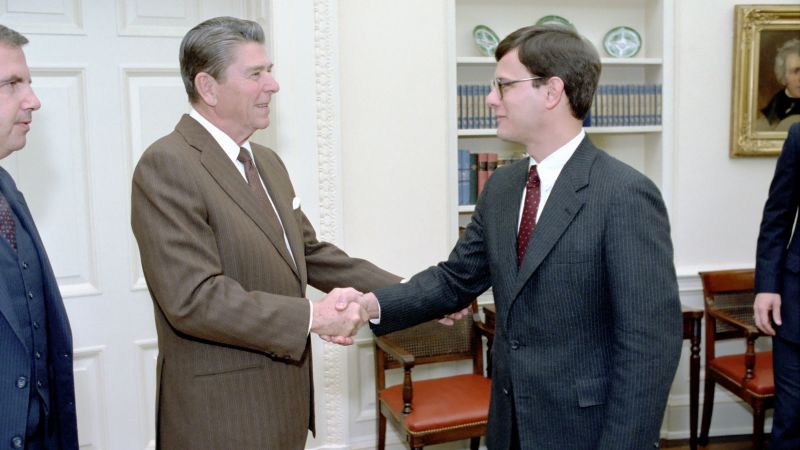
Roberts’ push for greater presidential power gained momentum in the early 1980s. In a 1983 memo addressed to White House counsel, he argued that the system of independent agencies represented a “constitutional anomaly” that should be revisited. “The time is ripe to reconsider the constitutional anomaly of independent agencies,” he wrote, setting the stage for a broader ideological campaign. This effort continued as he ascended to the Supreme Court in 2005, where he began systematically challenging precedents that constrained the president’s firing power. His 2010 opinion in a pivotal case underscored this philosophy: “Without such power, the President could not be held fully accountable for discharging his own responsibilities; the buck would stop somewhere else.”
The 1935 decision, Humphrey’s Executor, had established that the president could only remove agency heads for “inefficiency, neglect of duty, or malfeasance in office,” effectively shielding them from arbitrary dismissal. Roberts viewed this as an obstacle to executive autonomy, arguing that the Founding Fathers intended for the president to wield unchecked authority in enforcing laws. “Our Constitution creates three branches, but only one President,” he wrote in a 36-page opinion, framing the executive as the central figure in governance. “That President is not all powerful – not by any means. But he is not impotent either. He and he alone is vested with ‘the executive Power’ of the United States.”
A Pattern of Judicial Expansion
Roberts’ approach to presidential power has been consistent across multiple cases, reflecting a methodical strategy to redefine the boundaries of executive authority. This pattern became evident in 2024 when the court granted Trump broad immunity from criminal charges, citing the president’s “conclusive and preclusive” authority. The same reasoning applied to the reversal of Humphrey’s Executor, which has implications for independent agencies like the Federal Trade Commission (FTC). The FTC, established in 1914 to protect consumers and regulate unfair business practices, has faced increasing scrutiny under Roberts’ leadership. His 2026 ruling allows the president to remove agency heads without the need for specific cause, potentially undermining the stability of these regulatory bodies.
The court’s decision also echoes earlier efforts to weaken the Voting Rights Act of 1965, a cornerstone of civil rights legislation. Roberts’ jurisprudence on this issue has been instrumental in shifting the balance of power, creating a 6-3 supermajority that enabled the Supreme Court to roll back federal protections for Black and Latino voters. These cases illustrate a broader trend of judicial expansion, where the executive’s role is increasingly prioritized over checks and balances. “The Court gives the President a power unknown even to the English Crown against which the Founders revolted,” Justice Sonia Sotomayor noted in her dissent, criticizing the ruling as an elevation of the executive above its coequal branches. “Elevating him above his once-coequal branches by transforming a duty to take care that the laws be faithfully executed into a license to act in defiance of those very laws.”
Independent agencies, which regulate critical areas of public life, have been central to Roberts’ agenda. These bodies impose standards on businesses and individuals, influencing everything from workplace safety to nuclear energy oversight. The 2026 ruling, however, threatens to erode their independence, allowing the president to appoint leaders with minimal oversight. This aligns with Trump’s attempts during his second term to replace Democratic-appointed commissioners at agencies like the FTC, where Rebecca Slaughter was in the middle of a seven-year term. Trump’s March 2025 email to Slaughter, demanding her continued service on the FTC be reconsidered, exemplifies the pressure exerted on agency leaders under this new framework.
Legacy of Judicial Reform
Roberts’ reversal of Humphrey’s Executor is the latest chapter in a decades-long effort to centralize executive power. His jurisprudence has not only reshaped the interpretation of the Constitution but also influenced the administration of regulatory agencies. By dismantling the legal safeguards that once protected independent officials, Roberts has paved the way for a more assertive presidency, one that can act decisively in the public interest without congressional interference. This philosophy has been reinforced by the appointments of conservative justices, which have created a cohesive bloc dedicated to expanding executive authority.
While the debate over regulatory power may appear less dramatic than issues like abortion rights or immigration, its implications are far-reaching. Independent agencies have long been a vital part of the American governance system, ensuring that policies are implemented consistently and transparently. Roberts’ 2026 decision, however, signals a departure from this model, favoring a presidential system where the chief executive holds ultimate sway. This shift has sparked concerns among legal scholars and civil rights advocates, who warn of the potential for abuse in a system where the president can remove agency heads at will.
Despite the criticisms, Roberts maintains that his rulings enhance presidential accountability. “The President is not all powerful – not by any means,” he wrote, but he also argued that the current structure leaves the executive too weak to act effectively. This duality has become a hallmark of his legal philosophy, one that balances the need for strength with the fear of unchecked power. The case of the FTC, which has been at the heart of the recent ruling, highlights this tension. While the commission has successfully protected consumers, its independence could now be compromised, allowing the president to prioritize political agendas over public welfare.
Roberts’ influence extends beyond the immediate cases, shaping the long-term trajectory of American governance. His strategic patience, combined with a growing conservative majority, has enabled a series of decisions that redefine the role of the presidency. As the court continues to expand executive power, the question remains: how far will this trend go, and what will it mean for the separation of powers? The 2026 ruling, though a victory for the conservative bloc, represents both a culmination of decades of effort and a new frontier in the ongoing battle over presidential authority.
