
Using the stars and paddles, indigenous Taiwanese recreate risky sea journey of Great Pacific Migration
Using the stars and paddles, indigenous Taiwanese recreate risky sea journey of Great Pacific Migration
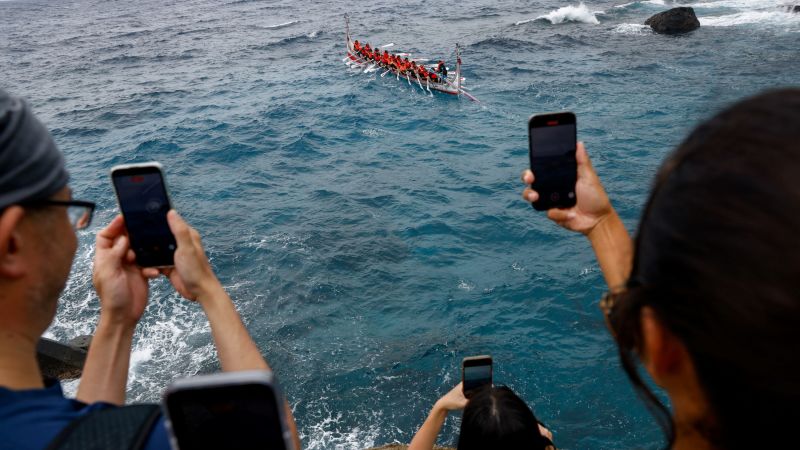
Using the stars and paddles indigenous – A group of indigenous Taiwanese navigators recently undertook a remarkable expedition, braving the open sea in a handcrafted canoe to replicate a historic voyage believed to have been made thousands of years ago. This journey, spanning 111 miles across the Pacific, not only honored the ancestral seafaring skills of Taiwan’s indigenous peoples but also underscored their pivotal role in one of humanity’s most extraordinary migrations.
Reconnecting with Ancient Routes
The voyage, led by 60 Tao people from Taiwan’s Orchid Island, aimed to revive a maritime path that had not been used for over three centuries. By navigating using the stars and paddling a traditional wooden canoe, the group sought to emulate the daring crossings of their ancestors, who are thought to have reached distant lands such as Hawaii, Easter Island, and Madagascar. These early voyagers, equipped with primitive vessels and a deep understanding of the ocean, successfully linked regions across vast distances, shaping the cultural and genetic fabric of the Austronesian peoples.
The Craft of the Journey
The canoe, named “Ovayan” or “Golden Friendship,” was meticulously constructed by more than 200 participants from six tribal communities. Using age-old techniques, the builders bound specially cut wood together without nails, relying on natural materials to replicate the methods of their forebears. “If the surface is uneven, with slight bumps here and there, the resistance from the sea will be much greater,” explained Hsieh Chen-Hsiung, a shipbuilder, in a promotional video. This painstaking effort reflected a commitment to preserving indigenous craftsmanship while reenacting a route that once served as a lifeline for early Austronesian migrants.
Ancient Skills and Modern Significance
Upon arrival at Batan Island in the Philippines, the group was greeted by enthusiastic celebrations, including drum and dance performances, symbolizing the cultural ties between the two communities. Maraos, chairperson of the Indigenous Peoples Cultural Foundation (IPCF), emphasized the importance of the event: “This is not only a significant day for the Pacific Ocean but also a day of commemoration for the Austronesian people.” Maraos, like many Tao individuals, uses a single name, a tradition that highlights the cultural identity of the group.
The migration, often referred to as the Great Pacific Migration, is considered one of the most remarkable human movements in history. Scholars believe that Taiwan’s indigenous people were the original navigators who expanded their reach across the Pacific, carrying knowledge of the stars and essential plant species like yams and taro. These crops, along with livestock, were vital for survival on isolated islands, according to Emeritus Professor Peter Bellwood of Australian National University. “Without those animals and plants, they couldn’t survive in small islands,” Bellwood stated, adding that women were typically part of these expeditions, contributing to both survival and cultural continuity.
Controversies and Cultural Legacy
While the “Out of Taiwan” theory is widely accepted in scientific circles, it has faced recent scrutiny from mainland Chinese academics who argue that the origins of Austronesian peoples may lie in southern China instead. This debate has sparked discussions about the political implications of such theories, as Taipei seeks to assert its own narrative of the migration’s beginnings. Despite the challenges, the theory remains supported by archaeological findings and genetic evidence, with Victoria Chen, a senior lecturer at Victoria University of Wellington in New Zealand, noting that Taiwan was the first identifiable point of the spread of Austronesian languages.
Chen highlighted the linguistic connections among these groups, pointing out shared words like “lima” for five in Bahasa Indonesian, “rima” in Māori, and “ʻelima” in Hawaiian. However, she also noted the complexity of Taiwan’s own linguistic landscape, which features more variations and intricate grammatical structures than many other regions. “The high-level diversity suggests that Taiwan was the original dispersal of the family,” Chen explained, underscoring the island’s role as a cultural crossroads.
Historical Context and Population Dynamics
Taiwan’s indigenous groups, though a minority in modern times, hold a crucial place in the island’s history. Today, they constitute just 3% of Taiwan’s 23 million population, with the majority being descendants of Han Chinese immigrants. The Tao people, one of the smaller indigenous groups, number only around 5,120, according to official records. Yet, their ancestral journeys were instrumental in spreading Austronesian languages and cultures across the Pacific.
The recent reenactment of the Great Pacific Migration served as a powerful reminder of these early explorers’ ingenuity. By paddling against strong currents and relying on celestial navigation, the participants demonstrated the resilience of their ancestors, who crossed the ocean without modern tools. This event not only celebrated cultural heritage but also reinforced the belief that the migration began in Taiwan “maybe 5,000 years ago,” as Bellwood suggested. From there, the groups expanded their influence to the Philippines, Indonesia, and the Pacific islands, a path corroborated by both archaeological records and DNA analysis.
Conclusion: Bridging Past and Present
The journey of the Tao people to the Philippines was more than a physical act; it was a symbolic reconnection with their roots and a testament to the enduring legacy of indigenous seafaring. By reviving an ancient route, the expedition highlighted the importance of preserving traditional knowledge and the role of the Austronesian peoples in shaping the world’s cultural diversity. As the debate over the migration’s origins continues, such efforts remind us that the story of human exploration is deeply intertwined with the resilience and resourcefulness of indigenous communities.
