
For whom the boys troll
For Whom the Boys Troll
The Arrest of a Teenager
For whom the boys troll – When 19-year-old Lucas “Luke” Nevcherlian stood outside his family home in Edgewater, Florida, with his mother, he insisted it was all in good fun. “It’s just jokes,” he said, his voice calm as they reviewed his online activity. While such conversations are common between teens and their parents, this one was captured on a police bodycam, where an FBI agent presented a series of messages Luke had allegedly posted. The content ranged from sexist remarks to antisemitic statements, including one that declared, “I hate women so much it’s unreal. Just seeing them makes me seethe with rage.” Another read, “Total Jewish death now, bring it forth.”
“You might be thinking in your head that it’s just a joke,” his mother told him. “But it’s not a joke.”
Though Luke did not confess to all the messages, he spoke with defiant confidence: “I don’t care, I can say all of this, this is free speech.” The FBI agent explained that while the First Amendment shields a wide range of expressions, it does not shield written threats. Luke’s comment about “total Jewish death now” was accompanied by a message to a friend, “It will happen soon brother. It’s all falling into place.” This, combined with the broader context of his online behavior, led to his arrest and charges of making a threat to conduct a mass shooting or act of terrorism. His lawyer remained silent when approached for comment.
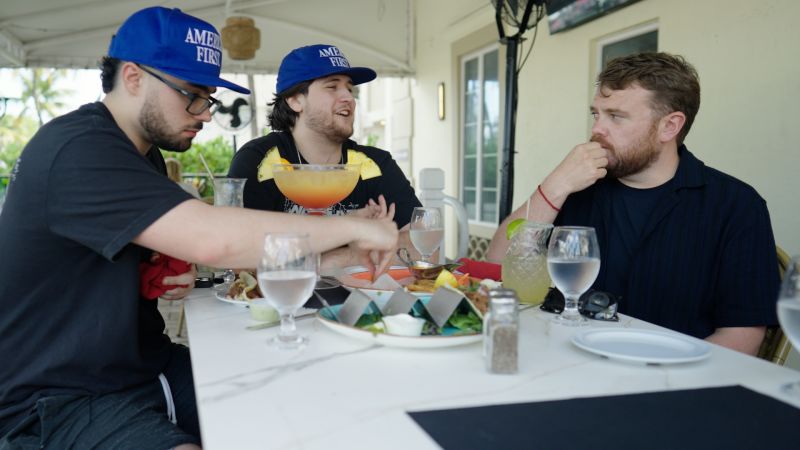
From the jail cell, Luke later spoke to his brother on a phone call that was released by law enforcement. “It was just a f**king joke on the internet,” he sighed, echoing the sentiment that his actions were meant to be lighthearted. His friend Rich, 23, shared a similar perspective, grinning as he donned his blue “America First” baseball cap. “It’s all just jokes,” Rich said, reinforcing the idea that the group’s online provocations were not taken seriously by them.
The Rise of the Groypers
Rich and John, both in their early 20s, are part of a growing subgroup known as “groypers”—a term used to describe fans of far-right influencer Nick Fuentes. The label reflects their shared admiration for the content they consume, which often blends conspiracy theories, racial resentment, and cultural critiques. Fuentes, who has gained a massive following on platforms like YouTube, is a Gen Z version of historical figures such as Father Charles Coughlin and Rush Limbaugh. Coughlin used radio to bypass traditional media and spread his nativist, antisemitic messages to millions in the 1930s, while Limbaugh built a media empire by tapping into listeners’ frustrations and grievances.
Fuentes, however, has been banned from major social media platforms like Instagram and Twitter, forcing his fans to maintain alternative accounts. These accounts often circulate clips of his monologues, which are frequently shared across forums and groups. The scale of this activity is so vast that Fuentes’ rhetoric frequently goes viral before the platforms intervene. For Rich and John, this digital strategy is not just a way to stay connected to their favorite content—it’s a method of reclaiming influence in a world they see as increasingly controlled by cancel culture.
“He’s funny,” Rich said, describing Fuentes as a master of modern trolling. “He says the things that might get you canceled.”
Fuentes’ appeal lies in his unapologetic political incorrectness. He speaks openly about his belief that Jews dominate society, that women should be silenced, and that Black people are mostly responsible for systemic issues. As he put it in a 2025 interview, “Jews are running society, women need to shut the f**k up, Blacks need to be imprisoned for the most part, and we would live in paradise, it’s that simple.” This kind of language resonates with a generation that grew up in the shadow of social media’s power to amplify voices and silence others.
Rich and John, like many groypers, navigate this tension between online and offline life. They are not just followers; they are active participants in a community that seeks to redefine norms. While they attend events, date women, and engage in typical youth activities, they also enjoy a different kind of humor—one rooted in provocation. This duality has sparked debates about whether their actions are a harmless form of expression or a sign of deeper ideological commitments.
A Generation in Turmoil
Rich and John came of age during a period of rapid societal change. As teenagers, they saw the rise of Donald Trump, the global pandemic, and the contentious aftermath of the 2020 election. These events upended old assumptions about authority, trust, and social hierarchies. For many young people, the idea of cancel culture seemed like an overreach, a tool used by “the wrong people” to stifle free speech. Fuentes offered a counter-narrative, framing his critiques as a necessary response to this perceived censorship.
His fans argue that he provides a platform for voices that are often marginalized in mainstream discourse. “He’s not afraid to say the things that others won’t,” John said. “That’s what makes him stand out.” This boldness, they claim, is both a strength and a badge of honor. For Rich and John, Fuentes’ content is not just entertainment—it’s a form of rebellion against what they view as an oppressive cultural climate. They see themselves as part of a movement that is reclaiming power and identity in the digital age.
Yet, this perspective has drawn criticism. Some argue that groypers like Luke and his friends are part of a broader trend where online anonymity fuels hatred. Their actions, while defended as jokes, have real-world consequences. The FBI’s case against Luke highlights how far the line can stretch between satire and threat. Still, the groypers insist that their views are rooted in a genuine belief system, one that they see as a reaction to the chaos of recent years.
As the debate continues, the question remains: Are these young men simply using the internet to vent, or are they planting seeds for a more radical future? For now, they remain in the spotlight, their words and actions capturing the complexities of a generation grappling with identity, power, and the ever-present reach of social media.
