
US military leader held rare meeting with senior Cuban military officials near US base at Guantanamo Bay
US military leader held rare meeting with senior Cuban military officials near US base at Guantanamo Bay
High-level dialogue marks shift in diplomatic engagement
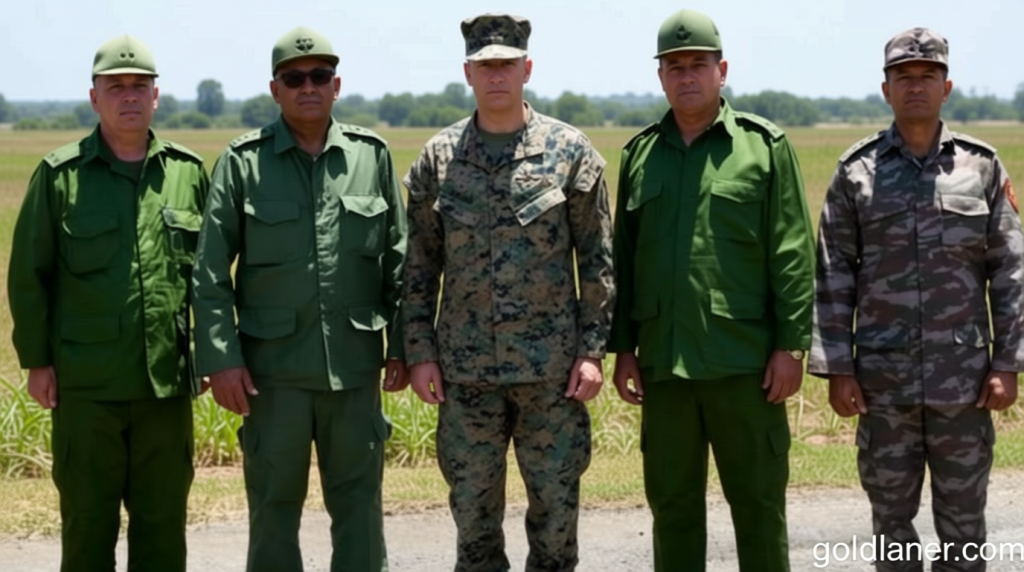
US military leader held rare meeting – On Friday, General Francis Donovan, the head of the US Southern Command, convened a high-level meeting with Cuban military officials at the perimeter of Naval Station Guantanamo Bay, a strategic US military base situated in Cuba’s southeastern region. This encounter, described as rare by SOUTHCOM, focused on operational security discussions, according to the military command. The participants included Cuban Army Corps General Roberto Legrá Sotolongo, who holds the title of Cuba’s first deputy minister of the chief of the general staff, alongside other senior Cuban military representatives.
The Cuban Ministry of Defense issued a statement affirming that the meeting was a constructive exchange. “Both delegations considered the meeting to be positive, where issues related to security around the dividing perimeter of the military enclave were addressed,” the statement noted. It further emphasized that the officials agreed to sustain communication channels between their respective military commands, signaling a potential thaw in bilateral tensions.
This dialogue occurs against a backdrop of heightened US military activity near Cuban territory. The arrival of the USS Nimitz carrier strike group in the Caribbean last week has intensified scrutiny of Cuba’s strategic position. The strike group, a powerful naval unit, includes aircraft carriers, fighter jets, and submarines, raising concerns about the US’s readiness to project force in the region. Such a buildup is seen as a response to recent geopolitical developments, including Cuba’s alleged support for Russian and Chinese interests.
Donovan’s meeting with Cuban officials follows a warning from Cuban President Miguel Díaz-Canel, who recently asserted that a US military assault on the island would lead to a “bloodbath with incalculable consequences.” This statement underscores the growing anxiety in Havana over the potential for conflict, particularly as the US continues its military presence in the area. The dialogue between the two sides appears to be an effort to preempt escalation and establish a framework for cooperation.
The meeting is part of a broader trend of renewed engagement between the US and Cuba. In early May, CIA Director John Ratcliffe had visited Havana for a separate session with Cuban Ministry of the Interior officials and intelligence service leaders. These interactions suggest that both nations are exploring ways to manage their relationship despite lingering hostilities. The Cuban government, however, has maintained that its military cooperation with the US remains limited to specific security concerns.
Historically, “fence line” meetings between US and Cuban military personnel were conducted monthly at Guantanamo Bay. These sessions, held along the base’s perimeter, allowed for direct communication on issues like border security and logistics. However, the Trump administration suspended such meetings during its second term, citing diplomatic tensions and shifting priorities. The resumption of high-level talks now marks a departure from that policy, with the Biden administration prioritizing dialogue to stabilize the region.
Donovan’s visit also included a perimeter security assessment, during which he reviewed the military installation’s defenses with base officials. The discussion covered force protection strategies, the safety of service members and their families, and the readiness of US forces in the area. This focus on security aligns with broader concerns about Cuba’s role in hosting foreign listening posts, a charge the US has leveled repeatedly in recent months.
According to CNN, the US has accused Cuban officials of allowing Russian and Chinese military installations to operate on the island, potentially undermining American interests in the Caribbean. These allegations have been used to justify increased economic and legal pressure on Cuba. In addition to a persistent oil embargo, which has exacerbated the island’s economic crisis, the US has imposed sanctions targeting Cuba’s intelligence agency and interior ministry. The Justice Department’s recent indictment of former Cuban President Raúl Castro further highlights the administration’s hardline stance.
The indictment of Castro, who led Cuba for over 15 years, is part of a long-standing prosecution that has been in progress for decades. The charges include allegations of corruption, human rights abuses, and collusion with foreign entities. While Castro’s tenure saw significant diplomatic challenges with the US, his successor, President Díaz-Canel, has faced mounting pressure to address economic instability. The oil blockade, implemented in January, has been particularly devastating, leading to widespread power outages, food shortages, and fuel rationing.
Despite these adversities, the Cuban government has continued to assert its sovereignty and resistance to US influence. The recent meeting with Donovan is seen by some analysts as a tactical move to ease tensions while maintaining a firm position on key issues. The US, meanwhile, has framed the dialogue as a demonstration of its commitment to regional security, even as it tightens its grip through sanctions.
Experts note that the resurgence of military talks between the US and Cuba reflects a delicate balance between diplomacy and defense. While the Cuban government has historically viewed the US as a threat, it has also recognized the need to engage with American forces to prevent direct confrontation. The fence line meetings, once a routine fixture, had been a symbol of the two nations’ strained relationship, but their resumption signals a shift toward more collaborative engagement.
The meeting’s timing is significant, as it follows a series of diplomatic and military maneuvers in the region. The presence of the USS Nimitz, combined with the US’s renewed interest in Cuba’s security infrastructure, has raised questions about the potential for a broader military alliance. Meanwhile, Cuban officials have sought to reassure their counterparts that the base’s perimeter remains a focal point for mutual cooperation.
Secretary of State Marco Rubio has indicated that the administration is prepared to escalate its pressure on Cuba. “Additional sanctions actions can be expected in the following days and weeks,” he stated, highlighting the ongoing strategy to isolate the island economically. However, the recent dialogue with Donovan suggests that the US may be testing the waters for a more nuanced approach, one that combines firmness with openness.
As the situation evolves, the meeting near Guantanamo Bay has become a flashpoint for examining the complex dynamics between the two nations. While the US seeks to strengthen its strategic foothold, Cuba aims to preserve its autonomy and resist external control. The outcome of this engagement will likely shape future interactions, influencing the trajectory of US-Cuba relations in the coming months.
This story has been updated with additional information. CNN’s Patrick Oppmann contributed to this report.
