
Australians think this place is boring. Here’s why you should visit anyway
Australians think this place is boring. Here’s why you should visit anyway
Australians think this place is boring – Canberra, Australia’s capital, has long been viewed as a less exciting destination compared to its coastal counterparts. While Sydney and Melbourne draw crowds with their vibrant cultures and natural attractions, Canberra often fades into the background, regarded by many as a city best suited for school excursions or a trivia answer. Yet, beneath its reputation lies a story of purposeful design, cultural evolution, and a growing sense of community that makes it a compelling destination for those willing to look beyond the surface.
Designed to Resolve a Political Conflict
The capital city was born from a compromise between two rival cities: Sydney, then Australia’s largest and most populous, and Melbourne, which had initially held the seat of power. The Australian Constitution, established in 1901, required the capital to be at least 100 miles away from Sydney to satisfy Melbourne’s claim. This led to the creation of Canberra in 1911, a largely unpopulated stretch of land in rural New South Wales. Known as the “bush capital,” it was intended to symbolize a young nation carving its own identity, free from colonial ties.
At the time, Canberra lacked the allure of coastal cities. It had no opera house, no opal mines, and no immediate connection to the ocean. Its early years were marked by an almost existential purpose—serving as a political center without the amenities of a bustling metropolis. For decades, the city remained a backdrop to government affairs, with few residents and even fewer visitors. Locals, however, have grown accustomed to defending their home against what they describe as an outsider’s bias.
A Unique Architectural Experiment
One of Canberra’s defining features is its architectural vision. In 1912, American architect Walter Burley Griffin won a competition to design the city’s layout, creating a blueprint that emphasized symmetry, green spaces, and a sense of order. His vision was ambitious, aiming to reflect “the ideal of the city of the future.” Central to this plan was Parliament House, a structure designed to avoid overshadowing the skyline. Griffin’s approach was unconventional: the top of a hill was removed, the building constructed, and then the hill was reassembled atop it. This made Parliament House, as local lore suggests, the only place in the world where citizens could literally walk on top of government officials.
Griffin’s design was not just aesthetic. It was a statement of balance and equity, prioritizing the needs of the people over the demands of power. This philosophy shaped the city’s growth over time, particularly during the post-World War II era. As Australia sought to define itself as an independent nation, Canberra became a hub for national institutions, including the National Gallery, the National Library, and the National Zoo. These landmarks, along with the Australian National University (ANU), which opened in 1946, helped solidify its role as a center of learning and culture.
Despite its significance, Canberra has often been seen as a symbol of elitism. Nicholas Brown, author of A History of Canberra and a historian at the Australian National University, notes that the city’s image is frequently tied to “elites and privilege.” Yet, he also highlights its foundational principles of fairness. “The planning of Canberra was based on equity,” Brown explains. “It was meant to ensure that kids had access to good schools, suburbs were thoughtfully laid out, and roads were well-designed.” These ideals, though not always reflected in reality, have become a source of pride for many who call the city home.
A Growing Cultural Hub
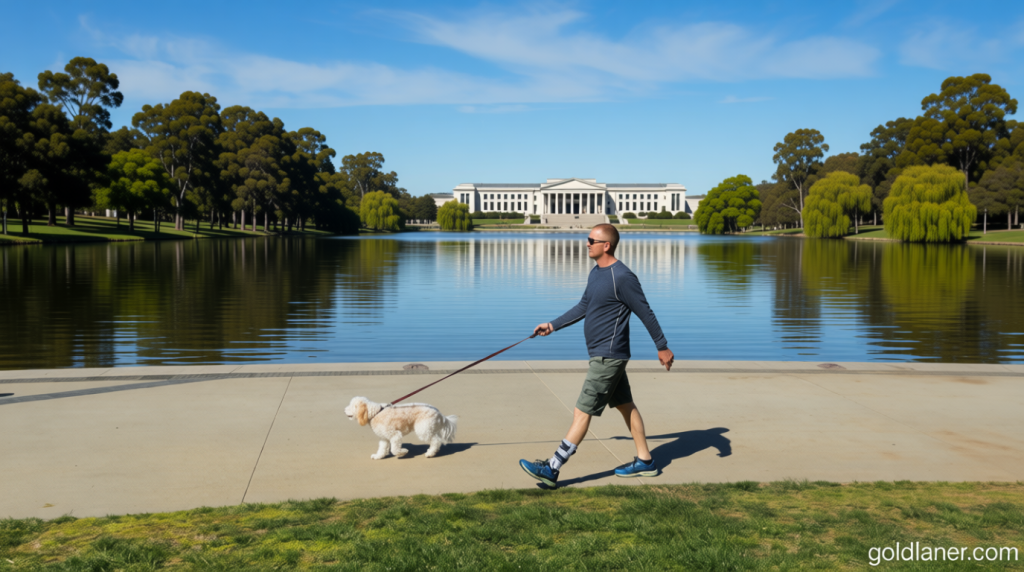
Today, Canberra is evolving into a city that offers more than just politics. It has developed a rich cultural scene, with world-class food, thriving arts, and extensive green spaces. The city’s parks, such as Lake Burley Griffin, provide a stark contrast to the urban bustle of Sydney or Melbourne, offering a serene escape for residents and visitors alike. Its cafes and restaurants now cater to a diverse crowd, including those who enjoy the quirky trend of dogs in strollers accompanying their owners through bustling streets.
Canberra’s charm is also evident in its unique urban culture. Saturday afternoons bring out locals for the farmers’ market, where fresh produce and handmade crafts take center stage. Street art has become a common sight, reflecting the city’s dynamic and creative spirit. Even its iconic round cement bus shelters have found a place in the hearts of Canberrans, serving as a symbol of the city’s identity. These elements, combined with the city’s growing sense of community, have begun to shift its image from a place of “daggy” monotony to a destination worth exploring.
Pop Canberra: A Symbol of Local Pride
Canberra’s rebranding efforts have found an unexpected ally in Pop Canberra, a bright yellow retail space on Lonsdale Road. This store is more than just a market—it’s a cultural statement. Its design and merchandise celebrate the city’s resilience and charm, particularly through items like “Canberra thinks you’re boring” drink coasters and pencil cups shaped like the iconic round bus shelters. Founder Gabe Trew tells CNN that these branded products resonate deeply with locals, who are increasingly proud of their city’s quirks.
“The story of Canberra is like the story of Washington DC or Brasilia,” says Brown. “It’s an artificially planned city placed in the middle of nowhere, which makes it hard to sell.” However, the city’s ability to adapt and thrive has been remarkable. As its population has grown, so too has its appeal. What was once a political compromise is now a place where people not only work but also live, love, and build a lasting connection to their surroundings.
While some Australians still avoid Canberra, its unique blend of purposeful planning, cultural depth, and community spirit makes it a destination worth considering. From its history as a “bush capital” to its modern identity as a hub of innovation and creativity, the city offers a perspective that is both nostalgic and forward-thinking. Whether it’s the stunning architecture of Parliament House, the vibrant local markets, or the subtle irony of a city that has turned its perceived blandness into a badge of honor, Canberra is proving that not all capitals need to be flashy to be fascinating.
For those open to discovering a city that is as much about its journey as it is about its destination, Canberra is a place that rewards curiosity. Its streets may lack the immediate glamour of a coastal metropolis, but they are rich with stories of resilience, design, and community. As its reputation grows, so does the likelihood that even the most skeptical visitors will find themselves intrigued by the capital that once seemed so unremarkable.
