
New York’s hottest club is the street outside Madison Square Garden
New York’s hottest club is the street outside Madison Square Garden
New York s hottest club is – On a sweltering evening in mid-May, a burly man in a tailored suit stood near the entrance of Madison Square Garden, his presence a silent testament to the fervor of the crowd. The heat was unusually intense for the season, but his gear—ear piece, badge, and walkie-talkie—was more than just professional attire. He embodied the role of a gatekeeper, a figure who watched over the chaotic energy of fans eager to witness the New York Knicks’ bid for a playoff victory. His stoic stance, facing away from the throng of ecstatic supporters, suggested a deeper mission: to remind skeptics of the team’s recent resurgence while guarding the line between those who had access to the game and those who had to wait outside.
A crowd beyond the barricade
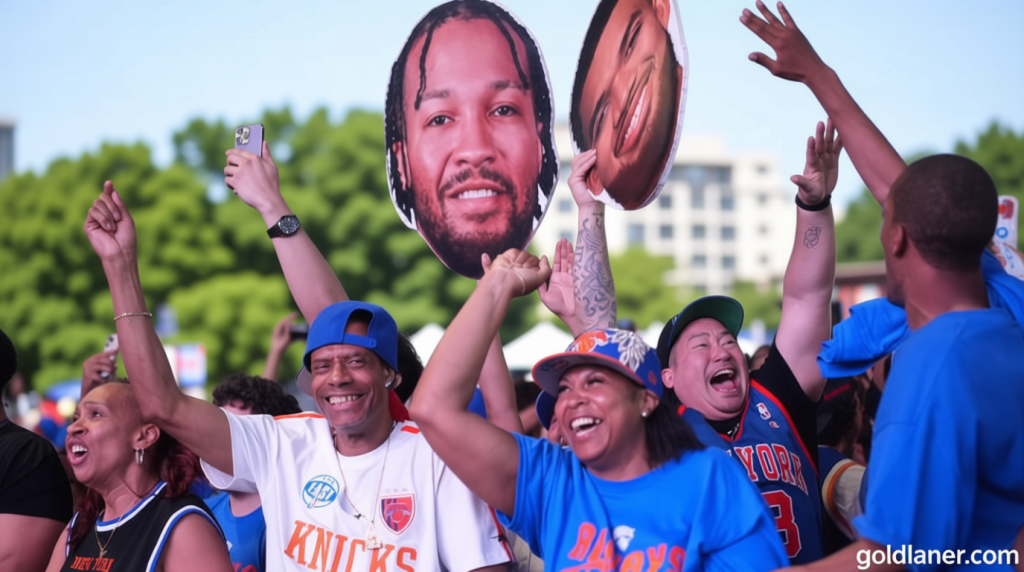
Inside the arena, the Knicks were locked in a thrilling battle to reclaim the first game of the Eastern Conference Finals. Yet, just beyond the temporary barriers that divided the city block, the streets of New York transformed into a makeshift arena of their own. Fans, unable to secure pricey tickets, gathered in front of two massive screens erected to stream the action live. The sidewalks became a mosaic of blue and orange, with cheers echoing louder than the traffic around them. But the scene was far from seamless—crowds jostled, climbed over one another, and competed for prime viewing spots, their excitement palpable even in the oppressive heat.
The watch party, though free to enter, was a high-stakes environment. To get close to the screens, fans had to navigate a maze of temporary barriers, often fending off others who tried to push their way through. The NYPD’s presence ensured order, but it also created a sense of exclusivity. Some entrepreneurs, stationed just outside the perimeter, capitalized on the desperation by selling vibrant plastic bottles of homemade drinks. The flavors were as bold as the crowd’s anticipation—sample offerings included the signature Blue Hawaii, a nod to the island-themed energy of the event.
Yet the real test of loyalty wasn’t just about proximity to the screens. It was about endurance. Once fans left the watch party, they couldn’t return—unless the officers at the gates had flawless memory of faces. This exclusionary rule added a layer of tension, as those on the outside relied on the visual and auditory cues of the game to feel connected. The security official, a steady presence amid the chaos, seemed to embody the stakes of the moment. As the Knicks fell behind by 22 points in the fourth quarter, he addressed the restless masses with a message that resonated through the humid air: “You should have had faith.”
“You should have had faith,” the security official pronounced dispassionately to the desperate throngs who had departed the watch party as the Knicks fell behind by 22 points, right before a furious comeback led to a win in the opening game of the Eastern Conference Finals.
The phrase was a sharp critique, underscoring the disparity between expectation and reality. For those outside the barricade, the Knicks’ early struggles felt like a betrayal. But for those inside, the game had become a shared experience, a communal pulse that transcended individual disappointment. The watch party, in its strange blend of anticipation and frustration, served as a microcosm of New York’s relationship with its basketball team. It was a space where the city’s pride clashed with its practicality, where the thrill of the game was amplified by the effort required to access it.
A test of commitment
The logistics of the watch party were as rigid as the Knicks’ playoff schedule. An hour-and-a-half before tip-off, the area opened to the public, but the rules were clear: no alcohol, no restrooms, and no easy way to escape the heat. Fans who braved the conditions were rewarded with a front-row view of the action, but at a cost. Some, like a group of friends, resorted to buying Saratoga water from an upscale sushi and steakhouse nearby, spending $50 for a single bottle to stay hydrated in the sweltering streets. Others, however, were more driven by the Knicks’ performance than by thirst.
The team’s late-game rally, fueled by a nine-day break between series, had transformed their fortunes. After sweeping the 76ers in the previous round, the Knicks had built a reputation for dominance, their playoff run a source of pride for fans who had long waited for such a moment. But the skepticism lingered, especially after the opening game of the Eastern Conference Finals. The Knicks’ sloppy play in the first half had left some fans questioning whether the team’s recent confidence was justified. The crowd’s reaction to the game’s early struggles was a reminder that even in New York, faith is a fragile thing.
As the game progressed, the energy outside the arena became a living entity. Hype teams handed out Thunder Stick-esque inflatables, their rhythmic waving a coordinated effort to drown out the opposing Cavaliers during free throws. The chants, though spontaneous, were meticulously timed, a blend of raw passion and strategic intent. It was a far cry from the controlled atmosphere of the stadium, where the Knicks’ postseason offense, now led by Karl-Anthony Towns, had started to click. Coach Mike Brown, once seen as a stabilizing force, had seemingly fine-tuned the team’s approach, giving fans a reason to believe in a long-dormant franchise.
The Knicks’ victory in Game 1 marked a turning point, but the story of the night wasn’t just about the game. It was about the city itself—a place where fans could pay $50 for water or endure the heat for a chance to witness history. The streets outside Madison Square Garden became a symbol of both hope and hardship, a testament to the Knicks’ place in the heart of New York. Whether they could sustain this momentum remained to be seen, but for one night, the city had found its rhythm, united by the promise of a comeback that defied the odds.
CNN’s Don Riddell reported on the scene, capturing the essence of a city that had long learned to live with uncertainty. The watch party, with its blend of camaraderie and competition, was more than just a gathering—it was a ritual, a reminder that even in the face of adversity, the Knicks had become a beacon of possibility for New Yorkers. The streets may have been the unofficial venue, but the spirit of the game was unmistakable, echoing through the city like a rallying cry. And as the clock ticked down, the question lingered: Could this momentum carry them through the rest of the playoffs, or would the faith of the crowd be tested once again?
