
A total lunar eclipse is turning the moon red. Here’s how to watch
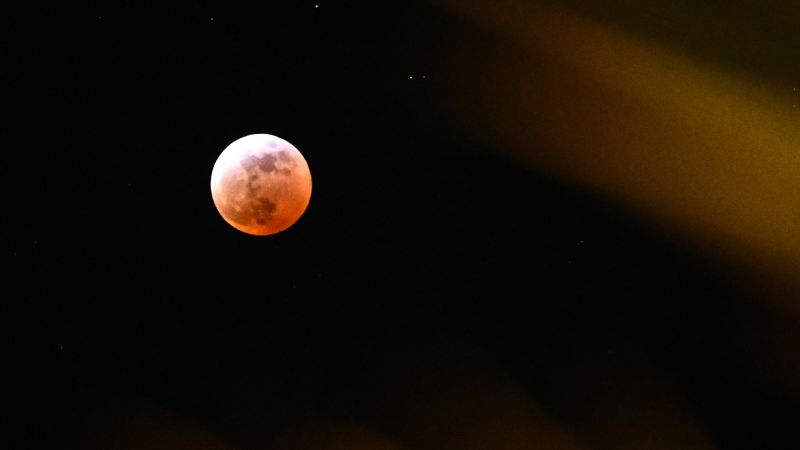
A Total Lunar Eclipse Turns the Moon Crimson – Here’s How to Observe
This Tuesday, a total lunar eclipse will cast the moon in a deep reddish hue, visible across Asia, Australia, the Pacific Islands, and the Americas. NASA explains that this phenomenon, commonly known as a blood moon, happens when Earth aligns between the sun and the moon, blocking sunlight and coloring the moon in shades of crimson. The event marks the final in a series of three consecutive total lunar eclipses, as noted by Dr. C. Alex Young, associate director for science communication at NASA’s Goddard Space Flight Center in Greenbelt, Maryland.
The Eclipse Sequence
The sequence begins with a penumbral lunar eclipse at 3:44 a.m. ET, where the moon passes through Earth’s outer shadow, causing a subtle dimming. This is followed by a partial eclipse starting at 4:50 a.m. ET, during which the full moon is partially obscured by Earth’s shadow. The total eclipse, the most visually striking phase, will begin at 6:04 a.m. ET. At its peak, around 6:34 a.m. ET, the moon will display the most intense red color. “If you only have time to observe one stage, this is the highlight,” Young emphasized.
“Even without specialized equipment, the event is a spectacle worth watching. Simply step outside and gaze upward,” Dr. Young said.
The total phase will last until 7:03 a.m. ET, after which the moon gradually exits Earth’s shadow, followed by a partial eclipse and another penumbral phase. The entire event concludes at 9:23 a.m. ET. For precise timing based on your location, visit Time and Date’s website.
Names of the March Full Moon
While this eclipse is the focus, the March full moon has historical names rooted in cultural and natural observations. The Farmers’ Almanac highlights that the moon is sometimes called the “worm moon,” referencing the emergence of worms as spring begins. Other names include “snow crust moon” or “hard crust on the snow moon,” used by Ojibwe tribes near the Great Lakes, which alludes to snow thawing during the day and refreezing at night. The term “sore eye moon” is also used by Native American tribes like the Sioux and Lakota, stemming from the glare of sunlight on snow causing eye strain.
Future Eclipse Events
Looking ahead, the next total lunar eclipse will not occur until December 31, 2028. Meanwhile, this year’s second eclipse season will begin with a total solar eclipse on August 12, visible in Greenland, Iceland, Spain, Russia, and parts of Portugal. A partial solar eclipse will also be observable in Europe, Africa, and North America. Young noted that eclipses often occur in pairs or trios, with lunar eclipses typically preceding solar ones by about two weeks. The following lunar eclipses will take place on August 27 and 28, 2027.
Additionally, 2026 will feature a unique occurrence with two full moons in May, totaling 13 for the year. This is due to the moon’s 29.5-day cycle overlapping with months longer than that, leading to the blue moon phenomenon roughly every 2.5 years. The remaining full moons of 2026 include:
- April 1: Pink moon
- May 1: Flower moon
- May 31: Blue moon
- June 29: Strawberry moon
- July 29: Buck moon
- August 28: Sturgeon moon
- September 26: Harvest moon
- October 26: Hunter’s moon
- November 24: Beaver moon
- December 23: Cold moon
