
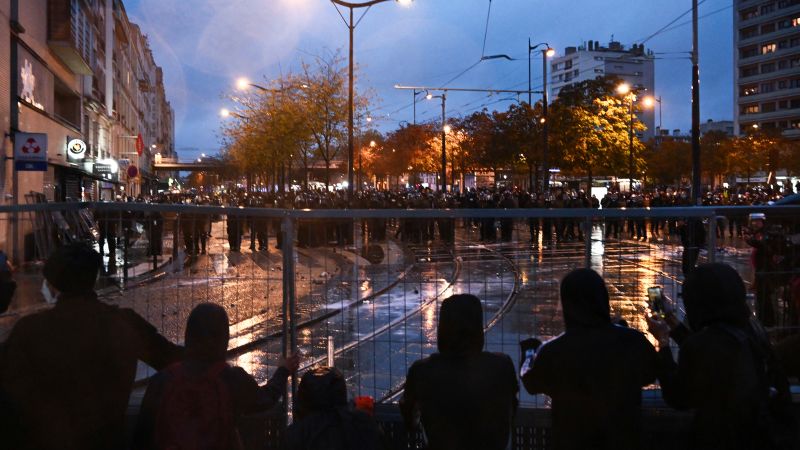
France Mobilizes Massive Security Operation as Protests Return Nationwide
Goldlaner.com – France faced a second consecutive weekend of large-scale demonstrations on Saturday, with more than 410,000 people joining marches across the country and security forces making nearly 1,000 detentions.
The Interior Ministry put the turnout in Paris at about 110,000 people, close to the size of the capital’s demonstrations the previous weekend. While many of the marches remained calm, confrontations, scattered looting and property damage emerged in several cities as authorities deployed an extensive security presence.
Protesters have voiced demands ranging from stronger support for public education to improved prospects for younger workers and action on rapidly rising living costs. The movement has also intensified political pressure on President Emmanuel Macron’s government ahead of a threatened nationwide work stoppage.
Detentions Rise Despite Fewer Serious Incidents
Interior Minister Laurent Nuñez said nearly 1,000 people were detained during Saturday’s protests, a significant increase from the 385 detentions recorded during the previous weekend’s demonstrations.
“In Paris, we had a major demonstration that took place peacefully, like most protest marches across the entire country,” Nuñez told reporters.
Nuñez said police had stopped groups from holding unauthorized mobile protests or moving toward city centers. He described business damage and looting as limited in scale, and said such incidents were markedly below the level seen a week earlier.
There were no targeted attacks on town halls, police stations or similar public buildings, he said, contrasting Saturday’s events with unrest during the earlier protests. Still, he described the violence directed at security personnel as unusually intense, citing repeated projectile throwing and the use of mortar-style fireworks.
“They were prevented from staging unauthorized roving protests or heading toward city centers.”
Security personnel were expected to remain in place until late Saturday to deter further looting. Authorities had mobilized roughly 70,000 police officers nationwide for the day’s operations.
Police Use Tear Gas and Water Cannons in Paris
French authorities prepared for the demonstrations with specialist tactical units, helicopters, armored vehicles, police dogs and water cannons. The scale of the deployment reflected concern after more than half a million people participated in protests across France the previous Saturday.
In Paris, the central march passed peacefully through the city before tensions developed at Porte de Vincennes, where the demonstration ended. Several thousand people confronted police there, and officers used tear gas and a water cannon to hold the crowd back.
The episode highlighted the challenge facing authorities: maintaining space for the vast majority of participants to demonstrate while preventing smaller groups from turning large gatherings into more volatile confrontations.
Unrest Reported in Marseille, Bordeaux and Nice
In Marseille, France’s second-largest city, protesters fired mortar fireworks toward police during running clashes in the streets. Looting was reported in several areas, including at a jewelry store where windows were broken and at a supermarket that was pillaged.
In Bordeaux, images from Place de la Bourse showed tear gas spreading across the well-known square. Masked individuals were seen throwing objects toward police as officers moved to disperse parts of the crowd.
Separate violence was reported in Nice, where dozens of far-right activists attacked people who had been taking part in a peaceful protest. The incidents underscored how demonstrations involving broad social and economic grievances can also attract groups with sharply different political agendas.
Threat of a November 5 General Strike
Jean-Luc Mélenchon, leader of the far-left La France Insoumise party, said national industrial action could follow if Macron does not address protesters’ demands. Speaking from the Paris demonstration, Mélenchon pointed to a general strike called by the CGT union for November 5.
“A general strike, called by the CGT, looms over the government for the 5th of November,” he said.
A strike of that scale could widen the political consequences of the street protests, shifting pressure from weekend marches to workplaces and public services. For the government, the immediate task is likely to remain balancing security concerns with the underlying anger over economic pressure, youth employment and investment in education.
Demonstrations Spread Beyond France
Anti-government protests were also held in several other European countries on Saturday. In Naples, Rome and Milan, businesses boarded up windows before planned demonstrations after earlier unrest had included looting.
In Tirana, Albania’s capital, protesters set dumpsters on fire and threw stones and tear-gas canisters. Students in Brussels displayed placards and erected street barricades, prompting police to deploy a water cannon.
The events across Europe showed that France’s unrest was unfolding amid a wider period of political frustration and public demonstrations. In France, however, the size of the crowds, the large police deployment and the prospect of a November 5 strike mean the coming days may determine whether the movement retains its mainly peaceful character or develops into a more disruptive national challenge.
Related Reading
Frequently Asked Questions
What is France sees another weekend of mass?
France sees another weekend of mass is the main topic of this guide. The article explains the context, practical details, and next steps readers should understand.
Why does France sees another weekend of mass matter?
France sees another weekend of mass matters because readers are looking for a useful answer, not just a short summary. Good content should match search intent and help them decide what to do next.