
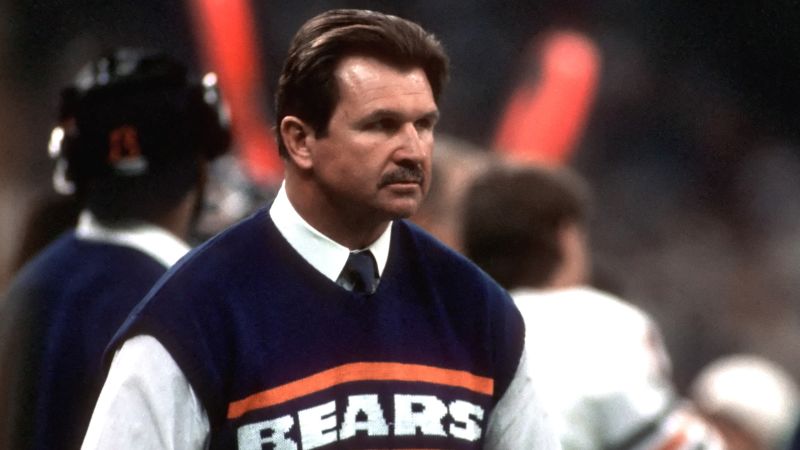
Mike Ditka, Chicago Bears Icon and Super Bowl-Winning Coach, Dies at 86
Goldlaner.com – Mike Ditka, the hard-driving football figure whose identity became inseparable from the Chicago Bears, has died at age 86. His family announced his death Friday, honoring a man celebrated nationally for his achievements in football and cherished privately as a husband, father, grandfather and friend.
“It is with profound sadness that we announce the passing of our beloved husband, father, grandfather, and friend, Mike Ditka,” the family said. “While the world knew Mike as a Hall of Fame football player, legendary coach, and leader of the Chicago Bears’ Super Bowl XX championship team, we knew him as the heart of our family. Mike will be missed beyond measure and remembered forever.”
To generations of Bears supporters, Ditka was “Da Coach,” the fierce, gravel-voiced leader of the unforgettable 1985 team. He was also much more than a coach: an elite player, a pioneering tight end, a television personality, restaurant owner, spokesman and outspoken advocate for better medical and retirement support for former NFL players.
A player who reshaped the tight end role
Born in Carnegie, Pennsylvania, Ditka was the son of a welder who had changed the family surname from Dyczko. He grew up in nearby Aliquippa, a western Pennsylvania community surrounded by coal and steel industries. A gifted athlete in three sports, he became an All-American at the University of Pittsburgh.
His physical approach earned him the nickname “Iron Mike,” a description that followed him throughout his career. The Chicago Bears selected him fifth overall in the 1961 NFL draft, with owner George Halas making the choice. Ditka quickly made an impact, earning Rookie of the Year recognition, appearing in multiple Pro Bowls and helping Chicago win the 1963 NFL Championship.
Alongside Baltimore’s John Mackey, Ditka helped change expectations for tight ends and the offenses built around them. He could overpower defenders as a blocker, but he also possessed the speed and receiving ability to turn shorter throws into long gains or outrun defensive backs downfield. That combination made the position a more central weapon in the passing game.
After leaving Chicago in 1966, Ditka played for Philadelphia and then Dallas. His connection with the Cowboys would shape the next stage of his career. In 1973, he joined Tom Landry’s coaching staff and spent eight seasons as an assistant under the revered Dallas coach.
Return to Chicago and the rise of “Da Coach”
Ditka returned to Chicago as head coach in 1982, arriving with a bold promise and an uncompromising manner. His decade with the Bears was eventful, producing five consecutive NFC Central titles, a championship season, public conflicts, health troubles and a lasting bond with the city.
Hall of Fame linebacker Mike Singletary later recalled the force of Ditka’s first meeting with the team. Ditka laid out a three-year plan to reach the Super Bowl and made clear that not everyone in the room would remain part of it.
“When I first heard him when he walked in the room, to me Coach Ditka had the opportunity to be the greatest coach of all time because he had the fire,” Singletary said during the Bears’ 100th anniversary celebration in June 2019. “I don’t know George Halas coached. But I can imagine that the fire and intensity and passion that Coach Ditka exuded that first day set the tone for exactly what he said: ‘Three years from now, we’re going to be in the Super Bowl.’ And that was 1982. In ’85, we were there and it was because of that vision.”
The 1985 Bears fulfilled that prediction in spectacular fashion. Their defense is widely regarded as one of the most dominant units the game has seen, while the roster’s larger-than-life personalities made the club a cultural phenomenon. Before the championship game, players released “The Super Bowl Shuffle,” a rap-style video that turned their confidence into a national spectacle.
Three months later, the Bears supported the bravado with a Super Bowl XX victory. The team’s mix of elite defense, confidence and showmanship helped establish its place among the most memorable champions in NFL history.
A turbulent but unforgettable coaching era
Ditka’s Bears tenure was not defined solely by victories. He was convicted of DUI, suffered a heart attack and engaged in a prolonged feud with defensive coordinator Buddy Ryan. Those clashes became part of the lore surrounding a team that often seemed to operate at maximum intensity both on and off the field.
Yet Ditka embraced the unusual energy of that group. He once described the 1985 Bears as far more than a conventional roster.
“It was more than a team,” Ditka once said. “It was a team of characters that had character that played for a crazy man, who let him be crazy and had fun doing it and don’t apologize for it ever. I wouldn’t want to be one of these suits walking around on the sideline today.
“I have no desire to be that. I was what I was and they were what they were and, damn, it was fun.”
That directness was central to his public image. Ditka was known for his demanding style, his blunt opinions and his refusal to soften his football persona. Chicago embraced those qualities, seeing in him a coach whose toughness reflected the identity the franchise wanted to project.
A legacy preserved in Canton and Chicago
Ditka earned enshrinement in both the College Football Hall of Fame and the Pro Football Hall of Fame, recognition of a career that succeeded at the highest levels as both a player and coach. In 2013, the Bears announced that his No. 89 would be the last jersey number retired by the organization.
His influence extended beyond game days. In retirement, he remained visible through business ventures, endorsements and broadcasting, while also speaking forcefully on behalf of retired players seeking stronger health care and pension benefits.
For Chicago, Ditka’s legacy will remain tied most closely to a team that turned a season into enduring civic mythology. The coach, the 1985 Bears and the image of “Da Coach” on the sideline became lasting symbols of a franchise at its most forceful and unforgettable.
Related Reading
Frequently Asked Questions
What is Mike Ditka the quintessential Chicago Bear?
Mike Ditka the quintessential Chicago Bear is the main topic of this guide. The article explains the context, practical details, and next steps readers should understand.
Why does Mike Ditka the quintessential Chicago Bear matter?
Mike Ditka the quintessential Chicago Bear matters because readers are looking for a useful answer, not just a short summary. Good content should match search intent and help them decide what to do next.