
Paris Fashion Week Brings Big Ideas, Big Houses and Unusual Silhouettes
Goldlaner.com – Paris Fashion Week is moving through its busiest stretch, with celebrity-packed crowds outside venues and a packed calendar of presentations across the French capital. After an opening day shaped by newer voices, the week quickly shifted into higher gear as major labels unveiled elaborate productions and sharply defined collections.
Rihanna has been among the high-profile names drawing attention, while fans have gathered outside show spaces to catch a glimpse of their favorite stars. Inside, designers have been using the runway to test ideas about beauty, function, fantasy and the changing shape of everyday clothing.
Emerging Designers Set an Early Tone
Monday placed attention on a group of younger talents, including the creative pair behind Matières Fécales, Swedish designer Ellen Hodakova Larsson and LVMH Prize winner Julie Kegels. Their presentations established an intellectually charged opening to the week, before Dior and Saint Laurent brought the scale and spectacle associated with Paris’s largest fashion houses on Tuesday.
The contrast is part of what makes the schedule compelling. Established brands can command vast productions, but smaller labels often offer some of the week’s most surprising proposals. Together, they create a broad picture of fashion at a moment when designers are reconsidering familiar ideas of polish, proportion and desirability.
Maison Margiela Finds Beauty in Disruption
Maison Margiela continued its rule-breaking approach under designer Glenn Martens. The show unfolded against fading flowers, whose presence added a faintly offbeat atmosphere to the setting. Floral motifs on clothing pushed against the flower-filled backdrop rather than blending neatly into it.
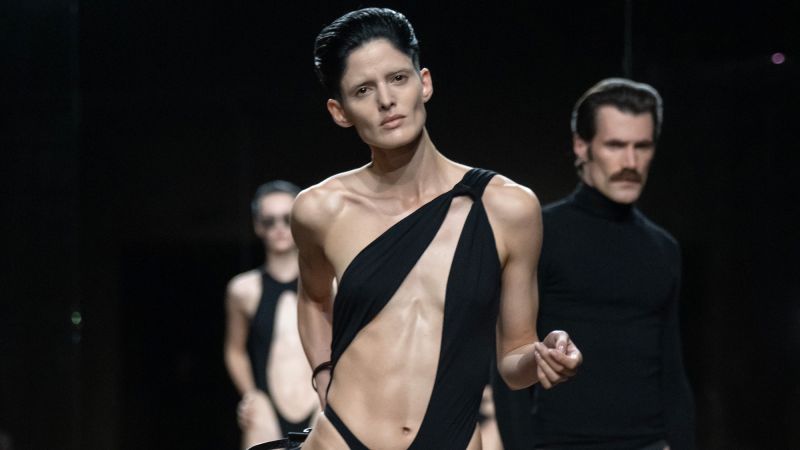
The collection included knee-high boots without toes, sharply formed blazers and shirts cut away to expose and open the chest. The effect was deliberately unsettling at times, but the clothes also demonstrated Martens’s interest in challenging conventional notions of what should be considered elegant or beautiful.
Maison Margiela has long been associated with experimentation, including its instantly recognizable tabi footwear. This latest outing extended that spirit through pieces that treated clothing less as a fixed uniform and more as a space for distortion, exposure and unexpected construction.
Rick Owens Turns the Runway Into Another World
At Rick Owens, the distinctive sloping runway begins high at the Palais de Tokyo before cutting across the fountain below. The setting already gives models the appearance of arriving from somewhere beyond the ordinary city landscape. On Thursday, that otherworldly mood became even stronger.
Owens sent out prismatic tentacle-like dresses made with tulle edging threaded through elastic cords. As the models moved, the cords sprang and shifted around the body, creating a sense of motion that was inseparable from the garments themselves. The collection made the runway feel less like a conventional fashion presentation and more like a futuristic performance.
Issey Miyake Uses Air as a Design Material
Satoshi Kondo, who has led Issey Miyake’s womenswear design since 2019, approached Friday’s collection with an expansive question: can clothing do more than follow the body, and can it use the air surrounding the wearer to create its own appeal?
The presentation opened with a five-minute interpretive dance choreographed by Tess Voelker. Voelker and her dancers worked with a huge expanse of pink material that expanded dramatically when it caught the air, then collapsed as they guided it back down. The performance offered a visual introduction to the collection’s interest in volume, movement and lightness.
That concept came into focus in the final three looks: two exceptionally light jackets and a skirt made from nylon yarn. A drawstring at the hem allowed the pieces to catch passing air like a sail. The proposal was both theatrical and practical in spirit, suggesting that an everyday trip through the city might become part of the garment’s design.
Balenciaga’s New Direction Continues
Pierpaolo Piccioli’s Balenciaga has now been developing for more than a year, and its vivid mood remains markedly different from Demna’s frequently sardonic and satirical take on the house. Piccioli’s latest collection included acid-bright City Bags, large cummerbunds, capes and inflatable flowers formed into neck braces.
One seemingly simple item captured the change especially clearly. A loose, box-shaped rose-colored shirt, close in tone to the pink associated with Piccioli’s Valentino years, appeared at first to be a straightforward office-ready button-down. It had turned-up cuffs and a chest pocket. When the model turned, however, the shirt revealed an integrated hood.
The shirt-and-hoodie hybrid had existed in Demna-era Balenciaga as well, though in much darker shades. Recasting the idea in a brighter color demonstrated how familiar product categories can take on a very different personality when filtered through a new creative vision.
Chloé Revisits Its Own Archive
Chemena Kamali’s work at Chloé has been informed by an ongoing fascination with the label she has led for three years. Her research into its archive has produced several personal touchstones, including the 1972 “Noel” suit originally created by Karl Lagerfeld. For Thursday’s collection, she reimagined its tailoring and paired it with frilled lingerie harnesses.
Another source of inspiration came from Chloé raincoats of the 1950s. That reference led to some of the collection’s strongest looks: transparent vinyl macs in pink and smoky gray, finished with flowing Inverness capes. They were layered over trench coats and decorative dresses, making outerwear central to the look rather than merely protective.
Scarlet and classic yellow rain slickers added a more robust counterpoint, each accompanied by an oversized sou’wester hat. Yet the styling remained firmly fashion-focused: models wore slingback pumps instead of rain boots, turning familiar wet-weather clothing into something more playful and theatrical.
An Evening Mood at Schiaparelli
Daniel Roseberry transformed a basement space at the Louvre into the setting for a refined jazz club. Black velvet drapery, cream-and-black carpet, chandeliers and softly lit bistro tables established an intimate atmosphere for a collection built around clothes for an evening out.
Across Paris, the week continues to move between grand displays and closely observed details. Some designers are looking backward through archives, while others are making garments behave in entirely new ways. Whether through wind-catching nylon, inflated florals, transparent rainwear or sculptural cords, the strongest collections have made the body feel like only one part of the story.
Related Reading
Frequently Asked Questions
What is Here s what s happening at Paris?
Here s what s happening at Paris is the main topic of this guide. The article explains the context, practical details, and next steps readers should understand.
Why does Here s what s happening at Paris matter?
Here s what s happening at Paris matters because readers are looking for a useful answer, not just a short summary. Good content should match search intent and help them decide what to do next.