
New DNA Analysis Strengthens the Case Linking Thomas Jefferson to Sally Hemings’ Children
Goldlaner.com – A strand of reddish-blond hair found inside a Bible once owned by Thomas Jefferson has helped drive a scientific inquiry that lasted more than a decade and has now produced powerful genetic evidence about one of the most debated relationships in early American history.
Researchers say their work offers the strongest evidence yet that Jefferson, the third US president and a central figure in the country’s founding, fathered at least one child with Sally Hemings, an enslaved woman who lived and worked in his household. Their analysis places the probability of Jefferson being the father of one or more of Hemings’ children at 99.96%.
The investigation and its historical significance are explored in the book History by a Hair: Thomas Jefferson, Sally Hemings & Solving a 200-Year-Old Mystery, written by Richard Kurin, a Smithsonian distinguished scholar and ambassador-at-large. The book was published September 22. Kurin is also the senior author of a scientific paper outlining the genetic methods used in the project. That paper appeared September 21 on the preprint site bioRxiv and has not yet completed peer review.
A Hair Found in an Unexpected Place
The story began in 2011 at the Smithsonian National Museum of American History, where staff opened a Bible associated with Jefferson and found a hair tucked between its pages. The discovery raised the possibility that scientists might finally obtain DNA directly linked to Jefferson rather than relying only on living relatives and broader family-line comparisons.
At first, the hair appeared to be a potentially decisive clue. Scientists tested it against DNA from a living woman descended from Jefferson’s mother through an unbroken maternal line. Because mitochondrial DNA passes through the maternal side of a family, the two samples were expected to share the same maternal genetic profile if the Bible hair had belonged to Jefferson.
They did not match. That result meant the hair hidden in the Bible was not the long-sought direct genetic sample researchers had hoped it would be.
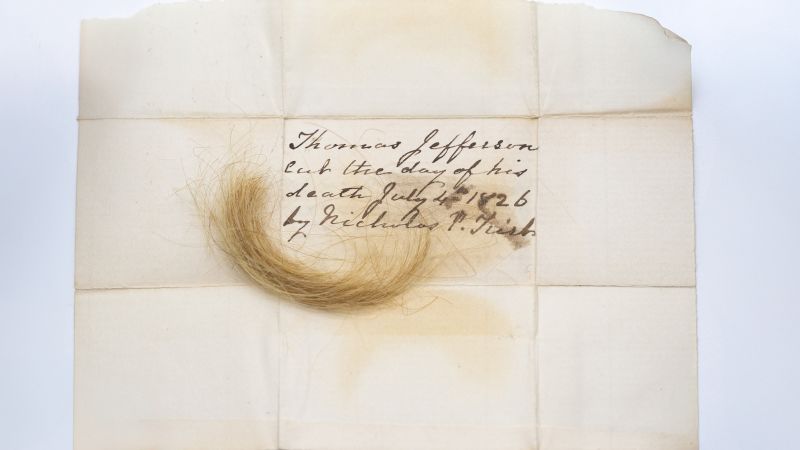
The disappointment did not end the project. Other hairs historically attributed to Jefferson became available for examination, including a lock cut at his deathbed. The Thomas Jefferson Foundation at Monticello supplied a packet containing those samples, which had not previously been open to this type of analysis.
Building a Wider Family Genetic Record
Scientists extracted and reconstructed fragments of historical DNA, then compared them with genetic samples from 16 living people. The study drew on descendants from several branches of the Jefferson and Hemings family trees, including descendants of Jefferson and his wife Martha, Jefferson’s brother Randolph, and Hemings’ sons Eston and Madison.
Hemings had four children who survived into adulthood. Eston and Madison were the two who identified Jefferson as their father. By examining several connected family lines rather than looking for a single shared trait, the researchers were able to compare patterns across much larger portions of the genome.
“What made this study so powerful is that researchers weren’t just comparing two genomes,” said Éadaoin Harney, a senior population geneticist at the 23andMe Research Institute. “Instead, they collected DNA samples from multiple people from different branches of the family tree.”
That broader approach is important because family-history questions can be difficult to resolve through one narrow genetic marker. A result tied to a single paternal line may show that people share an ancestor somewhere within a family, while still leaving open the question of which individual was the parent.
Why the Earlier Evidence Left Doubts
The question of Jefferson’s relationship with Hemings has been examined for generations. A 1998 study led by the late Eugene Foster, a retired pathology professor at Tufts University and the University of Virginia, found a rare Y-chromosome haplotype in male descendants of Jefferson’s uncle and in descendants of Hemings.
That finding was widely viewed as important evidence connecting Hemings’ descendants to the Jefferson male line. Yet it did not settle every question for critics, because the research did not include DNA directly identified as Jefferson’s. A different male relative in the extended Jefferson family could theoretically have shared the same paternal-line marker.
“He didn’t have Thomas Jefferson’s DNA,” Kurin said. “He didn’t have something to directly compare living descendants of the Jefferson family to Madison Hemings and Eston Hemings and others that might have been the descendants of Thomas Jefferson.”
Kurin said the aim of the newer effort was to obtain a more direct basis for comparison. The newly analyzed historical hair samples, combined with the wider set of living descendants, allowed researchers to test the question across many family connections instead of relying solely on a Y-chromosome signature.
What the Findings Mean
The new work does not simply revisit an old historical controversy. It demonstrates how advances in genetic reconstruction can provide evidence where written records are incomplete, contested or shaped by the unequal power structures of their time. The history of Jefferson and Hemings involves both a prominent political leader and an enslaved woman whose life was constrained by the institution of slavery.
DNA cannot by itself describe the personal circumstances of their relationship, the lived experiences of Hemings, or the full story of her family. It can, however, help answer a specific question that has long remained unresolved: whether Jefferson was biologically connected to her descendants.
The study’s reported 99.96% probability is presented as the clearest scientific support to date for the conclusion that Jefferson fathered at least one of Hemings’ children. Because the research paper remains a preprint, its methods and conclusions will still be subject to formal scholarly review. Even so, the work marks a significant development in a historical inquiry that has stretched across more than two centuries.
For descendants, historians and readers trying to understand the human stories behind the founding era, the findings add a new layer of evidence to an account that has long been debated. The result also underscores how objects preserved in museums, including something as small as a lock of hair, can carry information that later generations are finally able to interpret.
Related Reading
Frequently Asked Questions
What is DNA evidence from Thomas Jefferson s hair?
DNA evidence from Thomas Jefferson s hair is the main topic of this guide. The article explains the context, practical details, and next steps readers should understand.
Why does DNA evidence from Thomas Jefferson s hair matter?
DNA evidence from Thomas Jefferson s hair matters because readers are looking for a useful answer, not just a short summary. Good content should match search intent and help them decide what to do next.