
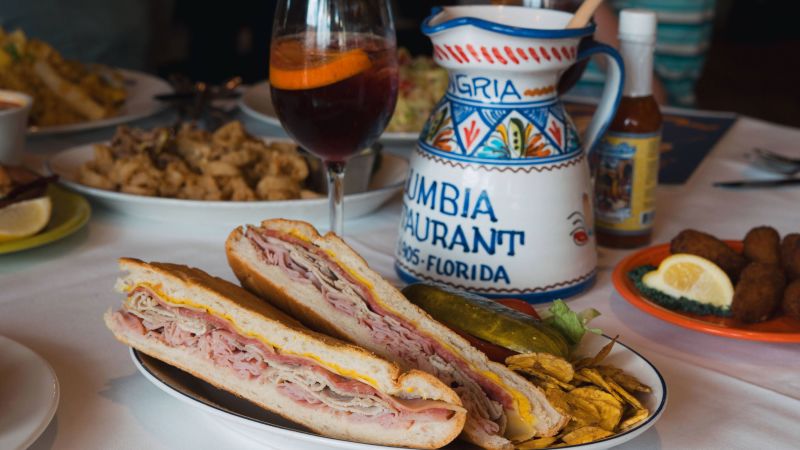
The Cuban Sandwich’s Florida Rivalry Begins in Cuba
Goldlaner.com – In Florida, the Cuban sandwich is more than a pressed lunch. In Tampa and Miami, it carries family memories, immigrant history and a long-running argument over which city best represents it. Both communities have deep Cuban roots, celebrated food traditions and a powerful attachment to the sandwich known in Cuba as the mixto.
The debate is not simply about civic pride. It turns on the bread, the meats and the migration routes that brought Cuban food traditions from the Caribbean to Florida. Tampa commonly includes salami, while Miami’s version is often associated with especially crisp Cuban bread, its crust thin and delicate.
A staple of Tampa gatherings
Andrew Tambuzzo, the Tampa-born owner of The Boozy Pig craft butcher and café, grew up with Cuban sandwiches as part of everyday community life. With Sicilian and Cuban family roots, he remembers seeing them at celebrations as well as moments of mourning.
“As far back as I can remember eating, I’ve been eating Cuban sandwiches in Tampa. They were always there at birthday parties, anniversary parties, funerals,”
Tambuzzo calls his version a mixto, using the sandwich’s original Cuban name. He connects Tampa’s claim to the city’s cigar-industry history, which drew Cuban migrants, and to its longstanding bread tradition.
“I think Tampa is where it all started because of the migration here for the cigar industry. Also, Tampa has the original Cuban bread,”
For him, the sandwich belongs to a larger local food heritage shaped by generations of Tampa purveyors and families.
Miami’s culinary identity
About 280 miles southeast, Miami has an equally personal relationship with the Cuban sandwich. Chef Michelle Bernstein, who owns Café La Trova on Calle Ocho in Little Havana along with other Miami restaurants, recalls eating Cuban sandwiches as a child while her mother shopped at a neighborhood Cuban market and butcher shop.
Bernstein, a James Beard Award-winning chef, remembers being seated at the counter with a Cuban sandwich and banana milkshake. The experience became an early lesson in how food can anchor a sense of place and memory.
“Miami doesn’t just eat the Cuban sandwich, we claim it as ours. It’s an identity. You grow up here and the Cuban sandwich is in your blood the same way café con leche is,”
That feeling helps explain why Miami residents see the sandwich as inseparable from the city’s Cuban-American culture. In Little Havana and beyond, it remains a familiar café order, a quick meal and a link to family routines.
The Sandwich Before the Florida Debate
The strongest historical starting point is Cuba itself, even if the precise moment when the sandwich first reached the United States cannot be firmly established. Bárbara C. Cruz, a Cuban-American professor at the University of South Florida in Tampa and co-author of The Cuban Sandwich: A History in Layers, is clear about the broader origin.
“The Cuban sandwich absolutely has its origins in Cuba,”
In its earlier Cuban form, the sandwich resembled the Spanish bocadillo: bread, cheese and whichever protein was available. Jeff Houck, another co-author of the book, describes it as a flexible food rather than a fixed recipe governed by strict ingredients.
By roughly the end of the 19th century, the sandwich developed into the mixto, meaning “mixed” in Spanish. Its key distinction was the possibility of combining meats, an idea that stood apart from more single-minded sandwiches such as ham, pork or pan con bistec.
Cruz’s research found Havana bakery advertisements for mixtos in historic Cuban newspapers. The sandwich was already recognizable as a mixed creation, but it was not yet bound to the precise standards that fuel modern arguments in Florida.
“From our research, we found that this idea of the mixto really was revolutionary. Up until that time, people would have a ham sandwich, or a pork sandwich, a pan con bistec (steak sandwich),”
A recipe shaped by availability
That early flexibility is important. On the island, a mixto could reflect what was available rather than a formal checklist. Today’s familiar combination of ham, roast pork, Swiss cheese, pickles, mustard and toasted Cuban bread has become iconic, but the older sandwich tradition was more adaptable.
“On the island, it literally was a mixture of whatever they had. There weren’t such strict rules or perceptions of what the sandwich should or shouldn’t have,”
Houck notes that people often ate these sandwiches during nighttime carriage rides. The image offers a useful reminder that the Cuban sandwich began as an accessible, portable meal before it became a regional emblem in the United States.
Why the Argument Endures
The Tampa-Miami disagreement does not erase Cuba’s role; instead, it shows how food changes when people move. Cuban migration brought culinary habits to Florida, where local ingredients, bakeries and communities gave the sandwich distinct regional expressions.
Tampa’s salami addition and Miami’s prized bread texture are not minor details to their respective supporters. They represent different ways of preserving, adapting and celebrating a shared heritage. A sandwich can be both rooted in Cuba and deeply identified with more than one Florida city.
Ultimately, the Cuban sandwich’s layered history resembles the sandwich itself. Cuba supplied the foundation, while Florida communities built their own traditions around it. Whether ordered in Tampa as a mixto or enjoyed in Miami with café con leche, it remains a food story shaped by migration, memory and an enduring appetite for debate.
Related Reading
Frequently Asked Questions
What is Two Florida cities claim the Cuban?
Two Florida cities claim the Cuban is the main topic of this guide. The article explains the context, practical details, and next steps readers should understand.
Why does Two Florida cities claim the Cuban matter?
Two Florida cities claim the Cuban matters because readers are looking for a useful answer, not just a short summary. Good content should match search intent and help them decide what to do next.