
Vulnerable Republicans Seek More Room to Break With Trump as Midterms Near
Goldlaner.com – Republicans facing difficult reelection contests are beginning to show more willingness to diverge from President Donald Trump, a notable shift as control of Congress comes under increasing pressure in the midterm elections.
The movement is appearing in several forms: votes challenging the president’s authority over the conflict with Iran, campaign messaging critical of immigration enforcement, objections to trade decisions and public efforts to protect local interests. The pattern does not mean every Republican is distancing themselves from Trump, but it reflects the strategic calculations confronting candidates in competitive districts and states.
Democrats are expanding their targets beyond traditional battlegrounds and into Republican-friendly territory, including Kansas, Texas and Florida. For GOP candidates who must win over independents, moderate voters and communities concerned about specific economic or local issues, demonstrating independence can become a central part of a campaign’s argument.
Iowa Republicans Back Limits on Iran War Powers
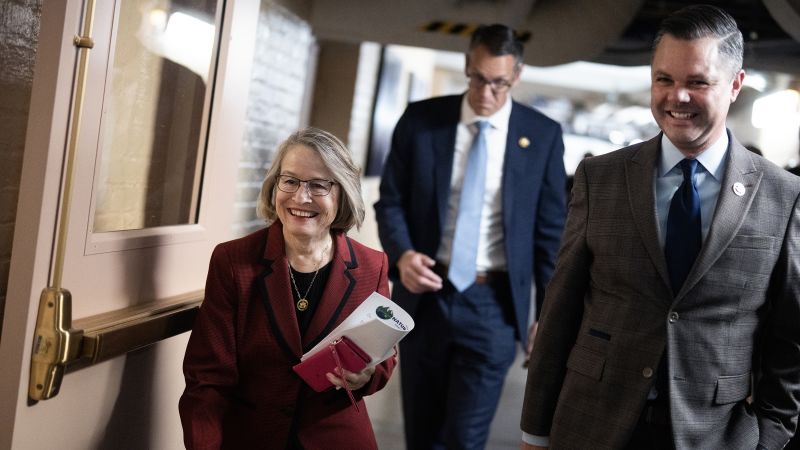
This week, Iowa Reps. Zach Nunn and Mariannette Miller-Meeks voted to curb Trump’s war powers in Iran for the first time. They were among seven House Republicans who supported the resolution, the largest group of GOP lawmakers to do so so far.
Both representatives hold seats that could be closely contested, and their votes underscored how concerns over a prolonged overseas conflict can intersect with domestic political pressures. In statements released after Tuesday’s vote, neither lawmaker named Trump directly, but Miller-Meeks made her position on the consequences of an extended war clear.
“I will not vote to keep our soldiers in an open-ended war, with Iowans paying too much at the pump.”
Higher fuel costs and the prospect of U.S. military involvement without a defined endpoint are issues that can resonate well beyond Washington. By tying foreign policy to household costs, Miller-Meeks framed the vote in terms familiar to voters weighing broader economic concerns.
Trump had not publicly commented on Nunn or Miller-Meeks after their votes. Before voting, Miller-Meeks said the president could understand a decision grounded in principle.
“I think when you do things out of principle, the president certainly understand that.”
Immigration, Trade and Local Projects Create Dividing Lines
Other Republicans have chosen different issues on which to separate themselves from the White House. South Florida Rep. Maria Elvira Salazar released a campaign advertisement arguing that Trump’s immigration enforcement effort had exceeded acceptable limits.
Trump responded Friday that he continued to support Salazar’s reelection, although he disagreed with her criticism.
“She got a little bit soft on the border – I understand that, I understand that – but I just don’t happen to be there.”
The president’s response illustrated the more flexible posture now surrounding some candidates in challenging races. Rather than immediately turning against every Republican who adopts a distinct position, the White House and national party appear focused on preserving a broader electoral coalition.
Natalie Baldassarre, a spokeswoman for the Republican National Committee, said the party remains aligned while recognizing that candidates must tailor their messages to their own contests.
“At the end of the day, we care about winning, and these candidates need to run the races necessary to accomplish that.”
Farm-state Republicans have also pushed back after Trump paused tariffs on foreign beef. The issue carries special weight in agricultural areas, where trade policy can affect producers, consumers and local businesses. For candidates in competitive races, the dispute offers a way to stress their connection to regional economic interests without abandoning the party outright.
Arizona Rep. Juan Ciscomani has similarly highlighted an earlier vote to override Trump’s veto of a water infrastructure measure. During a recent debate, he presented that vote as evidence that he can act independently when the needs of his district are at stake.
“That takes some courage.”
Nunn, meanwhile, said he raised concerns directly with U.S. Trade Representative Jamieson Greer during a private meeting. He also said he discussed those concerns with Trump at a White House dinner for Republicans running in battleground districts.
Texas Border Wall Dispute Shows the Importance of Local Politics
One of the clearest examples of a Republican candidate challenging the administration has emerged in Texas’ 23rd Congressional District. Brandon Herrera, the GOP nominee, began objecting months ago to plans for a border wall through Big Bend National Park.
Herrera met with administration officials, organized a community forum on the proposed construction and attended a rally against the project at the Texas Capitol. At that rally, he said “nobody” wanted the project. The administration paused the plan last month, and an aide to Herrera’s campaign said officials had been consistently receptive.
The episode demonstrates why broad national themes do not always determine every congressional race. Border security remains an important Republican issue, but disputes over land use, public parks, property concerns and community preferences can create a more complicated political picture. Candidates may find that emphasizing a local concern gives them a way to challenge a particular policy while maintaining support for the party’s larger agenda.
Not Every Republican Sees Distance as an Advantage
Some vulnerable Republicans reject the idea that separating from Trump is the best path to victory. Wisconsin Rep. Derrick Van Orden argued that colleagues who do so for electoral reasons are making a mistake.
“President Trump is an independent thinker. And what really deeply disturbs me is a lot of my colleagues are kind of trying to distance themselves from the president for political purposes which I think is dumb.”
That contrast highlights the difficult balance Republicans must strike. Trump retains deep influence within the party, and candidates in many districts still see his support as essential. Yet those running in more competitive territory face a different challenge: they must show voters that they can represent local priorities even when those priorities conflict with decisions made by the administration.
Affordability has become one such area of tension. While Trump has described affordability concerns as a “hoax,” Republicans in difficult races have continued to focus on reducing costs for families. Some have also criticized the administration’s escalation of a trade dispute with Canada.
With the midterms approaching, the emerging strategy is less a unified rebellion than a collection of carefully chosen disagreements. Candidates are testing whether they can preserve support from Trump’s coalition while appealing to voters who want more independence from Washington. How much room the president continues to give those candidates could shape the Republican effort to defend its congressional majorities.
Related Reading
Frequently Asked Questions
What is Vulnerable Republicans are increasingly defying President?
Vulnerable Republicans are increasingly defying President is the main topic of this guide. The article explains the context, practical details, and next steps readers should understand.
Why does Vulnerable Republicans are increasingly defying President matter?
Vulnerable Republicans are increasingly defying President matters because readers are looking for a useful answer, not just a short summary. Good content should match search intent and help them decide what to do next.