
Sweden’s election points to a possible center-left return
Goldlaner.com – Preliminary results from Sweden’s parliamentary election indicate that the center-left opposition may be on course to replace the country’s right-wing government, ending a four-year period in which immigration policy became substantially more restrictive.
With most ballots counted after Sunday’s vote, the bloc led by Social Democrats leader Magdalena Andersson was projected to secure 176 seats in the 349-member parliament. The governing alliance led by Prime Minister Ulf Kristersson was projected to take 173. The margin is only three seats, and the two sides were separated by 0.4% of the vote on Monday morning.
The election authority’s estimates were not yet final. Votes from 353 districts remained outstanding, while overseas ballots were not expected to be fully counted until Wednesday. That narrow margin has encouraged caution across the political spectrum, particularly because the 2022 election initially appeared to favor the center-left before the final result gave the right-wing bloc the advantage.
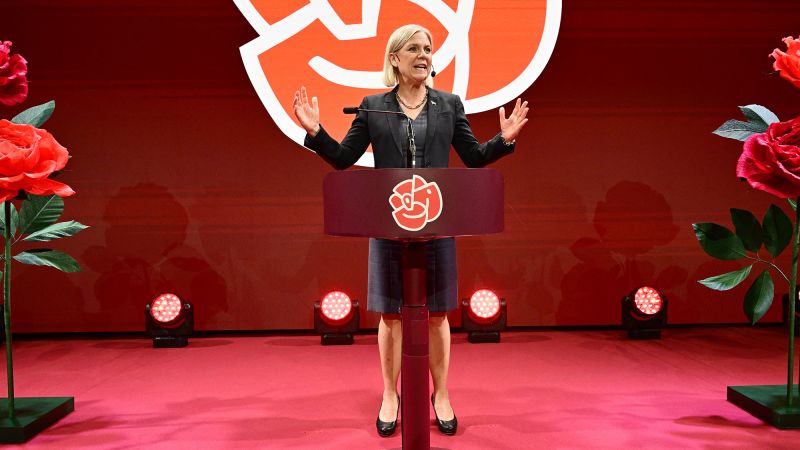
“If this result remains valid, Sweden will get a new government,” Andersson told supporters after the preliminary results were published on Sunday night.
A difficult path to forming a government
Even if the projected result holds, a new administration may not emerge quickly. Andersson is expected to become prime minister if the center-left prevails, but the eventual makeup of her government remains uncertain.
The Social Democrats would need to manage sharp differences among potential partners. The Center Party has said it will not govern alongside the Left Party, while the Left Party insists that it must be included in any coalition arrangement. Those competing positions could leave Andersson seeking a formula that provides parliamentary backing without bringing every allied party into the cabinet.
“It could very well be a complicated process to form a government,” parliament speaker Andreas Norlen told Swedish television.
The result therefore matters beyond the immediate question of who occupies the prime minister’s office. It will test whether Sweden’s center-left parties can translate a narrow electoral edge into a stable governing majority, while balancing disagreements over taxation, welfare and migration.
Immigration policy remains central to the political debate
A center-left victory would likely slow, rather than reverse, Sweden’s shift toward tougher immigration rules. Over the past four years, the country has moved away from the more welcoming asylum approach that helped define its international image in earlier decades.
The current government has overseen a significant tightening of the system. Permanent residency for refugees has been abolished, welfare rules have become stricter and expulsions of people without a legal right to remain have increased. Asylum applications have fallen to their lowest level in 40 years during the present administration.
The Left Party and the Greens have argued for less restrictive policies, but Andersson has made clear that the Social Democrats do not intend to return to Sweden’s former open-door approach. Her position suggests that migration will remain an area of broad political caution even under a government headed by the center-left.
That stance reflects how deeply the issue has reshaped Sweden’s political landscape. The far-right Sweden Democrats, whose influence has been a defining factor in recent years, were hoping to enter government directly if Kristersson’s bloc retained power. Instead, projections showed the party losing about 11 seats.
The setback does not erase the party’s impact. Its rise helped push the country’s political debate to the right and contributed to policies that once would have been far more difficult for mainstream parties to adopt. Any incoming government will be working within that changed political environment.
Continuity expected on Ukraine and the West
Sweden’s foreign-policy direction is unlikely to shift materially if Andersson forms the next government. The center-left has supported a pro-Western position and continued backing for Ukraine, making this one of the areas where a change in government is expected to bring continuity rather than a sharp break.
The more visible differences are likely to emerge in domestic policy. Andersson has campaigned on increased welfare spending, a more equitable tax system and greater social cohesion. Those priorities could contrast with the outgoing government’s approach, but negotiations among prospective coalition partners may limit how far any new administration can go.
Tax policy illustrates the challenge. The Greens and Left Party favor asking wealthy people to contribute more, while the Center Party opposes a tax on billionaires. Reaching agreement will require Andersson to reconcile demands for redistributive measures with the concerns of a party that has resisted some of the left’s preferred economic policies.
A result still awaiting confirmation
For now, Sweden remains in an unsettled period between a closely fought election and the formal confirmation of its outcome. Kristersson did not concede after Sunday’s vote, reflecting both the small gap and the experience of the previous election cycle.
If the figures are confirmed, Sweden will have chosen a change in leadership without necessarily choosing a return to its previous political model. A center-left government could place stronger emphasis on welfare and social cohesion, but it would inherit a country in which stricter immigration policy and a firm pro-Ukraine stance command significant political weight.
The final count will determine whether Andersson has the opportunity to build that government. The negotiations that follow may prove just as consequential as the election itself.
Related Reading
Frequently Asked Questions
What is Opposition set to halt Sweden s slide?
Opposition set to halt Sweden s slide is the main topic of this guide. The article explains the context, practical details, and next steps readers should understand.
Why does Opposition set to halt Sweden s slide matter?
Opposition set to halt Sweden s slide matters because readers are looking for a useful answer, not just a short summary. Good content should match search intent and help them decide what to do next.