
Pancakes: A Global Tradition That Refuses to Be Contained
Goldlaner.com – From the wood-fired hearths of medieval Brittany to the gleaming kitchens of Swiss luxury resorts, flat discs of cooked batter or dough have occupied a place at the center of human food culture for thousands of years. Sweet, savory, gluten-free, potato-based, hemp-protein-infused — the category is so vast that pinning down a single definition would be both impossible and undesirable. What unites every iteration is the act of spreading a thin layer of mixture across a hot surface and letting it set into something you can fold, stack, dip, or devour in one enormous bite.
The cultural weight of the pancake extends well beyond mere sustenance. Because traditional batters lean heavily on butter and eggs — ingredients historically associated with abundance — these foods were long reserved for the days immediately preceding periods of religious fasting. In Slavic Orthodox tradition, that window arrives each year as Maslenitsa, a full week of pancake-fueled revelry that closes out the run-up to Lent. The idea of eating pancakes daily for seven straight days is, frankly, one that most home cooks would welcome without hesitation.
Crêpes: Brittany’s Thin-Layered Legacy
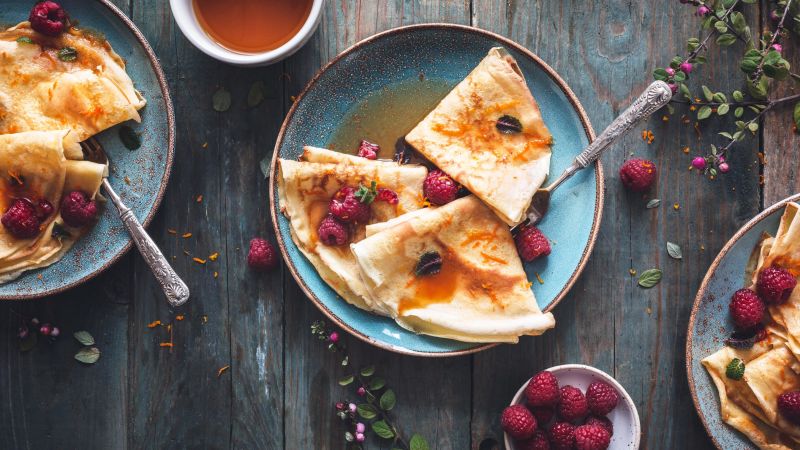
If a hall of fame existed for flat, cooked discs, the French crêpe would occupy a permanent seat near the top. Born in the Brittany region of northwest France during the 13th century, these paper-thin creations have since conquered menus on every continent. The sweet versions carry fruit preserves, chocolate, or cascades of syrup; the savory iterations are most famously loaded with ham and cheese melted to a glossy finish. Preparing them is less cooking and more performance art — the batter must be drawn to an exact viscosity before the cook executes a swift, practiced fold across the pan’s surface.
Socca and Farinata: Chickpea’s Mediterranean Stand
Rooted simultaneously in the French city of Nice and Italy’s Ligurian coast — where the same dish goes by the name farinata — this preparation strips the pancake down to its most elemental components: chickpea flour, water, olive oil, and seasoning. Traditionally, the mixture is ladled into broad copper pans submerged in pools of oil and slid into wood-fired ovens, producing a golden, blistered disc that serves as a genuinely satisfying gluten-free alternative to pizza. On the streets of Nice, vendors hand out socca folded into paper cones and finished with a crackle of freshly ground black pepper.
Blinis: Buckwheat’s Slavic Identity
In Russia and across the broader Slavic world, thin round pancakes leavened with yeast and built on a buckwheat-flour base carry deep cultural resonance. The home-cooked versions tend to be considerably larger than the petite discs that appear on fine-dining plates, where they are crowned with caviar or smoked salmon. Yet their most significant cultural moment arrives not in a restaurant but in the kitchen, during the Maslenitsa week described above, when families produce them in quantity as a communal act of celebration before the austerity of Lent begins.
Hemp Protein at Grand Resort Bad Ragaz
Dietary constraints and evolving nutritional preferences have spawned countless reinterpretations of the pancake, but few match the ambition of Michelin-starred chef Sven Wassmer at Verve by Sven, housed within Switzerland’s Grand Resort Bad Ragaz. Wassmer’s creation replaces wheat flour entirely with hemp protein, yielding a gluten-free disc that carries the wholesome ethos for which Swiss breakfast culture is already known. Toppings range from sliced bananas and toasted almonds to maple syrup, with perhaps a small dollop of whipped cream for balance.
Japanese Hotcakes: Engineering the Soufflé Stack
The Japanese term for these towering treats — “hottokeki,” a transparent nod to the English word — belies the considerable technique involved. Their extraordinary height and soufflé-like interior are achieved by whipping egg whites into a meringue and folding that aerated foam into the batter before cooking. The result is a structure so impossibly fluffy that it has become a fixture of Instagram food photography. Toppings span the full spectrum: fresh berries, whipped cream, maple syrup, even strips of bacon. The only non-negotiable rule is to photograph the stack before the first forkful.
Crispy Triangles: Dough, Not Batter
Departing sharply from the liquid-batter tradition, a family of fragrant, crispy triangular pancakes is constructed from rolled and pressed dough rather than poured batter. The finished product is flaky, chewy at the edges, and carries the sharp green note of scallions baked into the layers. Home cooks can replicate the technique with modest equipment, and some diners dip the triangles in soy-based or chili sauces. Straight from the pan or wok, however, the plain version — hot, shattering, and faintly savory — requires no accompaniment. Regional adaptations include a Shanghai variant that incorporates pork fat for added richness.
American Pancakes: Buttermilk, Bacon, and a 1796 Origin
Thick, pillowy, and drenched in maple syrup with a scattering of salty, crispy bacon, the classic American stack remains arguably the most decadent expression of the form. The recipe lineage stretches back to 1796, when Amelia Simmons published American Cookery, which included a recipe she called “Indian Slapjacks,” made from cornmeal. That particular formulation has largely faded from memory, but the buttermilk-based batter that followed became the standard. The acid in buttermilk reacts with leavening agents to produce a finer crumb, greater loft, and a faint tang that distinguishes the American version from its continental cousins. The cardinal rule of service, wherever the stack appears, is to build it high.
Latkes: Potato’s Ashkenazi Claim
A celebrated element of Ashkenazi Jewish cuisine, the latke introduces yet another uncommon base ingredient: the potato. Grated or shredded, the tuber is bound with egg and a minimal amount of flour, then fried into crisp, golden rounds. The dish is most closely associated with Hanukkah, when the oil used for frying echoes the festival’s central symbol. Though the text of this tradition stretches back centuries, the potato’s dominance in the recipe is a relatively later development, superseding earlier grain-based versions as the spud became widely available across Eastern Europe.
The pancake, in its infinite regional variation, remains one of the few foods that every culture has claimed, adapted, and elevated — a reminder that the simplest act of spreading batter across heat can carry millennia of meaning.
Whether folded around a slice of ham in a Breton bistro, stacked three-high with bacon in a suburban American kitchen, or folded into a paper cone on a Nice sidewalk, the pancake endures because it asks almost nothing of its maker while offering almost everything to its eater. That duality — radical simplicity paired with boundless variation — is precisely why no single definition can contain it, and why the next iteration is always already being cooked somewhere.
Related Reading
Frequently Asked Questions
What is The world s most delicious pancakes?
The world s most delicious pancakes is the main topic of this guide. The article explains the context, practical details, and next steps readers should understand.
Why does The world s most delicious pancakes matter?
The world s most delicious pancakes matters because readers are looking for a useful answer, not just a short summary. Good content should match search intent and help them decide what to do next.