
Chinese Mavericks Looking to Buck NCAA Basketball Trends
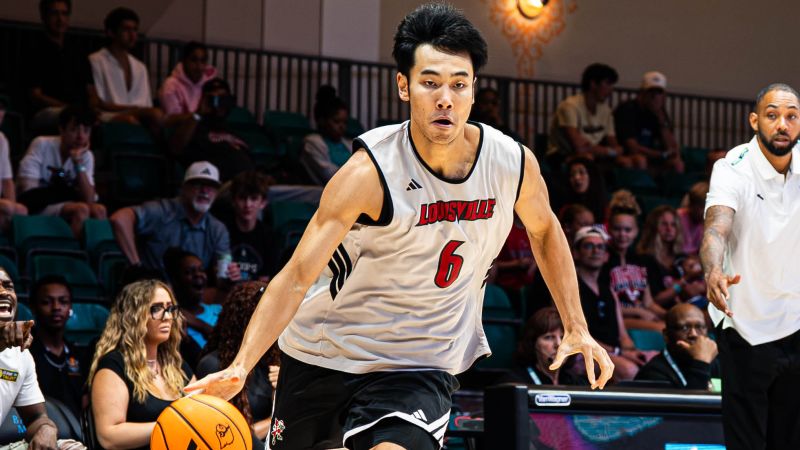
Goldlaner.com – This fall, more than a dozen Chinese-born athletes will lace up their sneakers on NCAA Division I courts for the first time — the largest single-year arrival from China into the American college system on record. At the heart of that surge stands Zhang Boyuan, a 19-year-old forward from Changchun who has pledged his talent to the University of Louisville Cardinals. His story epitomizes the Chinese mavericks looking to buck the old playbook: skip the domestic league entirely and build a professional résumé through American college competition instead.
One Night in Portland Rewrote a Life Plan
Through April of last year, Zhang’s trajectory was predictable — a top-tier Chinese university, steady development inside the familiar domestic structure, and eventually a CBA contract. Then the Nike Hoop Summit landed in Portland, and he was named to the World Team facing a U.S. roster loaded with elite American prospects. He dropped six points in the opening quarter before coaches pulled him as AJ Dybantsa and Cam Boozer took over the American side. Final score: World Team down 124-114.
“Before that game, I never thought about moving to America. My plan was to go to a good college in China. But just that single game changed everything.”
Back home in Changchun, Zhang spent weeks working his parents into agreeing to a trans-Pacific move. They eventually said yes. He enrolled at Veritas Academy in California, where he posted a 20.2 points-per-game average against top-flight high school competition. College scouts flocked to the tape, and ESPN ranked him No. 56 in the 2026 recruiting class.
Growing Up Under Changchun’s Long Winters
Changchun — a name that translates to “long spring” in Mandarin — is an industrial hub in China’s northeast where winters bite far harder than anything Louisville can muster. It was in that city that Zhang grew up watching NBA broadcasts alongside his father, a devoted hoops fan. Since American games first hit Chinese television screens in 1986, the league’s spectacle has captured successive generations of young players. For Zhang, the Golden State Warriors and Stephen Curry became touchstones during the years when Curry’s shooting and the Warriors’ dynasty defined the league.
His domestic development was swift. Representing one of Changchun’s strongest high school programs, he helped his squad finish third at a national tournament. At the 2024 FIBA U17 World Cup and the U18 Asian Cup, he averaged above 17 points in both events. Jia Lei, a veteran basketball journalist who has covered Chinese hoops for two decades, called Zhang the best player in his age group across the country.
“For every kid who hoops in China, playing in the NBA is a dream that ‘can be seen, but never reached.'”
Physically, Zhang pairs a 6-foot-9 frame with a quick first step for rim attacks, backed by reliable three-point shooting both off the catch and in transition. That skill set mirrors the modern forward archetype NBA front offices increasingly prioritize.
NIL Rules Opened a Door That Stayed Shut
The structural catalyst for this wave traces to 2021, when the NCAA adopted Name, Image, and Likeness rules allowing student-athletes to earn compensation while enrolled. Jonathan Givony, an NBA and NCAA draft analyst, framed the Chinese influx as the latest chapter in a broader globalization of American college sports.
“So, seeing Chinese players come over and playing high school basketball and then college basketball, that’s another extension of this same trend.”
Before NIL, the economic calculus for a young Chinese player tilted heavily toward the CBA, where salaries and media exposure were already established. The college pathway, once purely developmental, now pairs competitive exposure with genuine financial viability — a combination that reshapes how families and agents weigh the decision.
A Different Route to the Same Dream
The historical template for Chinese players reaching the NBA ran through the domestic league. Yao Ming, the Hall of Famer who transformed the sport’s global profile, spent years in the CBA before joining Houston. Yi Jianlian, his longtime teammate, followed a similar arc to Dallas. Most recently, Yang Hansen went 16th overall to the Portland Trail Blazers last summer after several seasons playing at home.
Zhang’s generation is charting an alternative course. By entering the NCAA directly — often after a single year of American high school basketball — these players access the highest level of organized competition available outside the pros while building the physical and tactical foundation that NBA scouts evaluate. The Chinese mavericks looking to buck the old domestic pipeline are not rejecting the dream; they are simply taking a shorter road to it.
Frequently Asked Questions
How many Chinese players are entering NCAA Division I this fall?
More than a dozen Chinese-born athletes are expected to compete at the Division I level this season, representing the largest single-year influx from China into American college basketball.
What changed that made the college pathway viable for Chinese players?
The 2021 adoption of NIL (Name, Image, and Likeness) rules by the NCAA allowed student-athletes to earn compensation while enrolled, making the college route financially competitive with the domestic CBA for the first time.
Where did Zhang Boyuan develop before committing to Louisville?
Zhang played one year at Veritas Academy in California, averaging 20.2 points per game, after growing up in Changchun and competing in Chinese high school and youth national-team events.
How does this new pathway differ from the Yao Ming model?
Yao Ming and subsequent players like Yi Jianlian and Yang Hansen spent multiple seasons in the CBA before reaching the NBA. Zhang’s generation bypasses the domestic league entirely, using American high school and college basketball as the direct developmental pipeline to professional competition.