Scientists attached transmitters to narwhals in the Arctic. The data they brought back was alarming

Narwhal Transmitter Data Exposes Arctic Ocean Warming
Goldlaner.com – Scientists attached transmitters to narwhals in a three-year Arctic monitoring program, and the oceanographic record those animals carried back has alarmed researchers. Between 2017 and 2020, six instrumented narwhals logged more than 2,000 temperature and salinity readings while swimming through East Greenland’s vast fjord network — the largest on Earth. The data confirm that warm, saline water originating in the Atlantic now penetrates over 180 miles into the interior of those ice-choked valleys, eroding the undersides of marine-terminating glaciers and accelerating ice loss. Researchers label the process “Atlantification,” a steady displacement of historically cold polar outflow by Atlantic-origin water.
Why the Arctic’s Blind Spot Matters
East Greenland occupies a pivotal position within the Atlantic Meridional Overturning Circulation (AMOC), the planetary conveyor belt that shuttles heat, freshwater, and nutrients across the North Atlantic. A weakening or collapse of that circulation would carry consequences far beyond the region: rapid sea-level rise along the U.S. eastern seaboard, severe cold snaps across western Europe, and prolonged drought stretching into parts of Africa. The new narwhal-derived observations add yet another indicator that the system is under mounting thermal stress.
Conventional ship-based surveys have struggled to fill the observational gap in these waters. Extreme remoteness, unpredictable sea ice, and brutal winter conditions make vessel operations costly, hazardous, and largely confined to summer months. Icebreakers are required even for brief forays, and winter work is effectively impossible. The result has been a persistent blind spot in one of the most climate-sensitive marine regions on the planet.
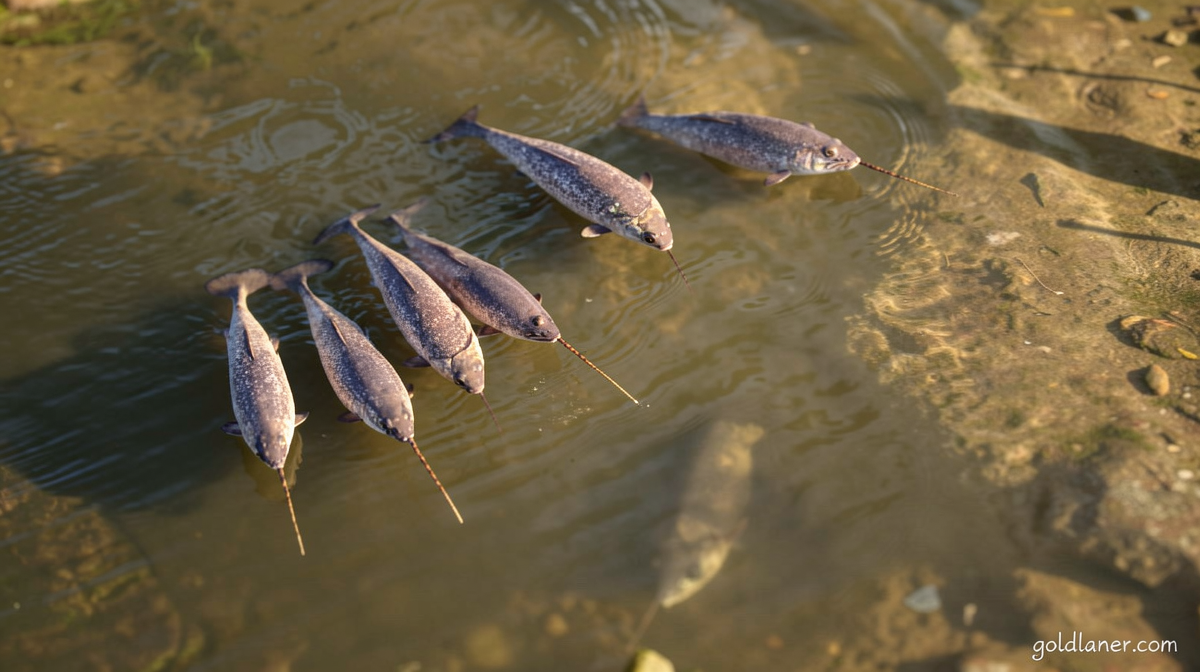
Narwhals — Arctic cetaceans long called the “unicorns of the sea” for their distinctive spiral tusk, which is actually a modified tooth — navigate these waters year-round and routinely plunge to nearly 6,000 feet, sampling the full water column from surface to abyss. They also return to familiar feeding and resting grounds each season, enabling repeated measurements at fixed locations.
How the Monitoring Worked
The logistics proved surprisingly straightforward. Local hunters captured the six animals and guided them into nets. Researchers then attached compact satellite transmitters, each weighing less than a pound, to the animals’ backs. The devices were engineered to record temperature and salinity continuously over extended periods and relay the data via satellite.
Mads Peter Heide-Jørgensen, a professor at the Greenland Institute of Natural Resources and co-author of the study, explained the rationale plainly:
“It’s a very understudied region … so we needed more data.”
Heide-Jørgensen added that the team developed a smaller transmitter capable of long-duration collection and satellite transmission without harming the animals. Once released, the narwhals resumed their normal lives while quietly streaming oceanographic data back to shore-based researchers.
“We can sit in front of our computers and the narwhals are swimming around in the icy waters in darkness,” he noted.
What the Readings Revealed
The researchers merged the narwhal-derived observations with historical records from the World Ocean Database, a global repository largely populated by ship-collected measurements. The combined dataset exposed a persistent, long-term trend: Atlantic-origin water was not merely edging into the outer fjords but penetrating deep into their interiors, arriving directly at the calving fronts of glaciers that drain the Greenland ice sheet into the sea.
Heide-Jørgensen described the magnitude of the intrusion as
“an eye opener.”
Because the animals operate through the polar night, the dataset includes winter observations — a period during which no ship can operate in the region. That seasonal completeness renders the record scientifically unprecedented.
Eric Achterberg, a professor at the GEOMAR Helmholtz Centre for Ocean Research Kiel in Germany and not part of the research team, called the methodology
“unique and elegant.”
Frequently Asked Questions
How many narwhals were involved, and over what period? Six narwhals carried the transmitters during a three-year deployment spanning 2017 through 2020, producing more than 2,000 discrete temperature and salinity observations.
Were the animals harmed by the tagging? According to Heide-Jørgensen, the transmitters weigh less than a pound and do not harm the animals in any way. Local hunters handled the capture and release.
Why can’t ships simply collect this data? East Greenland’s fjords are accessible to research vessels only during brief summer windows. Winter sea ice, remoteness, and the need for expensive icebreakers make year-round ship surveys impractical, leaving winter months unobserved.
What does “Atlantification” mean? It refers to the progressive encroachment of warm, saline Atlantic-origin water into Arctic seas that have historically been dominated by cold polar outflow, altering local ocean conditions and accelerating glacier melt.
How does this relate to the AMOC? East Greenland sits at a critical node in the Atlantic Meridional Overturning Circulation. Warming of its coastal waters adds another data point suggesting the circulation is under mounting stress, with potential downstream effects on global weather patterns and sea level.