
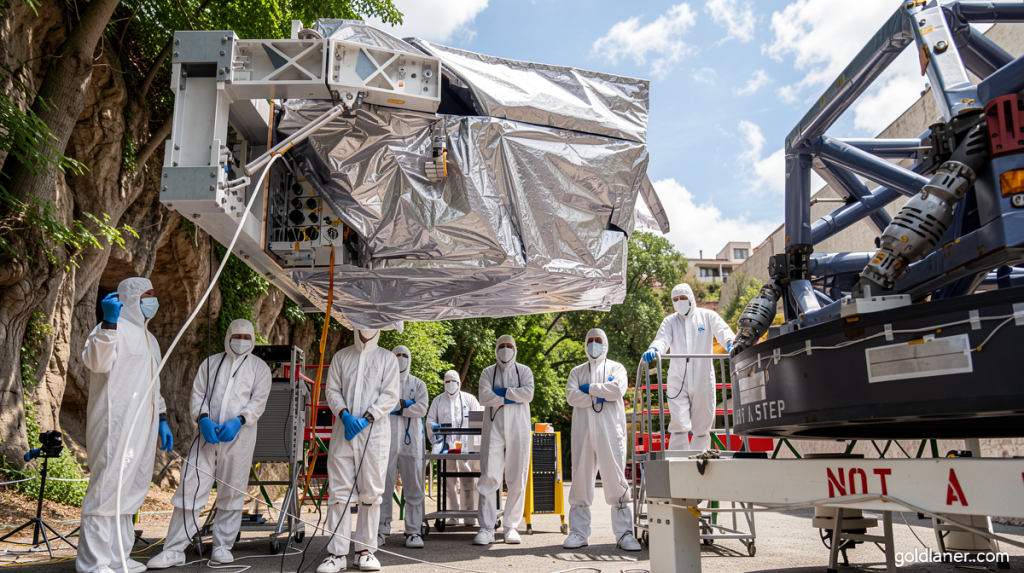
A New Eye on the Cosmos: NASA’s Roman Telescope Prepares for Launch
Goldlaner.com – This weekend marks a potential turning point for space-based astronomy. The Nancy Grace Roman Space Telescope, NASA’s latest flagship observatory, may lift off from its launch pad within days, carrying with it an experimental instrument designed to do something no previous space telescope has attempted: directly image faint, Jupiter-sized exoplanets orbiting nearby stars — and perhaps even detect cloud patterns on their atmospheres.
The telescope bears the name of Nancy Grace Roman, the astronomer who championed space-based observatories decades before they became routine. Her legacy now extends beyond Hubble and the James Webb Space Telescope, instruments that have already reshaped our understanding of the cosmos. Roman’s mission, however, aims at questions those earlier observatories could not answer: the nature of dark energy, the distribution of dark matter, and the large-scale architecture of the universe itself.
“Roman will investigate dark matter, dark energy and the structure of the universe itself, and accelerate the future of discovery of potentially habitable planets outside our solar system,” said NASA Administrator Jared Isaacman when the completed telescope was unveiled in April.
The “Starglasses” Coronagraph
At the heart of Roman’s exoplanet-hunting capability sits a device called a coronagraph, informally nicknamed “starglasses.” Its purpose is deceptively simple in description yet extraordinarily difficult in execution: block the overwhelming glare of a star so that the faint light of a planet orbiting nearby can be isolated and studied.
The instrument employs flexible mirrors capable of adjusting in real time, compensating for minute distortions to maintain optical precision at levels that would be impossible with rigid optics. If the technology performs as engineers have modeled, Roman could eventually be pointed at Earth-like worlds in habitable zones, searching for atmospheric signatures consistent with life.
Inside the Clean Room
Three years before the telescope’s imminent departure, a journalist was granted access to the clean room at NASA’s Jet Propulsion Laboratory in Pasadena, California, where the coronagraph was being assembled. The experience was disorienting: a blindingly white chamber where every visitor must wear a full-body white coverall — colloquially a “bunny suit” — leaving only the eyes visible. Contamination rules were strict. No makeup, no lotion, no scented products of any kind were permitted on the skin.
Because the physical instrument was still in assembly, the engineering team equipped the visitor with a pair of virtual-reality glasses, projecting every component of the coronagraph in three dimensions and demonstrating how the pieces interlock. This VR-assisted walkthrough is now a standard early step in assembling instruments of comparable complexity, allowing engineers to verify fit and alignment before hardware is committed.
Spending time with the team that had devoted years to building the device made clear the scale of human dedication behind a single space mission. The hopes they expressed — what the instrument might reveal about distant worlds — underscored why such projects demand decades of sustained effort.
Other Science Stories in Brief
Two “Ghost” Ancestors in Human Evolution
Researchers analyzing modern human DNA have identified traces of two previously unknown ancestral lineages — so-called “ghost” populations — that interbred with our species but left no recoverable fossils. Neanderthals and Denisovans, by contrast, left both skeletal remains from which ancient DNA could be extracted and clear genetic signatures in present-day genomes. The two new lineages, however, are known only through their genomic footprints.
Scientists have now developed a method to reconstruct these lost branches of the human family tree. One lineage appears to have interbred with Homo sapiens in Africa more than 50,000 years ago. The second has a far more tenuous and enigmatic connection to modern populations, and its full story remains unresolved.
Marmot Researchers Turn to Subscription Video
When federal funding for a decades-long study of yellow-bellied marmots was cut, a team at the University of California, Los Angeles, sought an unconventional revenue stream. They launched “OnlyMarms,” a safe-for-work subscription channel on the OnlyFans platform, sharing footage of the small rodents scurrying through their natural habitat. Viewers occasionally witness PG-rated scuffles between the round-bodied animals. The arrangement has kept the long-running ecological study alive without new government appropriations.
August’s Full Moon and a Partial Lunar Eclipse
Anyone looking skyward this weekend can observe August’s full moon at its peak. The silvery disc also featured in a partial lunar eclipse that reached maximum just after midnight Friday, when Earth’s shadow swept across portions of the moon’s near side. Photographs from North and South America captured the moody, partially darkened disc against the night sky.
The Ganges Shark: A Species Never Photographed Alive
Among the roughly 500 known shark species, only three are confirmed to inhabit freshwater rivers. The Ganges shark, one of those three, is classified as critically endangered and has never been captured on camera alive. Populations are known to be declining across parts of Pakistan, India, Bangladesh, Malaysia, and Myanmar, where individuals surface primarily as bycatch in riverine fishing operations. The absence of a single verified photograph of a living specimen underscores how little is known about its behavior, ecology, and remaining population size.
Related Reading
Frequently Asked Questions
What is An encounter with NASA s game?
An encounter with NASA s game is the main topic of this guide. The article explains the context, practical details, and next steps readers should understand.
Why does An encounter with NASA s game matter?
An encounter with NASA s game matters because readers are looking for a useful answer, not just a short summary. Good content should match search intent and help them decide what to do next.