
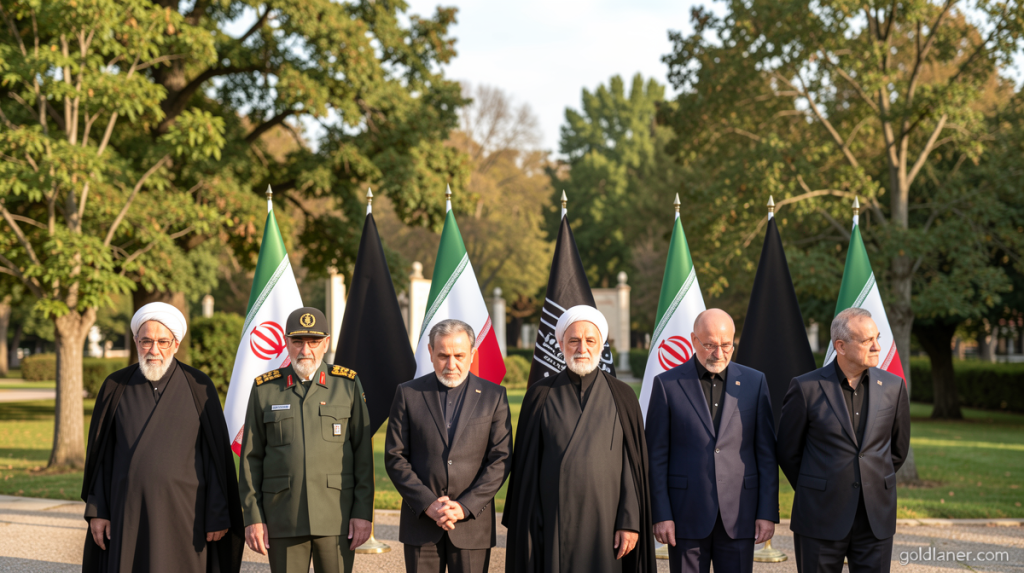
Iran’s Fractured Leadership Faces the Question That Defined Its Founding War
Goldlaner.com – Six months into a grinding conflict with the United States and Israel, the Islamic Republic finds itself locked in a stalemate that has split its own leadership down the ideological middle. With Supreme Leader Mojtaba Khamenei reportedly concealed from public view, Tehran’s competing factions are openly jockeying over whether to press for a negotiated settlement or to gamble on outlasting an adversary they believe will eventually blink first. The stakes extend far beyond the current battlefield: the answer will shape whether a regime that has endured four decades of sanctions, internal upheaval, and external pressure can sustain itself into another generation.
A Ghost from the 1980s Haunts the Decision
The parallel to the past is not accidental. In the early 1980s, after months of costly setbacks against Saddam Hussein’s Iraqi army, tens of thousands of young Iranian soldiers surged forward in a surprise assault that reversed the momentum of the war. Yet the then-supreme leader, Ayatollah Ruhollah Khomeini, refused to accept a partial victory. He demanded the complete overthrow of Baghdad’s dictator, who was receiving growing backing from Washington, and sought to send a message to every future adversary that war with Iran would carry a devastating price tag. That single decision stretched what might have been a short campaign into a six-year war of attrition that claimed hundreds of thousands of lives and ranks among the deadliest conflicts in the region’s modern history.
For the revolutionary generation that still occupies key seats in Tehran, the current US-Israeli war carries the same signature: an imposed conflict whose outcome will hinge not on raw military superiority but on which side simply refuses to fold. The question Khomeini faced in the 1980s — press the advantage or accept a partial gain — has returned, dressed in the language of naval blockades, shattered infrastructure, and a war-battered economy.
The Pragmatists: Close the Door While It Still Opens
At one end of the spectrum sit technocrats and pragmatic administrators, including President Masoud Pezeshkian, Parliament Speaker Mohammad Bagher Ghalibaf, and Foreign Minister Abbas Araghchi. Their argument is grounded in material exhaustion: the economy is battered, a US naval blockade has drained energy supplies, and critical infrastructure bears visible scars from months of strikes. They contend that the narrow window for concluding a settlement from a position of relative strength is rapidly narrowing.
For the citizens they claim to represent, ending a 47-year confrontation with Washington is not surrender but survival — the surest route to easing domestic crises and breaking the global isolation that has strangled growth for decades.
“The war must end at some point,” Pezeshkian said this month. “It would be better to end it today, while we are in a position of strength and dignity, and the entire world acknowledges our victory.”
The Hardliners: Endurance Is the Strategy
Opposing them stands a conservative bloc whose worldview is built on a half-century of suspicion toward Washington. They regard the American government as fundamentally committed to dismantling the Islamic Republic, and they point to Trump’s own war as vindication of warnings their moderate rivals dismissed for decades. They further accuse sitting officials of tilting public opinion toward a deal by amplifying domestic hardships beyond what the facts warrant, branding such officials as “Western-oriented.”
Sanam Vakil, director of the Middle East and North Africa program at London’s Chatham House think tank, explained the psychological architecture of that camp to CNN:
“They see the US as a deeply untrustworthy actor… and (have) been burnt so many times by Trump himself that they think that this is exactly what will happen again. In their minds, by not losing (the war), they’ve won, and they’re not just trying to win out with a better deal from Washington, but they’re looking for internal longevity in their competition with their opponents.”
The hardliners view Pezeshkian as a weak figure who assumed the presidency almost by accident after his hardline predecessor perished in a helicopter crash. His signature alongside Trump’s on the June ceasefire agreement, they argue, has only deepened his isolation within the power structure and emboldened their campaign to pin the shattered economy and the stalled negotiations squarely on his shoulders.
Accusations That Cut Deeper Than Diplomacy
The internal quarrel has grown so venomous that hardline lawmakers now allege the government is deliberately mismanaging the economic crisis to pressure a weary public into accepting a deal. Some claim fuel shortages have been engineered to make agreement seem unavoidable; others go further still, accusing moderates of staging a coup. Hardline lawmaker Mohammad-Manan Raisi put the skepticism bluntly:
“Economically, are we really in a dead end, or are you just projecting a dead end? It has all been blamed on the war, while it is not all related to the war.”
The conservative camp also marshals historical precedent: the 2015 nuclear agreement signed under the Obama administration, which Trump subsequently tore up, and two occasions on which the United States struck the Islamic Republic while negotiations were still underway. Each episode, they argue, confirms that Washington’s word is worthless and that only sustained confrontation preserves the regime’s autonomy.
What the Deadlock Means Beyond Tehran
For regional neighbors and global energy markets, the length of this stalemate carries consequences that ripple well past the Persian Gulf. A prolonged naval blockade disrupts shipping lanes that carry a meaningful share of the world’s oil and gas. A negotiated settlement, by contrast, would reopen diplomatic channels that have been frozen for years and could reshape the architecture of sanctions that have constrained Iranian trade since the 1979 revolution. Either outcome — endurance or agreement — will determine whether the Islamic Republic enters its fifth decade of rule with its founding revolutionary ideology intact or with a pragmatic compromise stitched into its constitutional fabric.
With the supreme leader absent from public view and both camps claiming the mantle of national survival, the next weeks may prove as consequential as the moment in the 1980s when Khomeini chose to press forward. The question has not changed. Only the stakes have grown larger.
Related Reading
Frequently Asked Questions
What is A power struggle in Iran could?
A power struggle in Iran could is the main topic of this guide. The article explains the context, practical details, and next steps readers should understand.
Why does A power struggle in Iran could matter?
A power struggle in Iran could matters because readers are looking for a useful answer, not just a short summary. Good content should match search intent and help them decide what to do next.