
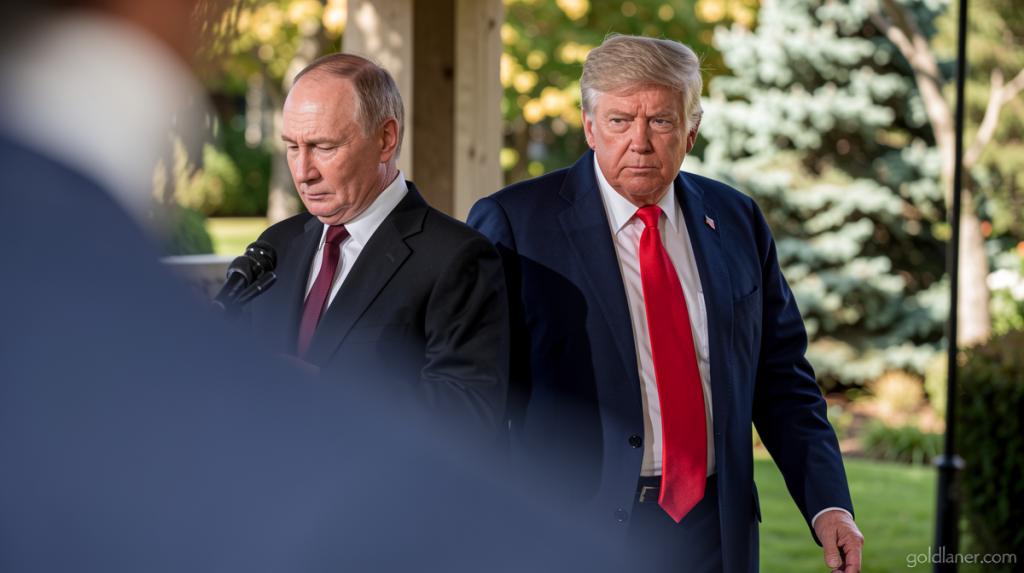
A CIA Director Lands in Moscow to Deliver Unwelcome News — While His Own President Faces a Mirror Image of the Same Problem
Goldlaner.com – The irony was not lost on anyone in the Kremlin. CIA Director John Ratcliffe touched down in Moscow this week carrying, by all accounts, a blunt message: Russia is losing its war in Ukraine. The timing made the visit read almost like a dark joke, the kind that has long been a staple of Russian political culture. Yet the humor cuts both ways. While Ratcliffe was preparing his briefing for Russian intelligence chiefs, President Donald Trump was locked into his own intractable conflict in Iran — one that, by most assessments, he cannot win and cannot cleanly exit.
Two Leaders, Two Quagmires
The structural resemblance is hard to ignore. Both men launched military campaigns after what appears to have been a fundamental miscalculation of their opponents’ resolve and operational capacity. Ukraine and Iran, each facing a conventional force vastly superior in matériel and firepower, responded not with head-on confrontation but with cheap, proliferating technologies — above all drones — that reshaped the calculus of modern combat. The result: tactical superiority on paper translated into strategic stagnation on the ground.
Each leader now confronts the same paradox. The war’s original objectives remain out of reach, yet a public withdrawal would carry an unbearable political cost. Walking away means admitting the gamble failed. Staying means absorbing ever-larger losses while the endgame recedes.
The Information Problem
A persistent worry in Washington’s foreign-policy establishment is that Putin has not been receiving candid, unfiltered assessments of how the Ukraine war is actually progressing. The question naturally extends to the other side of the Atlantic. If Trump’s public commentary on the Iran campaign has been uniformly optimistic, observers wonder whether his inner circle is similarly filtering bad news before it reaches the Oval Office. A president who believes he is winning a war he is not winning will make different decisions than one who faces the raw arithmetic of attrition.
Where the Parallel Breaks Down
The comparison, however, has limits. Trump has not replicated what many analysts consider Putin’s most consequential error: committing large formations of ground troops into a grinding, open-ended land campaign. That decision, made in Moscow, has produced a toll that the Center for Strategic and International Studies places above 1.4 million young Russians killed, wounded, or missing. A figure of that magnitude would be politically impossible to sustain in American domestic politics.
Authoritarian governance also grants Putin a latitude Trump simply does not possess. Domestic opposition, media scrutiny, and electoral cycles constrain the American president in ways that do not bind his Russian counterpart. On the battlefield itself, Trump has largely refrained from deliberately striking civilian populations or critical infrastructure, whereas Putin’s missile and drone campaigns have systematically targeted Ukrainian cities, hospitals, and power stations.
One exception has drawn scrutiny. In February, a missile strike struck an Iranian school, killing nearly 200 children and adults. The administration has not offered a full public accounting of the incident, which appears to have stemmed from reliance on outdated intelligence. The silence around that event has fueled questions about transparency in the Iran campaign.
Ratcliffe’s Agenda in Moscow
The CIA chief’s visit carried a broader diplomatic payload beyond the Ukraine briefing. Two people familiar with the matter described his warning to Russian counterparts: avoid any overt or covert strike on NATO territory, amid growing European anxiety that Putin might probe the alliance’s collective-defense commitments. Ratcliffe also pressed Russian espionage officials to scale back economic and military assistance flowing to Iran.
For US allies who have long questioned the durability of American security guarantees under the current administration, any visible re-engagement on the Ukraine front would carry significant reassurance value. A renewed American push toward ending that war would be broadly welcomed, even as the president’s recent downgrading of military aid to President Volodymyr Zelensky’s government has raised doubts about his underlying motives.
The Patriot Question and the 24-Hour Promise
Trump still has not moved on an apparent summer offer to permit Ukraine to license domestic production of Patriot anti-missile systems. His earlier prediction that he could end the Ukraine war within 24 hours has gone nowhere. His repeated assertion that Putin desires peace is contradicted, week after week, by continued Russian offensive operations.
Six Months in Iran and the Pivot to Economic Warfare
The Iran conflict has now reached its six-month mark. This week marks a notable shift in administration strategy: from kinetic military action toward what amounts to all-out economic warfare — sanctions pressure, financial isolation, and trade restrictions aimed at compressing Tehran’s capacity to sustain the fight. US missteps in that campaign are under intense scrutiny precisely because the economic phase demands precision; a single intelligence failure or diplomatic miscalculation can unravel months of pressure.
Russia, meanwhile, occupies an over-the-horizon role in the Iran war. Multiple people familiar with the matter indicated that Moscow has been supplying Tehran with intelligence on the locations and movements of American troops, ships, and aircraft. Whether any quid pro quo arrangement linking Ukraine concessions to Iranian relief is feasible remains doubtful, given the president’s prior failure to compel Kyiv into territorial compromises.
The wider geopolitical picture is one of flux. Two simultaneous wars are destabilizing the Middle East, entangling the world’s great powers, and raising the specter of a broader conflict that neither Washington nor Moscow may fully intend but neither can fully control. Ratcliffe’s Moscow trip, for all its irony, was an attempt to manage that risk — to keep the two crises from fusing into a single, uncontrollable escalation.
Related Reading
Frequently Asked Questions
What is Secret CIA visit highlights Putin and Trump?
Secret CIA visit highlights Putin and Trump is the main topic of this guide. The article explains the context, practical details, and next steps readers should understand.
Why does Secret CIA visit highlights Putin and Trump matter?
Secret CIA visit highlights Putin and Trump matters because readers are looking for a useful answer, not just a short summary. Good content should match search intent and help them decide what to do next.