
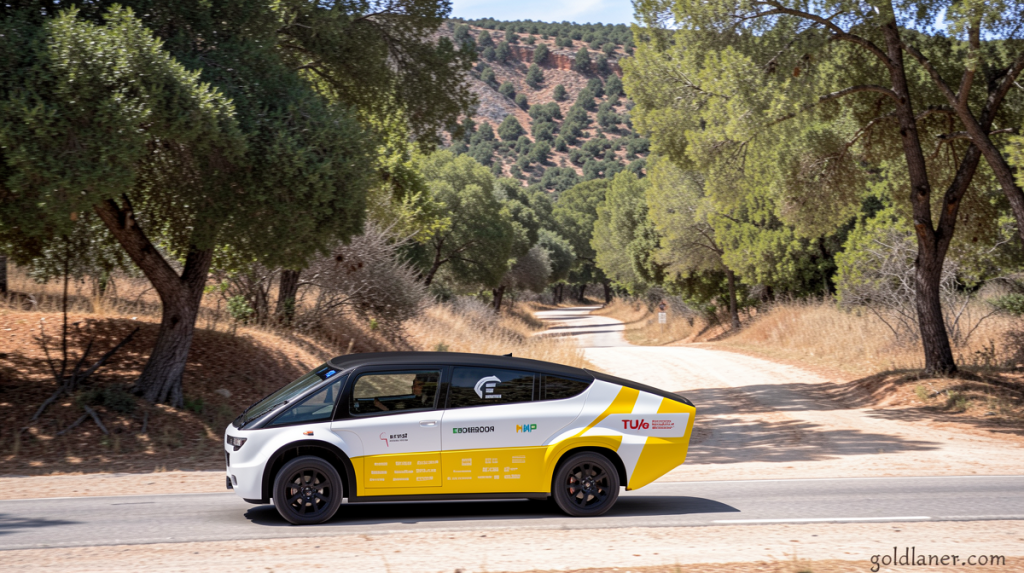
Solar-Powered Mobile Clinic Clears Long-Distance Trial in Kenya
Goldlaner.com – A prototype vehicle built by Dutch engineering students has completed a demanding field trial across Kenya’s rugged southwestern terrain, demonstrating that a fully solar-charged mobile medical unit can sustain its onboard diagnostic and cold-chain equipment without any external power source. The test, conducted this month in partnership with the nongovernmental organization Amref Health Africa, pushed the vehicle beyond 800 kilometers (roughly 500 miles) of Kenyan roads, including stretches of potholed clay tracks leading to a clinic in Mosiro, Narok region, that has no grid electricity at all.
The result: while parked and running every piece of medical gear simultaneously, the vehicle produced more electrical energy than it consumed. The developers say this confirms the unit can operate autonomously in locations with neither fuel supply nor charging infrastructure.
What Stella Juva Actually Is
Despite its name, the vehicle functions less like a conventional ambulance and more like a rolling diagnostic clinic. Its cargo bay houses an X-ray unit, an ultrasound scanner, and a refrigeration compartment designed to maintain vaccine cold-chain integrity. A rooftop array of photovoltaic panels charges the battery pack during transit, while extendable wing panels that deploy when the vehicle is stationary multiply the charging surface area. The developers, Solar Team Eindhoven, describe it as the “world’s first solar ambulance,” though its operational role is closer to a mobile health station than a patient-transport vehicle.
During the Kenyan trial, no real patients were treated. However, Solar Team Eindhoven and Amref Health Africa estimate that, over a two-day deployment window, the onboard equipment could have serviced approximately 200 individuals.
The Team Behind the Build
Solar Team Eindhoven is a collective of 23 students drawn from Eindhoven University of Technology and two additional educational institutions. Since 2013, the group has organized yearlong collaborative projects aimed at designing sustainable vehicles. Earlier entries include Stella Vita, a solar-assisted campervan, and Stella Terra, billed as the first off-road solar-powered vehicle. Several alumni have moved into commercial ventures; most notably, Lightyear, a startup founded by five former team members, unveiled a demonstration electric vehicle featuring advanced solar-charging technology developed alongside Nissan.
Field Conditions in Narok
The Mosiro clinic visit required several hours of navigation over a dusty, clay-surfaced road riddled with potholes — precisely the kind of infrastructure gap that leaves rural Kenyan communities dependent on intermittent or nonexistent power. The vehicle handled the terrain without issue.
“We were all very positively surprised,” said Isabella Wanningen, a 22-year-old computer science and engineering student on the team. “Stella Juva reacted even better than we had expected.”
John Kutna, program manager at Amref Health Africa, noted that the absence of reliable electricity at clinics like Mosiro disproportionately affects expectant mothers who lack routine access to ultrasound screening.
“The solar ambulance would be quite useful in these locations,” Kutna said.
Why the Gap Matters
Roughly one-third of Africa’s population lives more than two hours from basic health services. Across the continent, unreliable or absent electricity at medical facilities constrains the range of diagnostics, surgical capability, and vaccine storage that can be offered. Solar photovoltaics have begun filling narrow slices of that gap: UNICEF and partner agencies have backed solar-powered refrigeration units for vaccine cold chains, and corporate foundations have funded solar lighting at select clinics. Yet solar energy has not yet been deployed at scale to power full diagnostic suites in remote settings.
Kennedy Wakoli, a family and reproductive health specialist at Amref Health Africa, frames the stakes plainly: solar energy is available virtually everywhere, making it a uniquely suited power source for areas where grid extension is decades away.
“Solar energy is everywhere,” Wakoli said, expressing hope that Stella Juva can serve as a catalyst for broader adoption.
Obstacles Ahead
The prototype will be shipped back to the Netherlands, but the team frames the Kenyan trial as a proof-of-concept rather than a final product. Yarno Basten, a 23-year-old sustainable energy technology student on the team, stated the group’s intent:
“We hope to inspire industry and society to use innovative technologies like Stella Juva to tackle some societal problems.”
Scaling from prototype to deployed fleet faces practical hurdles. Healthcare funding in Kenya remains tight, a constraint sharpened recently when the administration of US President Donald Trump reduced foreign-aid allocations. Even so, Kenyan health professionals see the successful trial as a potential inflection point — one that could motivate local engineering students to pursue homegrown solar-medical innovations and demonstrate, in tangible form, that sunlight can be converted into clinical capability where no other power source exists.
The country has made measurable progress expanding its renewable-energy capacity over the past decade, but translating that progress into point-of-care medical power in off-grid communities remains largely unaddressed. Stella Juva’s Kenyan test suggests the technical barrier is surmountable; the question now is whether financing, policy, and manufacturing pathways will follow.
Related Reading
Frequently Asked Questions
What is World s first solar ambulance just?
World s first solar ambulance just is the main topic of this guide. The article explains the context, practical details, and next steps readers should understand.
Why does World s first solar ambulance just matter?
World s first solar ambulance just matters because readers are looking for a useful answer, not just a short summary. Good content should match search intent and help them decide what to do next.