
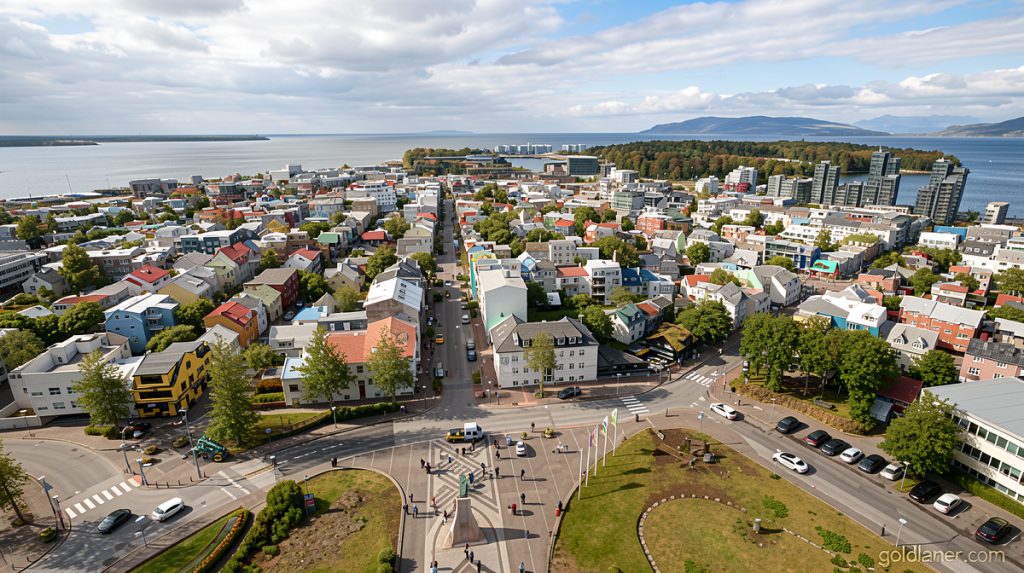
Iceland Puts Its EU Future to the Vote as Arctic Tensions Reshape Nordic Calculus
Goldlaner.com – On a warm Saturday in late August, when the island’s five-month winter grip has finally loosened, roughly 400,000 Icelanders head to polling stations to answer a question that has simmered beneath the surface of Nordic politics for over a decade: should the country reopen negotiations to become a member of the European Union? The referendum, called by the current center-left coalition government, asks voters whether to restart accession talks that were frozen more than a decade ago. The answer will determine whether Iceland re-enters a process it first initiated in 2009, in the aftermath of a financial collapse that devastated households and enterprises across the small island nation.
A Decade of Frozen Ambitions
The original application came in the wake of the 2008–2009 banking crisis, which wiped out much of Iceland’s private wealth and left the government scrambling for institutional lifelines. Accession talks began in earnest, but a center-right administration that took power a few years later hit the emergency brake. Its rationale was straightforward: joining the bloc would mean ceding meaningful control over Iceland’s territorial fishing waters and, by extension, a core pillar of national sovereignty. The talks were shelved, and for over a decade the question sat dormant in parliamentary archives.
The present coalition, led by the Social Democratic Alliance, campaigned on a platform that included holding a referendum on restarting those talks “no later than 2027,” alongside a broader foreign-policy pivot toward deeper cooperation with Brussels, fellow Nordic states, and NATO. Prime Minister Kristrún Frostadóttir has framed the vote not as a binary choice between isolation and integration, but as a question of optionality.
“It’s preserving optionality” to see what an agreement looks like, according to the prime minister. “You can be a ‘maybe’ person on the EU and still say ‘yes’ (to talks) because you want to see what this looks like.”
The Arctic Variable
Had the referendum been scheduled in 2022, the debate would likely have stayed confined to economics: eurozone membership, fishing quotas, agricultural subsidies. Instead, the vote lands in a fundamentally different strategic environment. Since last year, US President Donald Trump’s repeated and aggressive posturing toward Greenland — including occasions on which he misidentified the Danish territory as Iceland itself — has thrust Arctic security to the top of European policy agendas.
Iceland occupies an unusual position in this new landscape. It maintains a capable coast guard but possesses neither a standing army nor a dedicated defense ministry. Its security architecture rests on two pillars: NATO membership and participation in the European Economic Area, which guarantees free movement of people, goods, and capital across 30 countries. The island also sits inside the Schengen area of visa-free travel. Most recently, it signed a maritime-security pact with four other NATO allies aimed at strengthening patrols in the Arctic and North Atlantic — a region of growing importance given sustained Russian naval activity.
Almut Möller, director for European and global affairs at the European Policy Centre in Brussels, argues that the security context has fundamentally altered the calculus in Brussels.
“For the European Union, Iceland will be in the security environment a much more relevant partner compared to, say, 10 years ago,” Möller said. “This is a very different context.”
She added that, amid broader global instability, there is a desire within the 27-member bloc to demonstrate that the union remains dynamic and open — welcoming new members and expanding its geostrategic footprint. That appetite was sharpened by the United Kingdom’s 2016 Brexit vote, which triggered a wave of speculation about other nations potentially exiting the European project and left Brussels eager to counter the narrative of decline.
From Neutrality to Strategic Relevance
Icelanders have historically not thought of their island as a strategic actor. The country remained neutral through World War II and, after the Cold War, faced no serious external threat. The United States military, which had maintained a presence on the island, withdrew its forces in 2006 as the perceived Soviet threat receded. That quiet ended abruptly with Russia’s full-scale invasion of Ukraine in 2022, which brought renewed US Navy activity and fresh NATO investment back to Icelandic shores.
Ragnar Hjálmarsson, a senior adviser at the Icelandic think tank Varda, notes that the population is rapidly adjusting its self-image.
“The Trump administration’s actions toward Greenland caused some level of fear. The brazenness of it caused angst in Iceland,” Hjálmarsson said. “But it also made Icelanders aware of… the strategic importance of Iceland. It has, however, not changed what the voters are talking about.”
In other words, while the strategic backdrop has shifted dramatically, the referendum debate at the ballot box remains anchored in economic questions: what would eurozone membership mean for investment flows, what concessions would be required on fishing policy, and whether the island’s small, open economy could absorb the regulatory burden of full EU integration.
What a “Yes” Would Mean
A majority vote in favor of restarting talks would not, by itself, make Iceland an EU member. It would reopen a multi-year accession process involving dozens of policy chapters, from environmental standards to judicial harmonization. Frostadóttir has argued that the current geopolitical moment strengthens Iceland’s hand in any future negotiations.
“I think this is a great time for Iceland to join, because of the geopolitical situation we’re in,” Frostadóttir told The Rest is Politics podcast. “It also gives us a stronger position, I think, in accession talks.”
For a nation of 400,000 that once defined itself by its distance from continental politics, the Saturday vote represents something more than a procedural step. It is a referendum on whether Iceland’s future belongs in the orbit of European institutions, or whether the island will continue to navigate the Arctic’s growing turbulence through bilateral partnerships and its existing NATO-EEA-Schengen trinity. The answer, whatever it is, will be felt well beyond the island’s shores.
Related Reading
Frequently Asked Questions
What is A tiny nordic nation weighs moving?
A tiny nordic nation weighs moving is the main topic of this guide. The article explains the context, practical details, and next steps readers should understand.
Why does A tiny nordic nation weighs moving matter?
A tiny nordic nation weighs moving matters because readers are looking for a useful answer, not just a short summary. Good content should match search intent and help them decide what to do next.