
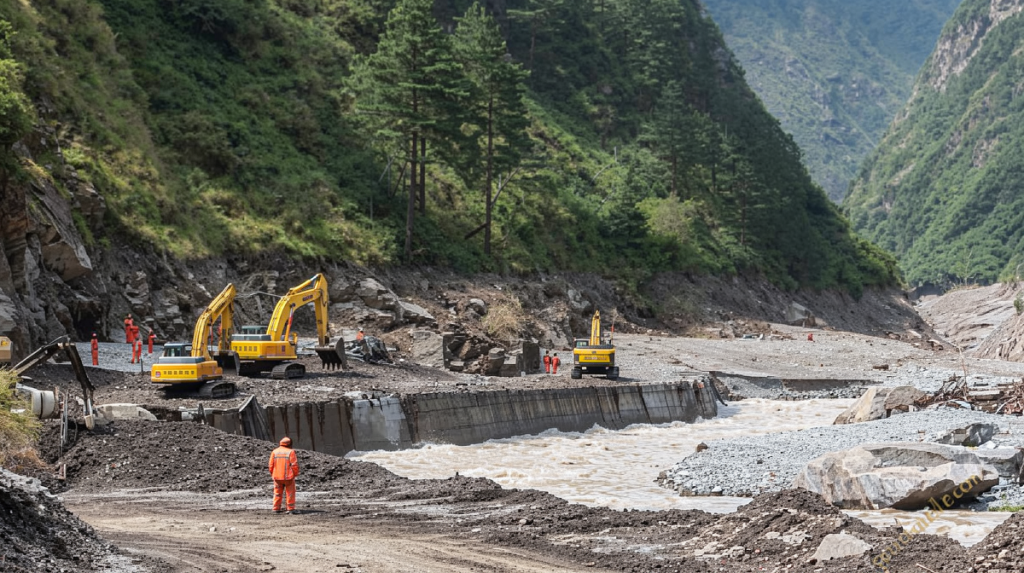
Overflowing Lake Adds New Danger to China-Nepal Rescue
Goldlaner.com – Overflowing lake adds new danger to desperate rescue efforts along the China-Nepal border, where crews are already battling the aftermath of a catastrophic landslide and torrential flooding. A barrier lake that formed in the wake of Wednesday’s disaster has begun spilling water continuously over its debris dam, compelling both Chinese and Nepali authorities to suspend all search-and-rescue operations on Friday. The development transforms an already dire humanitarian situation into a compounding catastrophe, with thousands of people in the downstream corridor still unaccounted for and no confirmed timeline for when field teams can safely advance again.
The Barrier Lake Threat
The lake sits roughly 10 kilometers upstream of the Gyirong border port and holds an estimated 2.5 million cubic meters of water — a volume comparable to approximately 1,000 Olympic-sized swimming pools. Its natural dam, composed of rock and soil debris from the original landslide, stretches roughly 150 meters in length and stands between 40 and 50 meters tall. Engineers monitoring the structure have confirmed that water is now overflowing the crest, a condition that accelerates erosion of the dam body and raises the probability of a sudden, catastrophic breach within days or even hours.
Barrier lakes form when landslide debris blocks a river channel, trapping water behind an unengineered dam of rock, mud, and sediment. While such formations can persist for days or weeks, their failure — whether through gradual seepage or a sudden structural collapse — can unleash a wall of water downstream with little warning. In this case, the downstream corridor is precisely where rescue teams are attempting to reach survivors trapped by the initial disaster, making the overflow a direct threat to both victims still in the zone and the responders trying to reach them.
Rescue Operations Halted
Helicopter operations over Nepal’s flood-wracked Rasuwa district were suspended once the overflow was confirmed. Witnesses reported locals scrambling up nearby hillsides as water levels rose visibly within hours, while road access through the affected valley was cut entirely. Chinese and Nepali coordination cells issued joint advisories urging all personnel to withdraw from the immediate downstream zone until hydrological conditions stabilize. The Gyirong border crossing, a critical supply and evacuation route linking the two countries, remains closed to all traffic.
Authorities have not provided a fixed timeline for resuming operations. Field teams are positioned at safe distances, monitoring the dam’s structural integrity while awaiting either a controlled drawdown or confirmation that the overflow rate has slowed sufficiently to permit safe passage. Every additional hour of delay increases the number of people in the affected zone who remain unreachable, and coordination between the two governments continues around the clock to assess when conditions allow a restart.
“The lake is now the primary variable in every rescue plan. Until we understand its behavior, no team moves downstream.” — unnamed coordination official, Friday briefing
Frequently Asked Questions
What is a barrier lake and why is it so dangerous? A barrier lake is a body of water impounded behind a natural dam of landslide debris. It is dangerous because the dam is unengineered, lacks structural reinforcement, and can fail without reliable warning, releasing its entire stored volume in minutes and flooding everything downstream in its path.
How large is the lake in this incident? The lake holds roughly 2.5 million cubic meters of water. Its debris dam is approximately 150 meters long and 40 to 50 meters high, placing it among the larger barrier lakes recorded in recent Himalayan disasters and making its potential energy substantial.
When will rescue operations resume? No fixed timeline has been announced. Operations will restart only after hydrological and structural assessments confirm that the overflow rate poses an acceptable risk to field teams. Both Chinese and Nepali authorities are coordinating the decision jointly.
Can travelers use the Gyirong border crossing right now? The crossing remains closed to all traffic. Travelers should monitor official advisories from both governments and avoid planning any transit through the region until authorities announce