
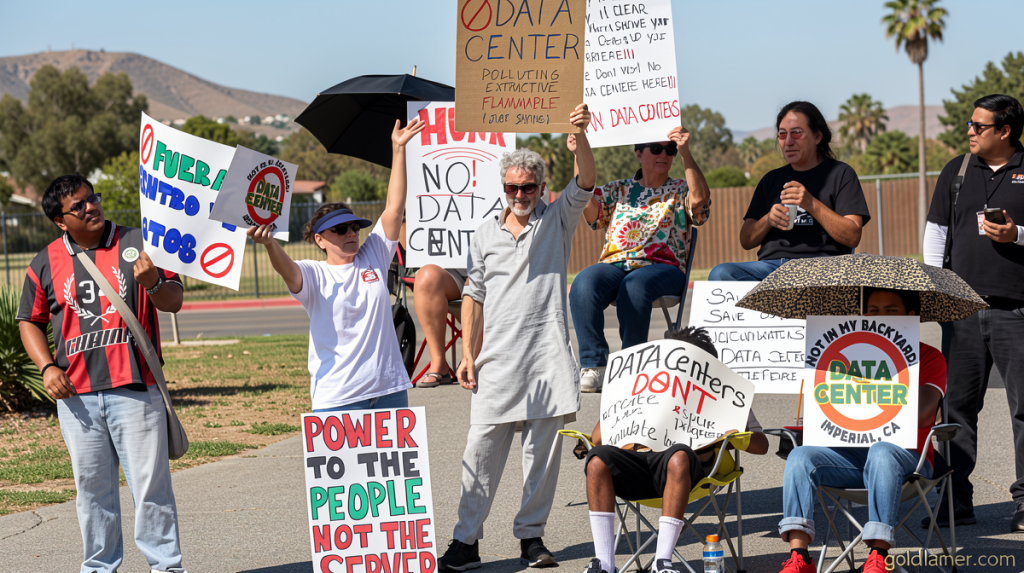
When Opposition Becomes an “Influence Operation”: Tech Leaders Recast Public Backlash as Foreign Manipulation
Goldlaner.com – Across the American landscape, residents are pushing back against the rapid construction of massive data centers meant to power artificial intelligence systems. The grievances are varied and well documented: environmental degradation from energy-hungry facilities, anxiety over job displacement as automation accelerates, skepticism toward industry promises of economic uplift, rising electricity costs for neighboring households, and the relentless mechanical hum that never stops. These are ordinary, locally grounded concerns shared by communities from rural counties to suburban neighborhoods.
Yet in the corridors of Silicon Valley, a competing narrative has gained traction. Rather than treating public resistance as a legitimate policy debate, several prominent figures in the tech industry have framed the backlash as a coordinated foreign operation designed to derail AI infrastructure.
The Claim Takes Shape
Last week, Garry Tan, a venture capitalist who also serves as CEO of Y Combinator, posted on X what he described as a reminder about the nature of anti-data-center sentiment. His message carried an attached flow chart tracing alleged amplification of anti-AI messaging back to Chinese state media and government channels, drawing on reporting produced by a cryptocurrency advocacy group.
“Reminder: the datacenter discourse is a documented psyop and they’re winning.”
Alexis Ohanian, co-founder of Reddit, weighed in shortly after, agreeing with Tan’s framing while adding his own assessment of the rhetorical landscape.
“It’s been brilliantly executed ngl. Facts are not gonna win this, esp at this point, it’s gotta be on emotional appeal.”
OpenAI has issued comparable statements pointing toward China as a source of organized opposition to AI deployment. Separately, Alethea, an AI-powered threat intelligence firm, concluded that China, Russia, and Iran have all attempted to leverage the data center backlash for their own strategic purposes. However, the actual magnitude of their influence on American public opinion remains uncertain and has not been independently quantified.
What “Psyop” Actually Means
The term “psyop” is an abbreviation for “psychological operation,” a formal military concept describing campaigns engineered to shape an adversary’s attitudes, beliefs, or behaviors without relying on kinetic force. The underlying principle — winning a conflict through perception management rather than physical destruction — stretches back to Sun Tzu’s ancient treatise The Art of War. In practice, however, modern psychological warfare crystallized during the twentieth century. Both World Wars saw belligerents deploying aircraft and hydrogen balloons to scatter propaganda leaflets over enemy positions.
The specific vocabulary arrived later. A 1949 United States Army field manual titled Psychological Warfare in Combat Operations codified the discipline. Two years afterward, in 1951, the shortened form “psywar” surfaced in a Washington Post article. Through the Korean War and the Cold War, American forces continued leaflet drops and loudspeaker broadcasts aimed at demoralizing opposing troops.
Vietnam and the Birth of the Abbreviation
The Vietnam War marked a significant escalation. In a campaign dubbed Operation Wandering Soul, American forces broadcast recordings of unsettling sounds and disembodied voices into jungle combat zones. These so-called “ghost tapes” were crafted to evoke the voices of dead Viet Cong soldiers, exploiting local beliefs that improperly buried spirits would wander endlessly. A 1962 Army field manual designated such manipulation and influence activities as “Psychological Operations.”
The clipped form “psyop” began appearing in newspaper coverage by 1965 and was subsequently enshrined in a 1979 Army field manual. That same year, the Christian Science Monitor noted the program’s growing institutional profile:
“A new key element in the Vietnam struggle against Communist forces is a stepping up of the pace in the battle of ideas. The expanded effort in psychological operations, or ‘psy ops’, as the program is called, was one of the topics taken up at last week’s White House discussions.”
According to Army historian Jared M. Tracy, the US Army Psyop unit became a formal regiment in November 1998 and was elevated to a regular Army branch in October 2006.
Overt and Covert Dimensions
Jan Goldman, a professor of intelligence and security studies at The Citadel who has studied psychological operations extensively, notes that psyops can operate on a spectrum from overt to covert, but always carry a defined objective. The loudspeaker and leaflet campaigns employed during the Gulf War, in Iraq, and in Afghanistan were explicitly designed to erode enemy morale and instill fear — with mixed results. Goldman also points to more elaborate operations in Latin America during the 1960s and 1970s, where the United States worked to destabilize socialist and communist governments and install leaders more aligned with Washington’s strategic interests. In 1964, the CIA contracted American advertising agencies to amplify anti-communist messaging in Chilean media, contributing to the election of a US-backed candidate.
The Rhetorical Move in Contemporary Politics
Daniel de Zeeuw, a lecturer in new media and digital culture at the University of Amsterdam, observes that Tan and fellow industry executives have adopted a term and rhetorical strategy that gained wide currency online and in right-wing media over recent years. His concern is less about any single claim and more about the epistemic environment the language creates.
“It just manages to establish this field of uncertainty where nobody knows what’s true anymore. Everything can be a psyop. Everything can be an influence operation.”
The practical implication for communities now debating whether to permit a 500-megawatt facility on their county line is significant. If local opposition can be dismissed as foreign manipulation, the ordinary channels through which residents voice environmental, economic, and quality-of-life concerns risk being delegitimized before a single permit hearing takes place. The historical record of psyops — from jungle ghost tapes to Cold War loudspeakers — shows that influence operations are real, measurable, and often effective. But the same record also shows that labeling every dissenting voice as an operation, without transparent evidence of foreign orchestration, can itself become a tool for silencing domestic debate.
Related Reading
Frequently Asked Questions
What is To Silicon Valley anything could be?
To Silicon Valley anything could be is the main topic of this guide. The article explains the context, practical details, and next steps readers should understand.
Why does To Silicon Valley anything could be matter?
To Silicon Valley anything could be matters because readers are looking for a useful answer, not just a short summary. Good content should match search intent and help them decide what to do next.