
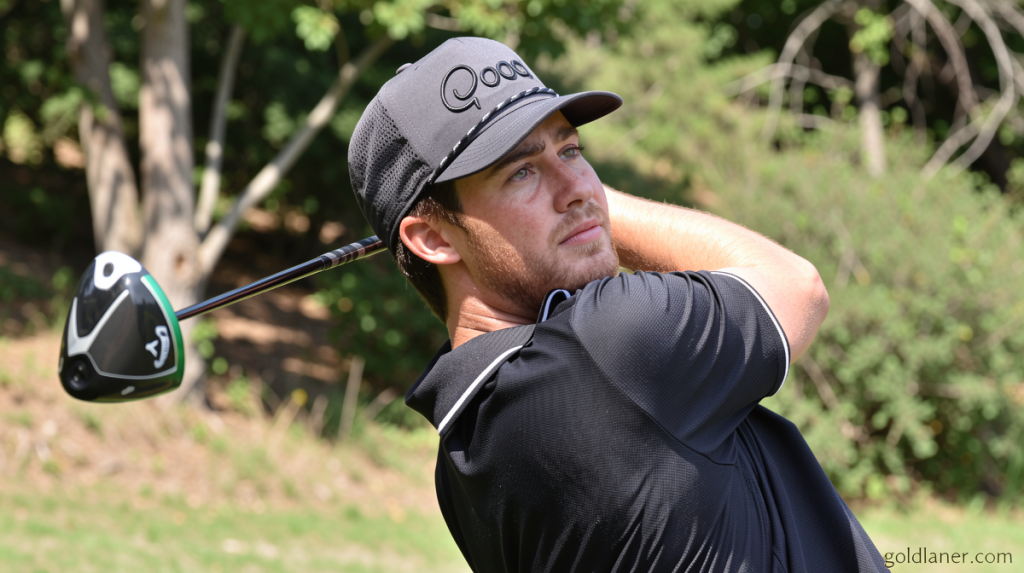
Golf’s Old Guard and New Internet Culture Collide Over a Viral Driver Ad
Goldlaner.com – A shoulder check delivered on camera has sent shockwaves through a sport long defined by quiet decorum and understated competition. The incident, captured in a promotional video for a co-branded golf driver, has reignited a debate that has simmered for years: how far should the game’s traditional institutions bend to accommodate the loud, fast-moving personalities now dominating social media? This week, that question moved from theoretical to urgent as two companies — equipment manufacturer Callaway and internet-first golf media brand Good Good — found themselves at the center of a public relations firestorm.
The Ad That Broke the Internet
The video in question opened with a jarring scene: Garrett Clark, one of Good Good’s co-founders, delivering a forceful shoulder check to Alexis Miestowski as she reached toward his driver. The image landed with the force of a dropped shot on a packed gallery, and within hours the clip had accumulated enough negative reaction to force both companies into retreat. The advertisement was pulled from circulation on Saturday, and the questions that followed were pointed: how did a spot depicting a violent act directed at a woman clear internal review and reach the public?
Callaway’s Apology
By early Tuesday morning, Callaway chief executive Chip Brewer had issued a formal statement on X, acknowledging that his company had given the green light to the video. He framed the episode as a failure of judgment rather than a failure of values.
“As we deal with the consequences of our mistake and complete our investigations, I want to make it clear that we sincerely apologize for the video. The content was inappropriate and does not reflect our values. To be clear: We are unequivocally against discrimination, domestic violence, or threatening behavior of any kind.”
The language was careful, measured, and explicitly tied to broader social expectations around gender-based violence — a framing that signaled the company understood the ad had crossed a line far beyond a simple creative misstep.
Good Good’s Response
Good Good, which had built its entire identity around welcoming newcomers into the game, issued its own apology after the Saturday takedown. The company emphasized its founding mission of inclusivity.
“Good Good has always stood for making the game of golf more inclusive to all, and we will continue to ensure that is our mission moving forward.”
The statement was brief and forward-looking, but critics noted it did not directly address the specific act depicted in the video or explain the internal process that allowed the clip to ship.
Why Good Good’s Involvement Matters
The controversy lands with particular weight because of where Good Good sits in golf’s evolving media landscape. Founded in 2020, the company began as a content-creation outfit producing irreverent, personality-driven videos that attracted younger and more casual audiences to the sport. Over the following years it expanded into merchandise — its stylized “Good” caps became a recognizable sight on fairways nationwide — and eventually into tournament-level partnerships.
That trajectory culminated in Good Good becoming the title sponsor of the Good Good Championship, a PGA Tour event scheduled for November in Austin, Texas. The deal was widely interpreted as a landmark moment: the internet’s loudest golf voice formally embedded within the tour’s official calendar. Now, in the aftermath of the driver-ad fiasco, that partnership has become the focal point of scrutiny.
The PGA Tour Weighs In
Tour chief Brian Rolapp addressed reporters on Tuesday at East Lake Golf Club in Atlanta, the venue hosting the season-ending Tour Championship that weekend. His comments struck a tone of measured disappointment rather than outright condemnation.
“Initially no. I think what we saw was concerning, and is clearly not aligned with PGA Tour values. We take it very seriously. I think their initial response was disappointing. It was a bit defensive and late, but I think the responses are getting better.”
Pressed on whether the episode would alter the November tournament, Rolapp offered a deliberately non-committal answer.
“It’s a bit of a fluid situation. We were disappointed at first. It sounds like in the last 24 hours they’ve made some progress. We’ll continue to monitor the situation and see how it develops.”
The phrasing — “fluid,” “monitor,” “see how it develops” — left the door open to every outcome, from full continuation of the sponsorship to a quiet restructuring of the event’s branding.
A Broader Tension
The Good Good/Callaway episode does not exist in a vacuum. The PGA Tour, which carries nearly a century of institutional history as the home of men’s professional golf, has spent the 2020s confronting challenges that previous generations of administrators never faced. The emergence of LIV Golf as a well-capitalized alternative circuit disrupted the tour’s monopoly on elite players. Simultaneously, internet-native media brands like Good Good have drawn millions of viewers to a version of the game that trades quiet reverence for personality-driven entertainment.
In response, the tour has made incremental moves toward modernization. Independent content creators now appear alongside traditional press corps at tournament sites, producing clips for their own channels. The tour has partnered with select creators to generate promotional content weeks before events. The Good Good Championship itself was conceived as a bridge — a single event where the old world’s prestige met the new world’s energy.
What the driver-ad controversy exposes is the fragility of that bridge. When the personalities who embody the new world are placed inside a traditional equipment brand’s marketing pipeline, the old world’s expectations of decorum and the new world’s appetite for spectacle collide. The question the PGA Tour now faces is not merely whether one advertisement was tasteless, but whether the institutional frameworks it relies on — approval processes, brand-standards reviews, partnership oversight — are equipped to police a space where the rules of engagement have fundamentally shifted.
For now, the November championship remains on the calendar. Whether it arrives in Austin under the Good Good banner, under a modified identity, or not at all will depend on how the next several weeks of dialogue unfold between the tour’s leadership and the company whose very name was once a punchline to purists. The sport’s old guard and its new internet culture are no longer merely coexisting. They are negotiating the terms of their coexistence, and the stakes of that negotiation now include one of the tour’s most visible commercial partnerships.
Related Reading
Frequently Asked Questions
What is A controversial ad for a driver?
A controversial ad for a driver is the main topic of this guide. The article explains the context, practical details, and next steps readers should understand.
Why does A controversial ad for a driver matter?
A controversial ad for a driver matters because readers are looking for a useful answer, not just a short summary. Good content should match search intent and help them decide what to do next.