
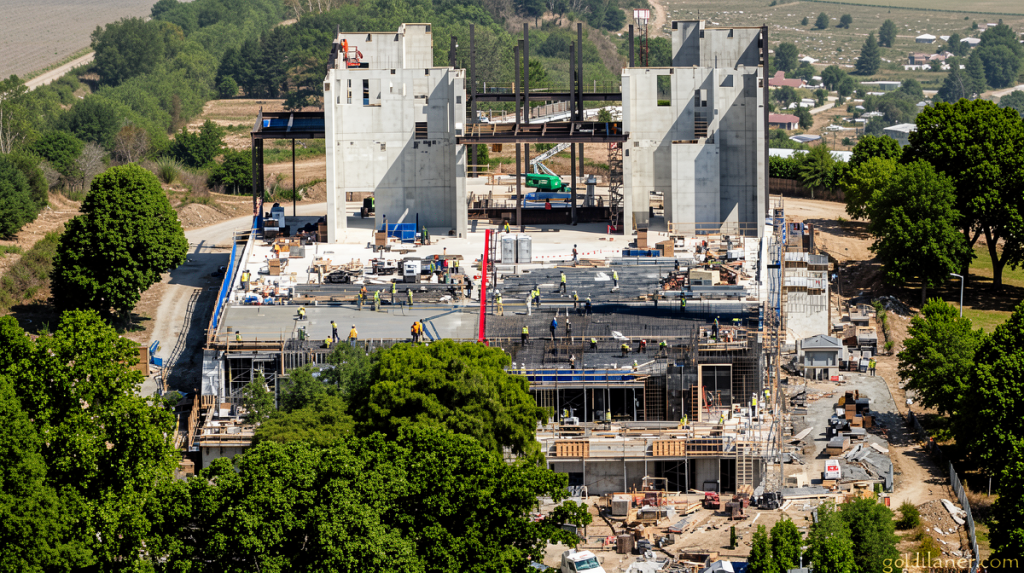
White House Ballroom Construction Pauses No More: Supreme Court Grants Temporary Stay
Goldlaner.com – Workers on the White House grounds will keep swinging hammers and pouring concrete through the weekend and beyond, after Chief Justice John Roberts issued a one-justice administrative stay on Friday afternoon that froze a lower-court order mandating an immediate halt to the project. The ruling means the sprawling ballroom-and-military-complex initiative can proceed without interruption until the full bench issues a separate directive — a timeline no one can predict.
The stay does not resolve the central legal question: whether the president may unilaterally authorize the demolition and reconstruction of a landmark federal building without congressional appropriation or statutory authorization. Two federal courts have already answered that question in the negative. What Roberts granted on Friday is purely procedural — additional breathing room for the justices to weigh whether to pause the adverse rulings indefinitely, as the administration has requested.
The Pace of Construction
According to filings the Trump administration submitted to the Supreme Court, the buildout has been advancing at extraordinary speed. A workforce of roughly 250 tradespeople has been operating on 20-hour shifts, seven days a week. The government characterized the ballroom complex as “65% complete in its entirety” at the time of filing. Because Roberts set no expiration date on the stay, there is no built-in sunset; construction simply continues until the Court acts again.
The order carried no written reasoning, no vote tally, and no dissent. That is standard for a single-justice emergency stay, which Roberts administers in his capacity as the justice who handles urgent applications rising from the D.C. Circuit Court of Appeals. He is expected to circulate the matter to all nine justices in due course, at which point the question will shift from an individual discretion to a collective deliberation.
A Legal Journey Through Three Courts
The dispute began in December, when the National Trust for Historic Preservation — the country’s oldest and most prominent preservation advocacy organization — filed suit challenging the project. The Trust persuaded Judge Richard Leon of the U.S. District Court for the District of Columbia to enjoin further work until Congress affirmatively granted the president authority to proceed. Leon did carve out one exception: he allowed crews to continue excavating and reinforcing a sophisticated subterranean bunker beneath the planned ballroom, accepting the administration’s argument at that stage that the two spaces were functionally separate.
As months passed, however, the administration’s public posture shifted. Trump and senior officials increasingly framed the entire above-ground structure — not merely the underground shelter — as indispensable to national security, pointing to a series of assassination attempts on the president’s life in recent years. That reframing set up the collision with the DC Circuit.
In early August, the appeals court, sitting en banc in a divided panel, sided with Leon. In a 2-1 decision, the panel ordered all work to cease effective August 21. The majority opinion was blunt about the separation-of-powers problem:
“Whether or not a massive ballroom should be constructed is for Congress to decide and is not a matter for Executive self-help.”
The court went further, addressing the scope of presidential authority over the executive mansion itself:
“The National Trust has shown, compellingly, that Congress has not ceded unfettered authority to the Executive Branch to dramatically redesign, reshape, and reconstruct the White House – the People’s House – to fit a particular President’s desires.”
The Administration’s Supreme Court Pitch
Days after the circuit ruling, the administration filed for Supreme Court intervention. Solicitor General D. John Sauer argued that the ballroom was justified by prior threats to the president’s life, ongoing national-security requirements, and what he characterized as architectural values. In his brief, Sauer drew a sharp line between the president and an ordinary occupant of federal property:
“The President of the United States of America is not a tenant, but rather the sole, elected head of the Executive Branch, and Congress has authorized him to renovate, secure, and protect the White House and its grounds, as other Presidents have been allowed to do, without exception.”
Political and Personal Dimensions
The ballroom project sits at the center of a broader pattern. Since returning to office last year, Trump — a former real-estate developer who spent decades designing and marketing large-scale commercial properties — has sought to reshape multiple elements of the Washington landscape to match his personal aesthetic and operational preferences. The most visible act in that campaign was last year’s demolition of the former White House East Wing to clear ground for the event space, a move that drew sharp criticism from members of both parties.
In August, while discussing the project publicly, Trump described the finished structure in superlative terms:
“This will be the greatest military complex slash ballroom anywhere in the world. There won’t be anything like it.”
Sources familiar with his thinking indicate that the president regards the ballroom and associated construction as the architectural cornerstone of his presidential legacy. He has recently characterized critics of the effort as “very disloyal to our country,” framing opposition to the project as a matter of patriotism rather than statutory interpretation.
Following Friday’s order, Trump took to social media to celebrate the decision:
“We are grateful for the Decision of the United States Supreme Court. The Military/Ballroom Complex being built on the hallowed grounds of the White House, which is so vital for National Security, will be THE GREATEST OF ITS KIND! It is something that Presidents have wanted for 150 years, and that the Military has been seeking for the last 100 years. Their wish will soon be fulfilled! Construction is under budget and ahead of schedule.”
What Comes Next
The stay buys time but resolves nothing. Once Roberts refers the case to the full Court, the justices will confront the question that two lower courts have already answered: whether the executive branch may, absent specific congressional authorization, undertake a project of this scale on the grounds of the executive mansion. The answer will carry implications well beyond one building — touching the boundaries of presidential authority over federal property, the role of appropriation statutes in constraining executive action, and the extent to which a sitting president may treat the White House as a personal development site rather than a congressionally maintained institution. Until the bench speaks, the 250-person crew will keep working.
Related Reading
Frequently Asked Questions
What is Supreme Court temporarily allows construction of White?
Supreme Court temporarily allows construction of White is the main topic of this guide. The article explains the context, practical details, and next steps readers should understand.
Why does Supreme Court temporarily allows construction of White matter?
Supreme Court temporarily allows construction of White matters because readers are looking for a useful answer, not just a short summary. Good content should match search intent and help them decide what to do next.