
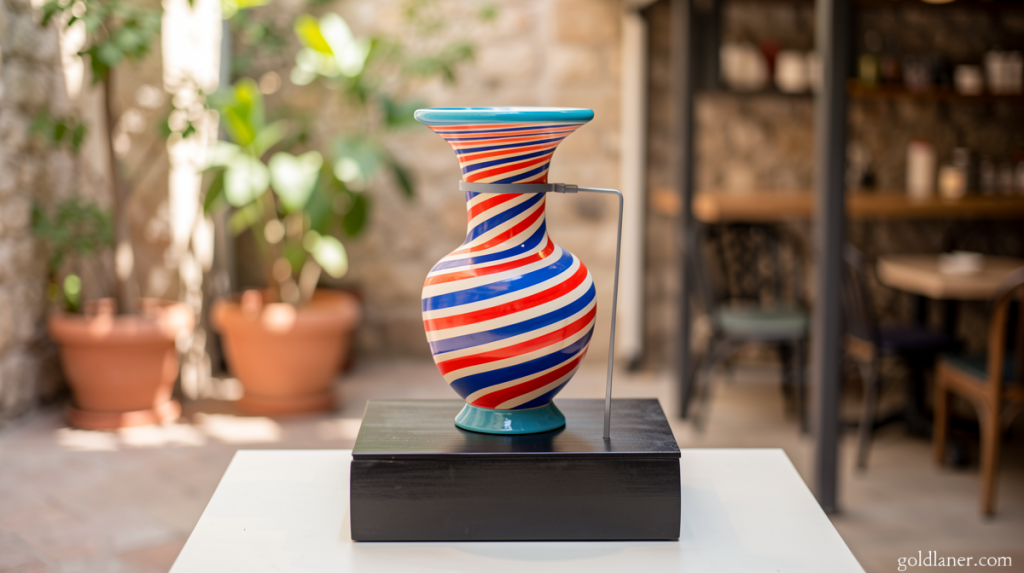
A Glass Vase from the Qianlong Court That Looks Like It Belongs in a 1960s Living Room
Goldlaner.com – Among the hundreds of thousands of imperial treasures housed in Beijing’s Palace Museum, one object stands apart from everything else on display. It is not porcelain. It is not cloisonné enamel. It is not lacquerware or jade. It is a blown-glass vessel, barely eight inches tall, whose body twists with ribbons of red, white, and blue glass capped by an emerald-green base and mouth. At first glance, the piece reads as something you might find on a mid-century coffee table or beside a rotary telephone — a spinning barbershop pole rendered in silica. Yet the reign mark stamped into its surface identifies it as a product of the Qianlong Emperor’s workshop, dating it to the eighteenth century, two centuries before the aesthetic sensibility it appears to anticipate.
The Collector Behind the Mark
The Qianlong Emperor, who reigned for roughly six decades in the eighteenth century, is widely regarded as one of history’s most voracious and prolific patrons of the decorative arts. His workshops produced hundreds of thousands of objects, nearly all bearing his reign mark in inscribed or stamped Chinese characters. His appetite was boundless and his taste leaned toward abundance.
“He loved the profusion of colors, and textures, and all kinds of fine things,” said Daisy Wang, Deputy Director and Chief Curator at the Hong Kong Palace Museum. “He always thought, ‘more is more.'”
Wang, who oversaw the vase’s exhibition on loan from the Beijing Palace Museum until August of this year, described the emperor’s court as remarkably cosmopolitan — comparable, she noted, to the Mughal court in India, which likewise drew artisans from across the subcontinent and beyond. Under such an environment, art production flourished at a scale and variety unmatched in Chinese history.
Why the Vase Was Unusual Even Then
China had long excelled in ceramics, lacquer, and metalwork. Glass, however, remained a secondary material. Although Chinese craftsmen had been working with glass since the Western Zhou period — more than two millennia before the Qianlong era — the technology had never reached the sophistication of contemporary European glassmaking. Most glass vessels produced in China at the time were small, plain, and monochromatic.
Marco Almeida, Senior Vice President at Christie’s Asia Pacific and the house’s Head of Chinese Ceramics and Works of Art, explained that this particular vase broke every convention of its category.
“Suddenly, you have this vase with multiple colors, and a style of decoration that was alien,” he said. “I think the emperor must have been quite taken by it and quite pleased.”
The piece’s swirling, multicolored patterning would have been startlingly foreign to a court accustomed to the restrained palettes of imperial porcelain, where, as Almeida noted, “little white space would be left” as a matter of aesthetic principle.
Rarity in a Collection of 300,000 Porcelain Pieces
The vase’s scarcity is almost difficult to grasp in context. The Beijing Palace Museum holds more than 300,000 porcelain objects spanning thousands of years of Chinese ceramic history. Against that backdrop, the number of glass vases in the collection amounts to what Wang described as a “handful.” This single multicolored example, with its barbershop-pole geometry and saturated palette, sits at the extreme edge of an already marginal category.
How It Was Made: Candy-Pulling and Venetian Technique
According to the Hong Kong Palace Museum, the fabrication process bore a close resemblance to pulling taffy. Artisans would draw hot, colored glass into thin filaments, adhere those filaments to the vessel’s body, then roll and reheat the assembly repeatedly until the desired swirled pattern locked into place. The technique aligns with what Venetian glassmakers called the “latticino” method — a layered, twisted construction that produced intricate internal patterning.
Almeida emphasized that while the manufacturing method was European in origin, the vessel’s silhouette was unmistakably Chinese, as was the reign mark. He called the result “the perfect, and clear-cut marriage of what is Chinese and what is Western.”
The Missionary Connection and the Zaobanchu
Wang assessed that the vase was most likely produced either by a European missionary working directly in the imperial workshops, or by Chinese artisans employing technologies and raw materials introduced by such missionaries. The historical precedent was established during the Kangxi emperor’s reign, when the German Jesuit Kilian Stumpf assumed oversight of glass production within the imperial system.
The zaobanchu — the network of imperial workshops situated within the Forbidden City complex and at satellite locations across the empire — operated dozens of specialized departments covering painting, textile, wood carving, metallurgy, and numerous other crafts. Every component required to realize an elaborate commission passed through these workshops. During Qianlong’s reign, the zaobanchu employed nearly one thousand artisans.
A Micromanager with a Thousand Hands
Wang, who is preparing a forthcoming exhibition on the imperial workshops at the Hong Kong Palace Museum scheduled for September, characterized Qianlong’s relationship to his workshops in terms that would feel familiar in a modern corporate boardroom.
“He would consider the vase to be really beautiful, different and novel. That was the value,” she said.
She further described the emperor as a “micromanager in today’s company culture.” He documented objects meticulously, issued specific directives on design, proportion, and scale, and enforced compliance through penalties that could include the forfeiture of an entire year’s salary. The artisans worked under sustained pressure to satisfy the demands of a ruler whose curiosity was matched only by his impatience.
Valuing the Unpriceable
Almeida acknowledged that assigning a monetary figure to the vase would be an exercise in futility. He nonetheless offered a qualifier that captures the object’s position at the intersection of rarity, technical novelty, and imperial provenance: he called it “borderline priceless.” In a collection where glass vases number in the single digits and where the technique that produced this particular example required European know-how married to Chinese form, the vase occupies a category of one — a small, swirling anomaly from a court that, for a brief window in the eighteenth century, looked outward and found something it wanted.
Related Reading
Frequently Asked Questions
What is A Qing Dynasty vase 200 years?
A Qing Dynasty vase 200 years is the main topic of this guide. The article explains the context, practical details, and next steps readers should understand.
Why does A Qing Dynasty vase 200 years matter?
A Qing Dynasty vase 200 years matters because readers are looking for a useful answer, not just a short summary. Good content should match search intent and help them decide what to do next.