
Beneath the Baltic Pines: Poland’s Secret Underground Command City
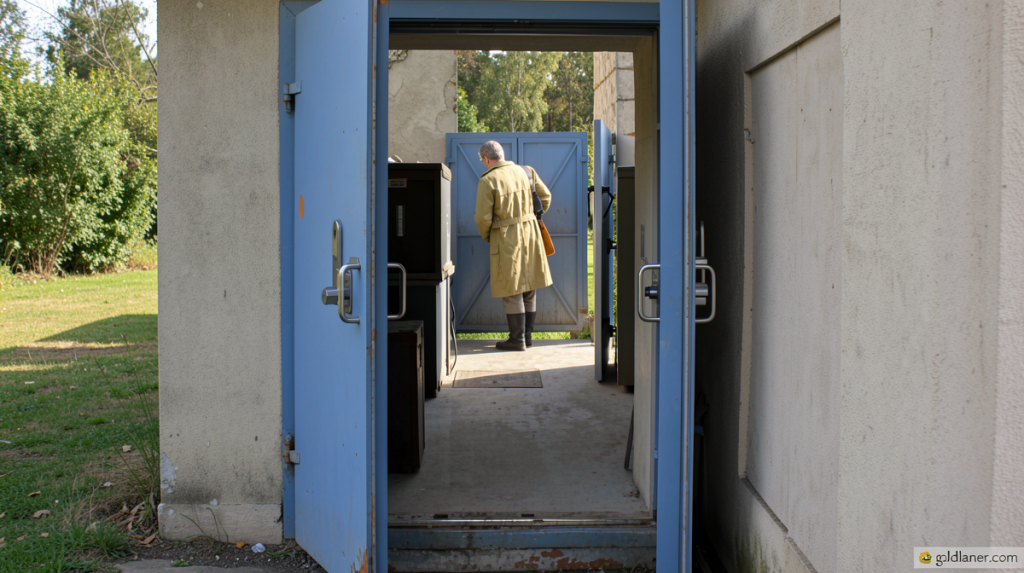
Goldlaner.com – Step through a massive steel door that groans open with a mechanical shriek, and the humid chill of a subterranean military world closes around you. The air temperature holds steady at roughly 10 degrees Celsius (50°F) year-round, indifferent to whatever summer heat or winter frost rages above. This is not some crumbling ruin left to rot. The corridors, utility rooms, and command chambers of the Wolin Underground City feel startlingly habitable — a place where, had nuclear war erupted in the 1960s, officers could have walked in and begun issuing orders within minutes.
Today the site operates as a privately run museum on Wolin Island, a stretch of Baltic coastline just beyond the resort town of Świnoujście in Poland’s West Pomeranian Voivodeship. Visitors are admitted only in guided groups, and the experience is deliberately theatrical: tour leaders adopt the persona of stern Polish army commanders, and guests are organized into “platoons” expected to stand at attention, obey sharp commands, and tolerate the occasional shouted reprimand. Outside the bunker complex, a Soviet-era armored personnel carrier sits parked beside the ticket desk, fragments of a missile fuselage rest among the beech trees, and a heavy-duty ZIL military truck idles in the shade. The Cold War is not merely a backdrop here; it is the entire atmosphere.
A Fortress Built in Defiance
The infrastructure beneath the island’s sandy soil did not begin as a Cold War nerve center. Its origins stretch back to the late 1930s, when the Nazi command ordered the construction of two coastal defense batteries along the Baltic shore. Designated Goeben and Vineta, these fortifications were erected between 1936 and 1939 in the tense run-up to World War II. The Vineta Battery — the name that would later become associated with the entire underground complex — comprised a network of reinforced concrete bunkers: four crowned with rotating cannon mounts, supplemented by separate structures for command functions, ammunition storage, and utilities.
The project was deliberately clandestine. The region that now constitutes West Pomeranian Voivodeship had belonged to Germany since the end of World War I, and the 1919 Versailles Treaty had explicitly prohibited German rearmament. By pouring concrete into the dunes and burying gun emplacements beneath earthworks, Hitler’s regime was quietly assembling a coastal shield while officially observing the treaty’s disarmament clauses. The strategic logic was straightforward: a hardened battery guarding the Baltic approach would protect the northern flank before any broader conflict commenced.
From Nazi Guns to Soviet Command
Paradoxically, the complex never faced sustained combat. The Western Front and Eastern Front consumed the war’s momentum elsewhere, and the Baltic sector remained comparatively quiet. Rather than firing at Allied shipping, the Nazis repurposed the bunkers as a training school for the navy during the conflict’s later years.
“As the World War II front was moving very quickly forward, this area was very calm during the war, and the Nazis converted the whole complex into a school for the navy,” explains Kacper Stachula, a local guide born and raised in Świnoujście who now leads regular tours of the site.
In May 1945, retreating German forces detonated stored ammunition and attempted to demolish the compound. The effort failed. Much of the concrete framework survived intact, and the advancing Red Army took possession of what remained. In the immediate postwar chaos, Soviet occupiers stripped away metal fittings and valuables, while local residents scavenged whatever else they could carry. For several years, nobody seemed to know what to do with the half-ruined tunnels.
The Cold War Transformation
The answer arrived in the 1950s, when the Polish socialist government designated the site as an emergency command center — a fallback headquarters “in case of World War III,” as Stachula puts it. Two waves of major modernization followed: one in 1955 and another in 1965. The driving impetus was Poland’s ultra-classified contingency plan for an invasion of Denmark, formulated after the Warsaw Pact was signed in 1955. The Baltic coast became what planners called the “Polish front,” and the existing Nazi bunker network, buried deep in forest and dune, proved ideally suited to shelter the Polish and Soviet military elite should those invasion plans be activated.
The Polish army undertook extensive engineering work to convert five originally standalone bunkers into an interconnected underground city. New tunnels were bored between the structures, additional utility chambers were excavated, and underground water pumps were installed to manage the damp. The finished complex contained nearly a mile of passageways. Its perimeter was partitioned into five distinct security zones, each gated behind its own access document. Soldiers stationed here lived and worked underground for months at a stretch, making the site a functioning subterranean community rather than a mere storage depot.
Walking Through History
For the modern visitor, the experience begins in the forest. A guide leads the group through pine and beech to the first bunker entrance, where the grinding of the heavy door marks the threshold between the idyllic Baltic landscape and the buried military apparatus beneath. Inside, the contrast is immediate: no dripping decay, no skeletal eeriness typical of abandoned fortifications. The chambers are dry enough, structured enough, and maintained enough to feel almost neutral — a place designed for people to live and work, not merely to endure.
The island above remains what it has always been: a ribbon of coastal dunes, dense woodland, and the quiet rhythm of a Polish seaside resort. Below that surface, however, almost a mile of Cold War tunnels still waits, its five security zones and rotating-cannon emplacements preserved as a reminder that the most ordinary stretches of Baltic coastline can conceal the most extraordinary layers of history.
Related Reading
Frequently Asked Questions
What is The idyllic holiday island that once?
The idyllic holiday island that once is the main topic of this guide. The article explains the context, practical details, and next steps readers should understand.
Why does The idyllic holiday island that once matter?
The idyllic holiday island that once matters because readers are looking for a useful answer, not just a short summary. Good content should match search intent and help them decide what to do next.