
Swiss Alpine Village Watches Over a Mountain That May Not Last
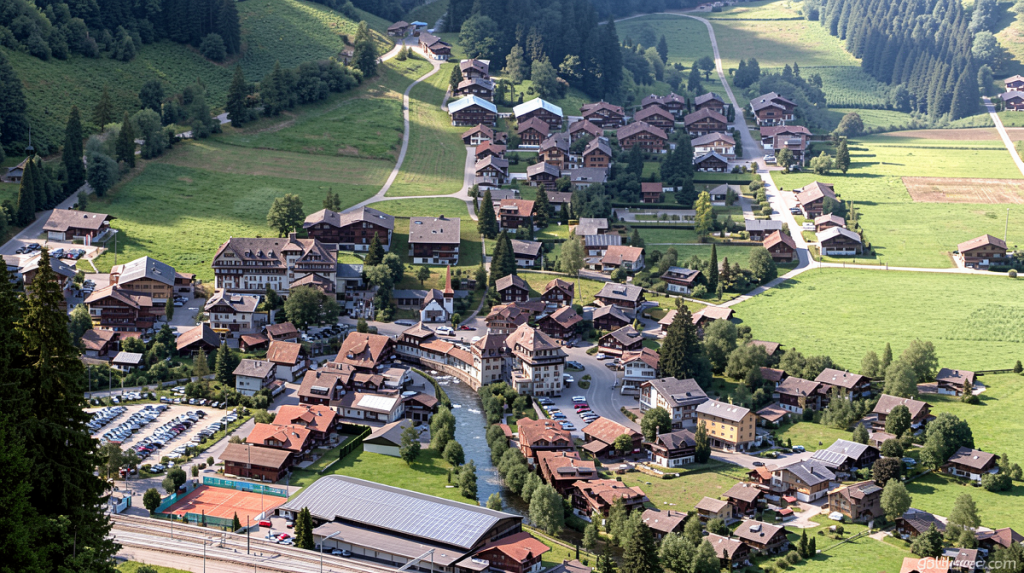
Goldlaner.com – Above the quiet Bernese village of Kandersteg, a vast slab of fractured rock hangs over the valley floor like a held breath. Scientists estimate the unstable section of the formation known as Spitze Stei contains somewhere between 15 and 20 million cubic meters of loose material. If it were to release all at once, the resulting debris flow would dwarf even the catastrophic rock-and-ice avalanche that buried the neighboring hamlet of Blatten in May 2025. For now, the 1,300 people who call Kandersteg home continue their daily routines amid steep green slopes, distant cowbells, and the white tongues of glaciers that once anchored the mountainside. But the glue that held those slopes together is melting, and the question is no longer whether the rock will move, but when and how much.
A Village That Knows What Is Coming
Kandersteg sits in Switzerland’s Bern canton, a region defined by razor-edged summits, glacial valleys, and the slow rhythm of pastoral life. The village has not been evacuated, and authorities say there is no immediate danger requiring residents to leave. Evacuation protocols exist and have been rehearsed, yet the psychological weight of living beneath a known hazard is something no drill fully prepares a community for.
Brigitte Jüni, a longtime resident, describes the mood with a mixture of acceptance and quiet unease.
“You are aware that it’s happening, but not afraid,” she said. “But then it’s nature. It’s nature and you never know.”
She noted that local officials have implemented every precaution available to them, from continuous sensor arrays embedded in the rock face to staged evacuation routes that channel residents out of the valley floor within minutes.
The Blatten Precedent
The specter of Blatten hangs over every conversation in Kandersteg. In May 2025, a colossal mass of rock and ice sheared off a glacier in the nearby Loetschental valley, sending towering plumes of dust into the sky and smothering nearly the entire settlement in a blanket of mud. Blatten had been evacuated beforehand as a precaution, sparing lives, but the physical destruction was total. The event became a stark, visible demonstration of what decades of climate modeling had predicted: that warming temperatures would progressively weaken the structural integrity of Alpine slopes.
Residents of Kandersteg are quick to distinguish their situation from that of Blatten. Rudolf Isler, another local, emphasized that the two scenarios differ in scale, geometry, and timeline.
“This isn’t the same case as in Blatten. It’s a different situation,” Isler said. “We are not afraid of the Spitze Stei rock. It’s been many years seeing stones falling from up there. The problem here is about global warming and rising temperatures.”
Why Permafrost Matters
Permafrost — the permanently frozen sediment, soil, and rock that threads through mountain interiors — functions much like a natural cement. It binds fractured strata together, fills voids, and resists the gravitational pull that would otherwise cause slopes to creep downhill. As global temperatures climb, that frozen matrix thaws, converting solid support into liquid water that lubricates fracture planes and increases pore pressure within the rock mass.
Markus Stoffel, a professor specializing in climate change and natural hazards at the University of Geneva, explained the mechanism in plain terms.
“In the mountains and in the unconsolidated debris, there is lots of ice,” Stoffel said. “Once this ice is melting, it acts like a cement. These mountain slopes will become increasingly unstable.”
The implication extends well beyond Kandersteg. Across the Swiss Alps, dozens of monitored rock formations and glacier tongues face the same thermodynamic pressure. The Blatten event was not an anomaly; it was a data point confirming that the failure threshold is being reached earlier and more frequently than earlier models projected.
Monitoring, Gradual Failure, and the Long Game
Experts monitoring Spitze Stei assess that a single, instantaneous total collapse is less probable than a progressive breakdown — a series of smaller rockfalls and debris flows over years or decades. Continuous geodetic surveys, acoustic sensors, and satellite interferometry track millimeter-scale movements in the formation. Should readings cross predefined thresholds, evacuation of the valley floor would be triggered automatically.
Still, the long-term calculus is unsettling. Nathan Solothurnmann, a climate and energy specialist with Greenpeace Switzerland, framed the broader trajectory in terms that go beyond any single village.
“Maybe even one day we will have to abandon certain valleys or certain villages because it’s becoming impossible to live there,” Solothurnmann said. “Or the measure you will need to take to protect infrastructure is so expensive, the efforts are so big, that it’s not worthwhile anymore living there.”
What Comes Next
For Kandersteg’s residents, the near-term reality is one of calibrated vigilance: checking sensor dashboards, keeping evacuation bags stocked, and watching the sky above the ridge for the telltale dust of a minor rockfall. The village’s identity — its churches, its hiking trails, its centuries-old alpine architecture — remains intact. But the geological clock above the valley is ticking in a direction that no amount of local resilience can reverse. The question facing Bern, the cantonal authorities, and eventually the Swiss federal government is not whether to monitor the rock, but how long a community can be asked to live beneath it before the cost of protection outstrips the cost of relocation.
In the meantime, the cowbells still echo across the valley, and the glaciers still catch the afternoon light. The mountain has not yet decided.
Related Reading
Frequently Asked Questions
What is Looming rock collapse threatens Swiss village?
Looming rock collapse threatens Swiss village is the main topic of this guide. The article explains the context, practical details, and next steps readers should understand.
Why does Looming rock collapse threatens Swiss village matter?
Looming rock collapse threatens Swiss village matters because readers are looking for a useful answer, not just a short summary. Good content should match search intent and help them decide what to do next.