
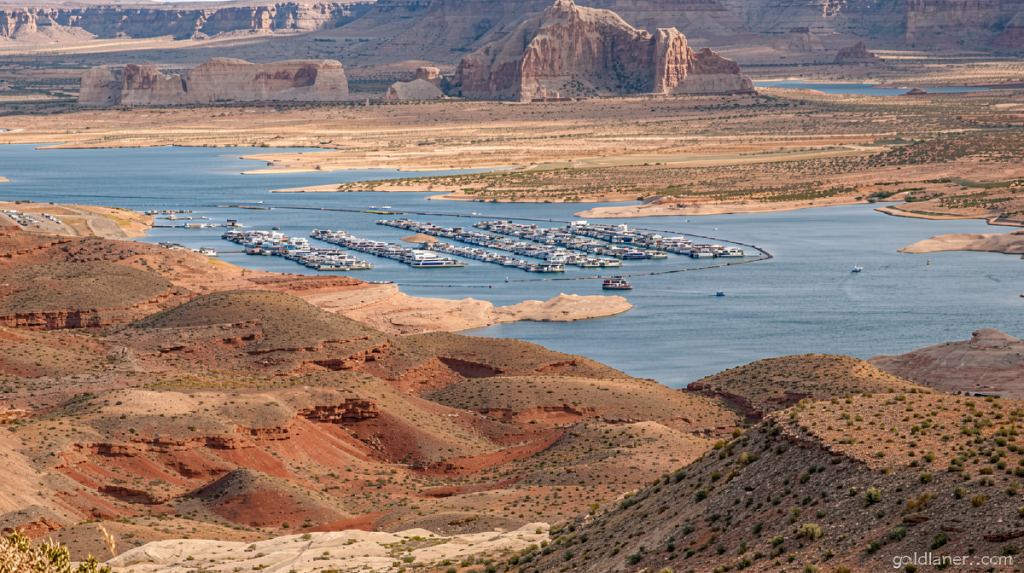
American West’s Water Lifeline Hits an All-Time Low as Lake Powell Shrinks Below Every Recorded Mark
Goldlaner.com – The reservoir that once served as a vast buffer against drought for millions of Western Americans has now slipped beneath every level previously documented. Lake Powell, the second-largest reservoir in the country, registered a depth of 3,519.91 feet on Saturday, edging past the prior record of 3,519.92 feet established back in April 2023. Figures released Sunday by the US Bureau of Reclamation confirmed the milestone, placing the water body just under 30 feet above the elevation at which its dam can no longer spin turbines and produce electricity.
The timing makes the event particularly stark. Only nine days earlier, Lake Mead — the nation’s largest reservoir — fell to its lowest point since it was first impounded nearly a century ago. Together, these two enormous water bodies, separated by the Grand Canyon yet functionally part of a single storage system, hold just under 60 percent of all water currently stored across the Colorado River basin. Their simultaneous plunge underscores how deeply the river system feeding the American Southwest is under strain.
“We are in uncharted territory,” said Jack Schmidt, director of the Center for Colorado River Studies at Utah State University.
The River That Sustains a Region
Originating in the Rocky Mountains and sustained by seasonal snowmelt, the Colorado River travels southward before emptying into the Gulf of California in Mexico. Along its course it supplies drinking water to approximately 40 million people and irrigates more than 5 million acres of agricultural land spread across seven states: California, Arizona, Nevada, New Mexico, Wyoming, Colorado, and Utah. For decades it has been called the lifeblood of the Southwest, a designation that now carries an increasingly urgent weight.
Since the turn of the millennium, the river’s overall flow has contracted by roughly 20 percent. The drivers are well documented: a warming climate that accelerates evaporation and shortens snowpack seasons, compounded by decades of extraction that outpaced natural replenishment. The reservoirs that once absorbed surplus flow in wet years have been drawn down for more than two decades without meaningful recovery.
How Lake Powell Came to Exist — and Why It Matters
Stretching across portions of Arizona and Utah, Lake Powell was created behind the Glen Canyon Dam, a structure completed in the 1950s. Filling began in 1963 and required 17 years before the reservoir reached its full pool elevation of 3,700 feet above sea level. Water managers have long described the reservoir as a kind of bank account: in wet years, surplus flow is stored; in dry years, that stored water is released downstream to cities, farms, and industrial users.
Under normal conditions the reservoir’s surface oscillates predictably. Between May and July, snowmelt runoff from the Rockies pushes levels upward. Over the remaining months, evaporation and downstream releases pull them back down, leaving visible mineral and sediment bands — so-called “bathtub rings” — along the rocky shoreline. This year, however, the seasonal refill never materialized. Last winter ranked among the driest and warmest on record for the western United States, depriving the basin of the snowpack that historically recharged the system each spring.
The Energy Cliff Ahead
The most immediate operational concern is not water scarcity at the tap but electricity generation. The Colorado River’s force drives eight massive turbines at Glen Canyon Dam, producing enough power annually to supply nearly 500,000 households. Utilities in Colorado, Utah, Wyoming, New Mexico, Arizona, Nevada, and Nebraska depend on that output.
At an elevation of 3,490 feet — the so-called “minimum power pool” — water depth becomes insufficient to turn the turbines. Brad Udall, a senior water and climate research scientist at Colorado State University, warned that this threshold will be breached within the current year unless operators implement what he called “extraordinary measures,” including sharply curtailed releases from Lake Powell and from upstream storage.
“I would expect draconian steps to decrease water use to prevent this from occurring. But who knows?”
Beyond minimum power pool lies an even more extreme scenario: “deadpool” conditions below 3,370 feet, at which point water can no longer pass through the dam at all. Schmidt called that outcome nearly unimaginable, yet the trajectory of recent years makes dismissing it difficult.
What Comes Next for Communities
A Bureau of Reclamation spokesperson stated that the agency and the Department of the Interior remain “committed to reducing the collective risk of both Lake Powell and Lake Mead falling below critical elevations to protect critical infrastructure to continue to meet the water and hydropower needs of the basin.”
For most urban residents, the crisis unfolds slowly enough that immediate rationing is not yet anticipated. Sarah Porter, director of the Kyl Center for Water Policy at Arizona State University, noted that municipalities such as Phoenix and Tucson “are extremely aware that they are first in line for cuts” and have invested in backup supply infrastructure to bridge any shortfall. Yet the calculus differs sharply for Tribal nations and smaller communities along the river corridor, which lack the financial capacity to purchase alternative water sources or build parallel delivery systems. As the reservoirs continue their long descent, the question shifts from whether the crisis will arrive to who bears its costs first.
Related Reading
Frequently Asked Questions
What is Uncharted territory?
Uncharted territory is the main topic of this guide. The article explains the context, practical details, and next steps readers should understand.
Why does Uncharted territory matter?
Uncharted territory matters because readers are looking for a useful answer, not just a short summary. Good content should match search intent and help them decide what to do next.