
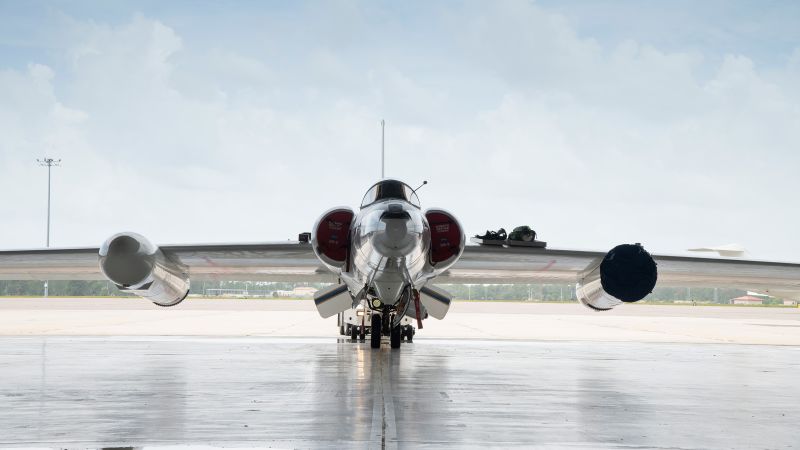
High-Altitude Hunters: NASA’s Cold War Aircraft Returns to Study Fire-Driven Storms
Goldlaner.com – Decades after its Cold War origins as a reconnaissance workhorse, the U-2 spy plane has found new purpose soaring above the world’s most dangerous wildfires. NASA has deployed a modified version of this legendary aircraft, known as the ER-2, to investigate how massive fires generate their own weather systems. This cutting-edge research aims to solve one of meteorology’s most persistent mysteries: predicting pyrocumulonimbus storms before they become catastrophic.
The Science of Fire Storms
When wildfires burn with sufficient intensity, they create atmospheric conditions that rival volcanic eruptions. The intense heat from burning vegetation pushes smoke and hot air upward through a vertical column, much like smoke rising from a chimney. This rising column acts as a warm bubble that triggers thunderstorm formation, creating pyrocumulonimbus clouds—gigantic storm systems fueled entirely by fire energy.
These fire-generated storms are not merely passive observers of combustion; they actively participate in it. The storms can produce lightning that ignites new fires, generate powerful winds that spread flames, and in extreme cases, create fire tornadoes that devastate entire regions. The relationship between fire and atmosphere becomes a self-sustaining cycle where the storm feeds the fire, and the fire fuels the storm.
It’s kind of like a chimney where the smoke from the fire is being pushed upward into the thunderstorm, accelerated through that vertical column, and then released.
David A. Peterson, a meteorologist at the Naval Research Laboratory, leads NASA’s INSPYRE mission—short for INjected Smoke and PYRocumulonimbus Experiment. His team is working to understand why these storms behave so erratically and how they can be predicted with greater accuracy.
A Steerable Satellite in the Sky
The ER-2 aircraft represents the evolution of the original U-2 design, which first took flight in the mid-1950s. Rather than carrying military surveillance equipment, the modern ER-2 functions as a flying laboratory packed with scientific instruments. The aircraft operates at altitudes reaching approximately 65,000 feet, positioning it above most weather systems while maintaining the ability to maneuver precisely over target areas.
Think of it as a steerable satellite. It’s flying above the weather at maybe 65,000 feet, and we can basically have it orbit back and forth over a wildfire.
Equipped with sophisticated radar systems, the ER-2 measures multiple aspects of fire storm behavior. These instruments track the physical dimensions of smoke plumes, monitor their altitude, and analyze air movement within the storm structure. Additional sensors measure electrical fields and lightning activity occurring inside the clouds.
While the ER-2 maintains its high-altitude perspective, NASA simultaneously deploys a Gulfstream 5 jet directly into the storm clouds. This dual-approach methodology allows scientists to cross-reference data between the airborne satellite observations and the in-cloud measurements, creating a comprehensive picture of storm dynamics.
Breaking Through Atmospheric Barriers
One of the most significant discoveries in recent years concerns the vertical reach of fire-generated storms. Scientists have found that pyrocumulonimbus clouds can penetrate through the troposphere and reach into the stratosphere—a phenomenon described as having a volcano-like effect. Once smoke reaches these extreme altitudes, it can be transported rapidly across continents by jet stream winds.
The generated smoke column is basically a warm bubble that triggers the thunderstorm, so it’s like any other really tall, severe thunderstorm cloud, but now you’ve filled it with smoke. The fire at that point is essentially feeding itself.
This stratospheric penetration has important implications for both climate science and air quality. Smoke particles that reach the stratosphere can persist for months or even years, potentially affecting global atmospheric circulation patterns and solar radiation levels.
From Spy Plane to Science Platform
The U-2’s transformation from military reconnaissance aircraft to scientific research platform reflects its remarkable versatility. Originally designed to photograph Soviet territory during the Cold War, the aircraft earned the nickname “Dragon Lady” for its distinctive appearance and capabilities. At the time of its introduction, American military planners believed Soviet missiles could not reach the U-2’s cruising altitude, providing American pilots with relatively safe passage over enemy territory.
That confidence was tested on May 1, 1960, when Soviet forces shot down a U-2 piloted by Francis Gary Powers, revealing that American intelligence had underestimated Soviet military capabilities. Despite this setback, the aircraft continued serving as a critical intelligence asset through subsequent conflicts including the Cuban Missile Crisis, the Vietnam War, and modern engagements in Iraq and Afghanistan.
Predicting the Unpredictable
The INSPYRE mission launched in July and has already conducted flights over active wildfires in northern Oregon and western Canada. The primary objective is to identify the specific atmospheric conditions that produce pyrocumulonimbus storms, enabling meteorologists to forecast these dangerous weather systems with greater precision.
We’re looking with (NASA’s) INSPYRE mission to understand first and foremost what conditions produce these storms.
The research operates on a feedback loop between observation and prediction. Scientists are developing new analytical tools to guide the mission while simultaneously using mission data to refine those same prediction tools. This iterative approach ensures that each flight contributes to improving future forecasting capabilities.
There will inevitably be a component of the mission where we produce better tools to predict this type of fire behavior.
As climate change continues to alter wildfire patterns worldwide, the ability to predict fire-driven storms becomes increasingly critical for protecting communities, managing resources, and understanding the complex interactions between Earth’s atmosphere and its most volatile natural phenomena. The Dragon Lady’s return to service demonstrates how Cold War technology can address twenty-first century challenges, proving that sometimes the best solutions come from looking backward to move forward.
Related Reading
Frequently Asked Questions
What is NASA s Dragon Lady is uncovering?
NASA s Dragon Lady is uncovering is the main topic of this guide. The article explains the context, practical details, and next steps readers should understand.
Why does NASA s Dragon Lady is uncovering matter?
NASA s Dragon Lady is uncovering matters because readers are looking for a useful answer, not just a short summary. Good content should match search intent and help them decide what to do next.